
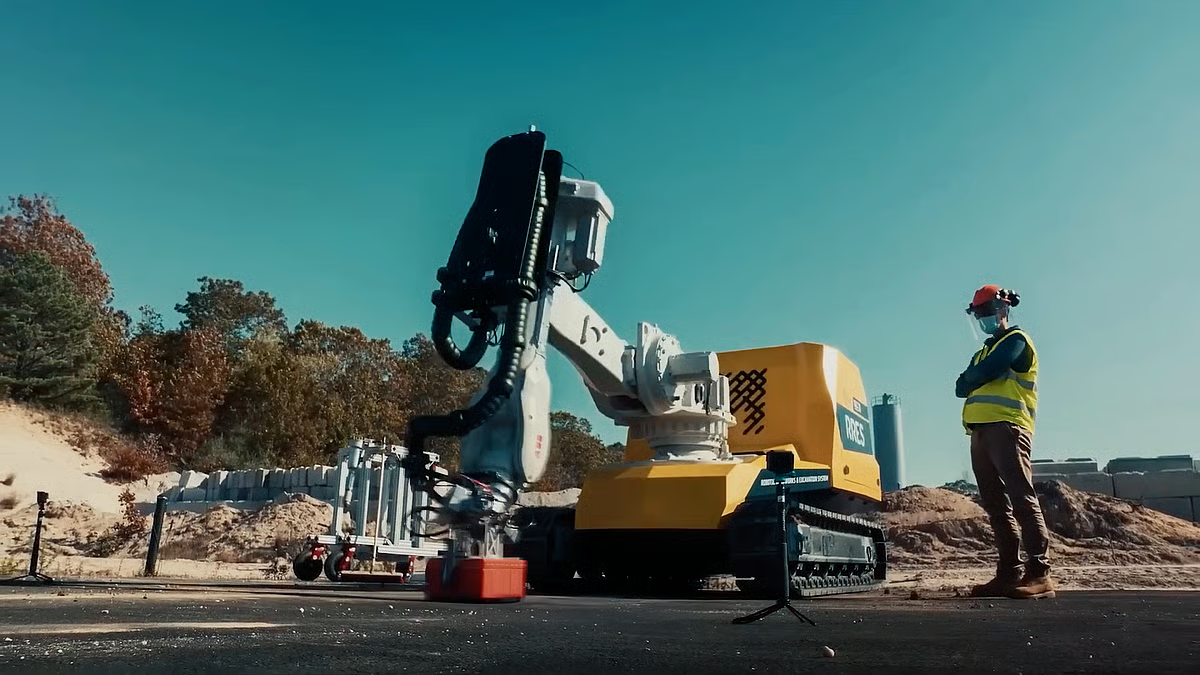

Dubai is pushing construction into a new gear with what’s being billed as the world’s first on-site robotic system designed exclusively for villas. Built to operate directly on the job site—rather than relying solely on factory prefabrication—the integrated setup targets smoother workflows, higher precision, and more predictable timelines. In a city where the villa segment is surging and delivery dates matter as much as design, the promise is simple: fewer delays, less rework, and a more scalable way to build. The next “world-first” isn’t a skyline trophy—it’s a quieter revolution happening at ground level.
The first thing you notice isn’t what’s there. It’s what’s missing.
No frantic hammering. No shouted instructions ricocheting between concrete forms. Just a steady, electric hum—like a giant appliance waking up. A robotic arm lifts, pauses, then moves again with the calm certainty of a metronome. Sand drifts along the edge of the plot. Heat presses down. And in the middle of it all, a villa is taking shape—step by step—under the guidance of a machine built for this exact moment.
Dubai has a reputation for announcing “firsts,” but this one lands differently: a villa-only robotic construction system, designed to work on-site, not tucked away in a controlled factory environment. The idea isn’t simply to deliver prefabricated pieces. It’s to automate and coordinate key parts of the build process where projects often lose time—handoffs, alignment, repeat tasks, and the endless loop of “fix it tomorrow.”
“Look at that edge,” a site supervisor says, pointing to a clean line where two elements meet. He squints as if he expects a flaw to appear. “We’d usually touch that up. Twice.” He shrugs, almost amused. This time, there’s nothing to correct.
The system is being positioned as the world’s first robotic construction setup created exclusively for villas. That focus matters. Villas aren’t skyscrapers. They’re a different puzzle: multiple rooms, layered finishes, tighter tolerances in visible details, and a level of customization that can turn a schedule into a guessing game. By tailoring robotics to villa typologies, the project aims to bring repeatability to a part of the market that’s traditionally craft-heavy.
At ground level, the shift feels less like science fiction and more like discipline. The machine doesn’t get tired. It doesn’t improvise after a long day. It repeats. It measures. It lands on the same mark again and again.
A worker watches the arm reset for another pass. “So… it doesn’t complain,” he says, half joking, half wary. Then he adds, quieter: “If it keeps doing that, we finish earlier.” It’s a small line, but it captures the emotional core of automation on a construction site: relief mixed with curiosity, and a constant calculation about what changes—pay, roles, pace, pride.
Dubai’s villa market has become one of the city’s most talked-about segments, fuelled by lifestyle demand, space preferences, and an ongoing appetite for private, low-density living. More demand means more pressure: on contractors, on materials, on timelines, on quality assurance. In that environment, predictable delivery becomes a competitive advantage.
That’s where on-site robotics aims to shine. If critical steps can be automated and standardized, projects become easier to schedule—and easier to scale. And scale is the quiet headline behind the headline. Villas may look unique from the street, but behind the façade they often share repeatable patterns: structural logic, room sequences, standard details that can be executed with precision if the workflow is controlled.
There’s also the symbolism of making this work in the open air. Dubai sites aren’t gentle. Wind carries dust into everything. Heat stretches the day. Conditions shift. A robotic system that can function reliably here isn’t just innovative—it’s proving toughness. And toughness is what turns a prototype into a model developers can replicate across multiple communities.
Walk a few steps across the plot and you can feel the tempo change. The site has a rhythm. Less chaos. More choreography. The machine moves, pauses, moves again—while people orbit it, checking, preparing, finishing, doing what humans still do best: judgment, adaptation, and the details that make a house feel like a home.
Dubai’s story has always been about building fast. Now it’s flirting with building clean—clean lines, clean handovers, clean planning. The kind of cleanliness that shows up months later when keys are handed over on time, when snag lists are shorter, when the developer’s promise looks less like a slogan and more like a schedule kept.
If villa-only robotics scales, it could reshape the buyer experience in very practical ways—especially around delivery confidence and build quality.
For investors and end-users, the smart questions are suddenly more technical: Which phases are automated? How is quality tracked and documented? Who operates and maintains the system? In a market where “new” sells quickly, process is becoming a feature—and it may end up being the feature that protects value.