
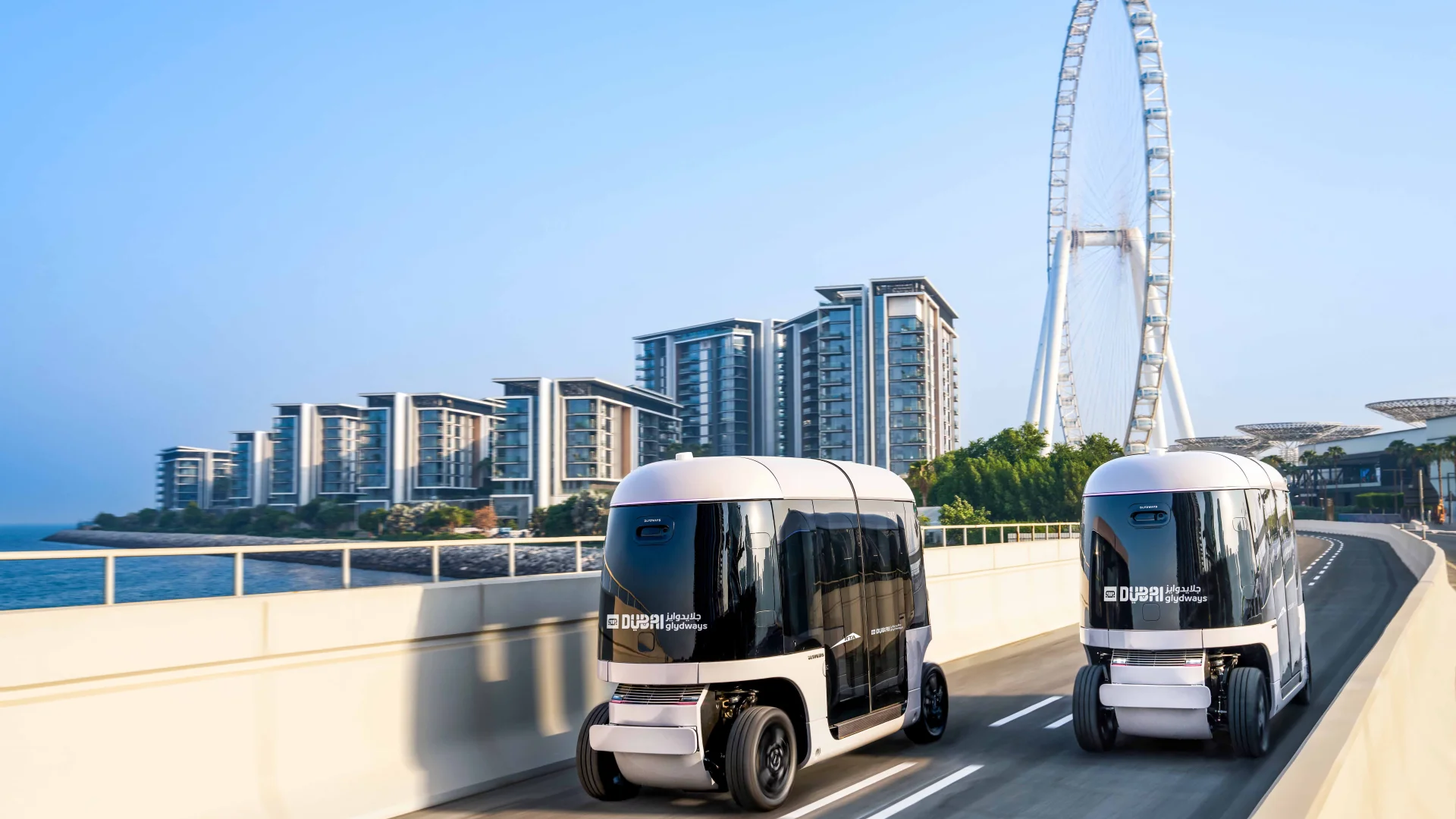

The next ride in Dubai may begin not with a driver, a bus timetable or a search for parking, but with a small electric vehicle arriving on demand. Dubai’s Roads and Transport Authority is partnering with Glydways to examine an autonomous transport concept designed to connect people directly with homes, offices, attractions and major transit stations. The initiative supports Dubai’s wider ambition to make autonomous travel a central part of urban life by 2030.
The heat still shimmers above the road. Glass towers catch the last light, taxis slip between lanes and the city keeps moving with its familiar, polished urgency. Then imagine a different kind of traffic: small electric vehicles gliding along dedicated corridors, arriving when needed and carrying passengers without a steering wheel or a driver.
That is the future Dubai’s Roads and Transport Authority is now exploring with Glydways. The US mobility company is developing an automated transport system built around compact vehicles, digital control and purpose-designed routes. The promise is not simply a driverless car. It is a new layer of public transport, one that could bring a direct, flexible connection closer to where people actually live and work.
Think of it as a horizontal lift. A passenger enters a vehicle, selects a destination and moves through the city with few stops or none at all. The vehicle can be dispatched according to demand rather than following a rigid timetable. In the morning, more units can serve business districts. Later, the flow can shift towards residential communities, hotels or transport hubs.
The agreement between RTA and Glydways is focused on examining how such a system could work in Dubai. The partners will consider possible applications, technical requirements and ways to connect autonomous vehicles with the city’s existing network of metro, tram and bus services.
That connection matters because most journeys do not begin at a station. They begin in a residential entrance, an office lobby or a hotel driveway. The final stretch can be uncomfortable, especially during Dubai’s hottest months. It may be too far to walk, too infrequent for a bus or too inconvenient to justify leaving the car behind.
Transport planners call this the first- and last-mile challenge. Glydways is designed to address precisely that gap. Smaller vehicles could serve areas where a full-size bus would be excessive, while still giving passengers a reliable link to the larger public transport network.
“Why wait for a big bus when only a handful of people are travelling?” That is the logic behind an on-demand system. Capacity can be adjusted to real-time demand, potentially reducing empty runs and making service more responsive.
Dubai has already made autonomous mobility a strategic priority. The city aims to have a significant share of journeys completed autonomously by 2030 and has been testing a range of technologies, including driverless taxis, automated buses and intelligent traffic systems.
The Glydways concept adds a distinct dimension. It is not only about teaching a vehicle to navigate. It requires an entire operating environment: dedicated corridors, stations, charging systems, control centres, passenger information and safety procedures. The journey should feel effortless, but every quiet movement depends on a carefully coordinated system behind the scenes.
Consider what happens when a concert ends or an office tower empties. A conventional route may remain fixed. An autonomous network can read the change and respond. Vehicles can be repositioned, service frequency adjusted and connections coordinated with other modes. Data becomes the invisible conductor of the city.
In Dubai, comfort is not a luxury detail. It can determine whether public transport is practical. Extreme summer heat, long distances and fast urban growth all shape the way people move. A sheltered, air-conditioned and accessible connection could make public transport attractive to residents, commuters, families, older passengers and visitors alike.
The vehicles would also offer a more intimate scale than a traditional bus. Fewer passengers. Shorter stops. A direct feeling of movement. The doors close, the cabin begins to glide and the city passes outside in a sequence of palms, towers and bright façades.
This would not make the metro, tram or bus obsolete. Quite the opposite. High-capacity modes remain essential on the busiest routes. Autonomous vehicles can fill the spaces between them, serving dispersed demand and neighbourhoods where a large fixed route would be difficult or inefficient to operate.
For the passenger, the experience may look simple. Behind it lies a demanding technical framework. Vehicles must detect obstacles, maintain safe distances and communicate with the operating centre. Stations must provide power, access and clear wayfinding. The system must continue to function in heat, dust, heavy traffic and unexpected situations.
Integration with the built city will be equally important. Dubai is expanding rapidly, with new residential districts, offices, hotels and attractions appearing across the urban map. If autonomous corridors are planned early, they could become part of the structure of new neighbourhoods rather than an afterthought added later.
That raises practical questions. Which communities should be connected first? Where should stations be placed? How should passengers transfer between an autonomous vehicle and the metro? How can the benefits reach ordinary neighbourhoods as well as premium destinations?
Electric propulsion could reduce local emissions and noise. In a city shaped by road travel, the effect would be easy to feel: less engine noise at the kerb, fewer exhaust emissions around stops and a calmer environment for pedestrians and residents.
The environmental benefit, however, depends on how the system is used. It must replace private-car trips rather than simply create another layer of traffic. Vehicle utilisation, electricity sources, maintenance and lifecycle impacts all matter. The strongest case for autonomous transport is not the novelty of the technology. It is the possibility of making shared mobility convenient enough to change everyday habits.
The next stage will involve technical, economic and operational evaluation. Potential pilot corridors, safety standards, vehicle capacity, infrastructure needs and network integration must all be assessed. These details will determine where the concept can deliver the greatest value.
For now, the announcement is a window into Dubai’s mobility workshop rather than the launch of a citywide service. There is no new network for passengers to board tomorrow. But the direction is unmistakable: Dubai is building towards transport that is autonomous, electric, data-led and shaped around demand.
Autonomous transport could also redraw Dubai’s real estate map. If residential districts, offices, hotels and metro stations are linked by dependable autonomous corridors, proximity may no longer mean being directly beside a conventional station or major road. A building’s value could increasingly depend on how quickly residents can reach the nearest mobility hub.
Developers may begin planning integrated transport into new communities: residential projects with dedicated pick-up areas, office districts linked to transit nodes and mixed-use neighbourhoods designed around short, car-light journeys. Properties connected to clean, frequent and convenient transport could become more appealing to tenants, buyers and corporate occupiers.
Investors will watch the route map closely. Improved accessibility can support demand, broaden employment catchments and strengthen emerging growth corridors. Yet the value will come from reliable operation, not from the word “autonomous” alone. Stations must be well located, connections must be simple and service must be available when people need it.
Dubai is therefore not just considering new vehicles. It is reconsidering the meaning of proximity. Places that feel peripheral today may be closer tomorrow. The city may soon drive itself – and take entire real estate districts along for the ride.