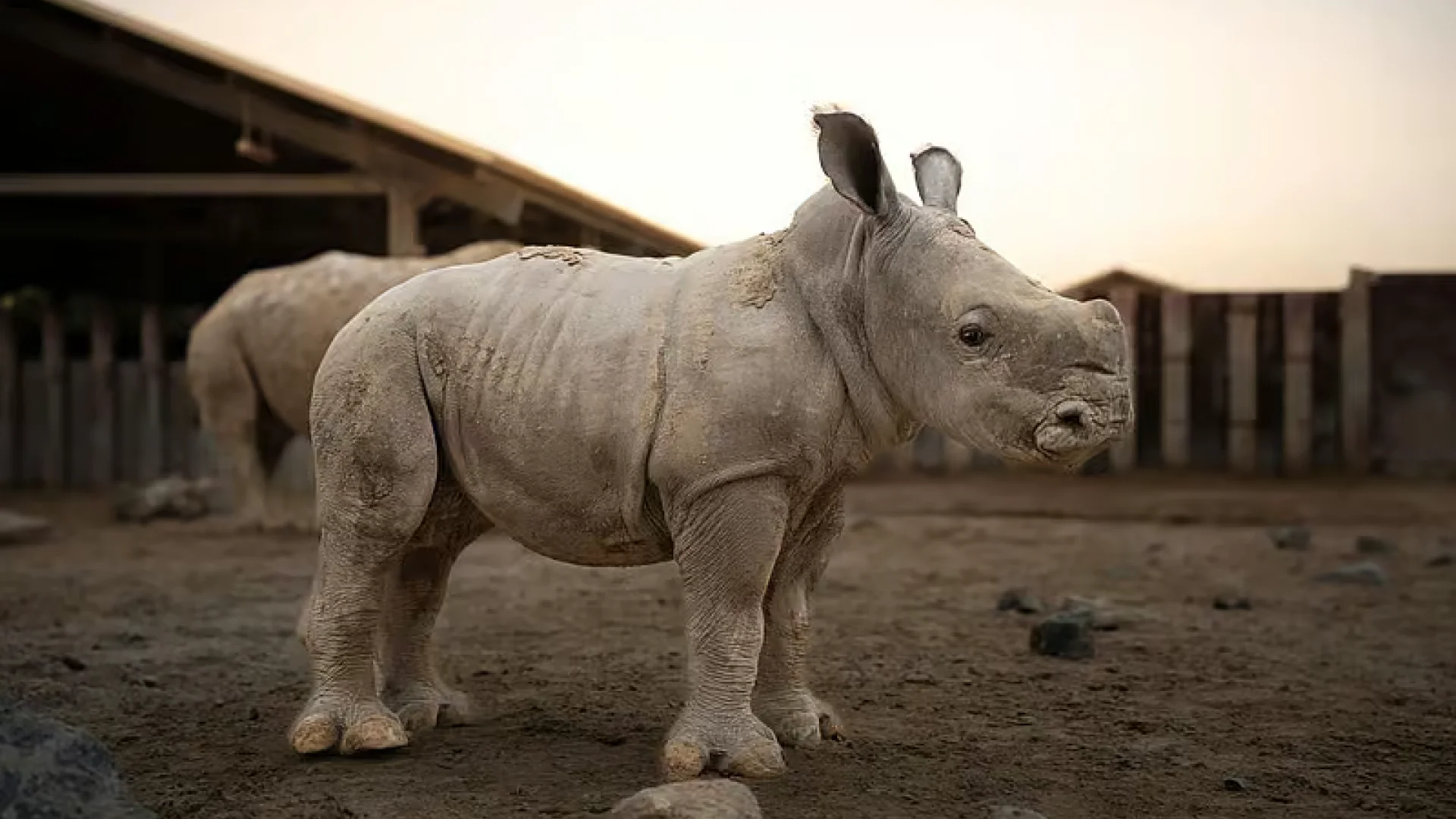
Before the heat sets in, Dubai Safari Park has a new heartbeat: Salam, a rare, unusually pale white rhino calf whose birth is being hailed as a standout moment for the park’s conservation efforts. In a world where rhinos remain under relentless pressure from poaching and habitat loss, every healthy calf matters—and this one instantly captures attention. Keepers are closely monitoring mother and baby, minimizing stress and watching the small signs that define survival: steady nursing, sure-footed steps, calm bonding. Salam is more than a crowd-stopper; it’s a living headline about how modern wildlife parks have shifted from spectacle to stewardship.
The morning air still feels almost cool when you step into the Dubai Safari Park—one of those brief windows before the city’s sun turns everything metallic and bright. Somewhere behind a quiet barrier, there’s a soft scraping sound. Straw. A low, steady breath. Then a small shape shifts, and the light catches it in a way that makes you blink twice.
A rhino calf. Pale—so pale it looks dusted in flour, like dawn left a fingerprint on its back. A keeper nearby exhales and says, barely above a whisper, “There it is.” Salam.
Salam—peace. The name fits the scene with almost suspicious perfection. The mother stands over the calf like a living wall, massive and patient, her head angled just enough to keep the world in check. The calf leans in, bumps, searches, finds the warm underside and the first real certainty of its day: milk, safety, rhythm.
For visitors, the moment is pure emotion—eyes widening, phones lifting, children tugging sleeves. For the people who work here, it’s something else: a checklist written in heartbeats. Is the calf nursing regularly? Is it alert? Are its steps getting stronger? Does the mother remain calm, protective, bonded?
Rhino births in managed conservation settings are never “just” cute news. They’re a measure of time bought—time against poaching networks, time against shrinking habitats, time against the slow erosion of genetic diversity. That’s why Salam’s arrival matters, and why the park is treating it as a milestone within its breeding and protection programs.
The calf’s unusually light appearance adds a layer of rarity that pulls people in. And in conservation, attention can be a tool. It can translate into public interest, education moments, funding, and pressure to keep protection efforts moving. A striking animal can become a messenger—quietly, simply—by making people feel something they didn’t expect to feel on a regular morning.
“We don’t rush this,” a staff member says, glancing at the daily logs. The tone is gentle but firm—the voice of someone who knows how easily a good start can turn fragile. “We observe. We give space. We let them settle.”
Modern wildlife parks are often misunderstood. People imagine constant handling, constant intervention. In reality, the work is a careful balance: close monitoring without crowding, medical readiness without panic, routine without noise. The best care sometimes looks like doing less—standing back, keeping the environment calm, reducing stressors, letting the mother-calf bond harden into something unshakeable.
That’s what you feel around Salam’s enclosure. A hush that isn’t enforced, just instinctive. Adults speak in lower tones. Kids mirror them. Even the cameras click more softly.
Salam takes a few steps. Not graceful—yet. The legs are still learning their angles. But the intention is clear. One step, then another, the tiny horn nub like a punctuation mark on a sentence that’s only beginning.
Dubai is famous for its scale—tallest, biggest, fastest. Salam’s story runs on a different measurement: continuity. The park’s message is less about spectacle and more about stewardship, about what it means to keep a threatened species breeding, healthy, and visible to a public that may never see a rhino in the wild.
And yet, the wonder is immediate. A child near the railing asks, “Why is it so white?” A parent answers, “Because it’s rare.” The child considers this, then says, with the blunt honesty adults spend years trying to recover: “Then we have to protect it extra.”
This is how conservation sometimes works—not through a lecture, but through a moment that sticks.
High-profile nature and family attractions function as “liveability anchors” in Dubai’s urban economy. They shape weekend mobility, strengthen surrounding retail and hospitality performance, and add a lifestyle premium to nearby residential districts—especially for family renters and long-stay visitors. For investors, the value is rarely direct ticket sales; it’s the way these destinations elevate a micro-location’s brand and footfall.
Investor watchpoints: proximity to major leisure hubs, access via key road corridors, the pipeline of new experiences, and mixed-use clustering (residential + hotel + F&B/retail). In a city built on momentum, sticky, repeat-visit attractions can support demand stability around specific neighborhoods.