
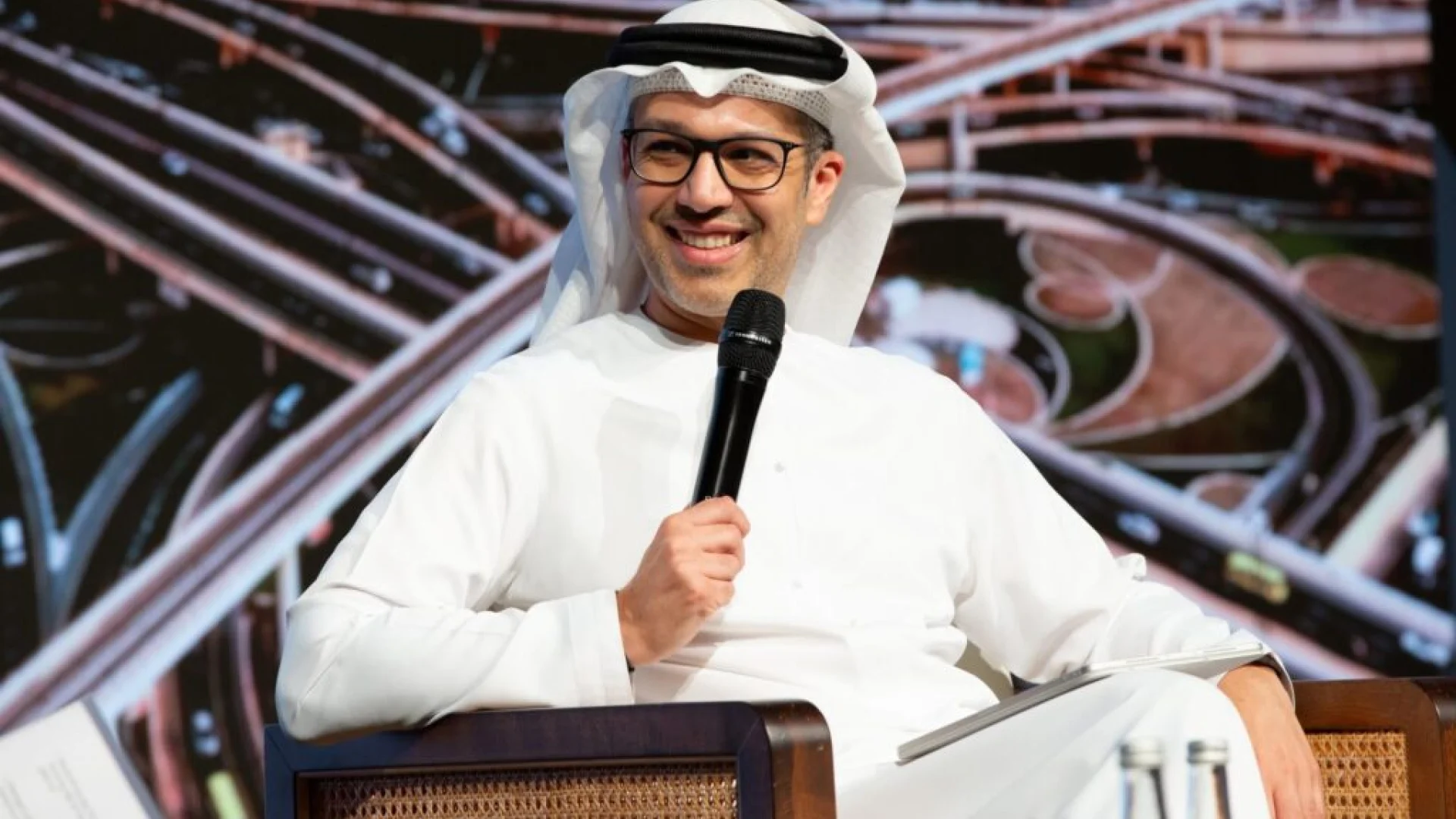
In a region on edge, Dubai is leaning into its signature message: it can keep money moving when others slow down. Hadi Badri, CEO of the Dubai Economic Development Corporation, says damage from attacks on the emirate was “very, very limited” and hasn’t derailed the push to attract global investors. He highlights a new “green corridor” with Oman that bypasses the Strait of Hormuz through streamlined customs and road-and-air routes, alongside a Dh1 billion ($272 million) package allowing fee deferrals for businesses and hotels. The backdrop is still bright—GDP grew 4.4% year-on-year in Q1 2026 and real estate transactions rose 6% versus the prior three months—yet sentiment has softened, with Dubai’s PMI easing to 53.2 as other financial hubs angle for inflows.
The first thing you hear is the hum.
Not the glamorous kind—the supercar rev on Sheikh Zayed Road—but the steady, industrial vibration of a city that refuses to pause. Down by the logistics corridors, forklifts skitter between pallets. A crane swings its long arm like a metronome. Somewhere behind the fence line, a truck driver leans out of his cab and calls, half-joking, half-checking: “We’re still on schedule, right?”
“Still” is doing a lot of work lately.
With conflict tied to Iran and tensions rippling across the Middle East, the world’s attention keeps snapping back to maps and maritime chokepoints. Dubai, by contrast, is trying to keep the camera on something else: continuity. Stability. The ability to process, ship, sign, and settle—fast.
That’s the message from Hadi Badri, CEO of the Dubai Economic Development Corporation, who has doubled down on the emirate’s reputation as a “safe haven for capital.” The damage from attacks on Dubai’s territory, he said, was “very, very limited relative to what’s been hurled at us.” And crucially, it hasn’t upset the plan: keep attracting global investors, keep deals alive, keep the city’s economic rhythm intact.
In Dubai, the promise of safety isn’t delivered with soft language. It’s delivered with infrastructure and process—what works at 2 a.m. when a shipment lands, what clears customs without drama, what lets a business keep cash in its account for one more payroll cycle.
Badri’s argument rests on two tangible levers: alternative trade routes and immediate economic breathing room.
Ask any operator moving goods across borders and they’ll tell you: uncertainty is rarely one big event. It’s a thousand small delays. A form that takes an extra day. A container that misses a slot. A phone call that ends with “we’ll revert.”
Dubai’s answer, Badri says, is a “green corridor” with Oman—opened March 14—designed to bypass the Strait of Hormuz. It’s essentially a streamlined customs process that allows goods to move between Dubai and Oman via air and road with less friction.
It sounds bureaucratic until you watch the way people react when you mention it. In a warehouse office—fluorescent lights, a whiteboard full of shipping codes—a manager nods once, sharply. “Options matter,” he says. “You don’t want to discover your Plan B when Plan A is already burning time.”
The corridor is a Plan B that’s been formalized, branded, and—most importantly—operationalized.
Then there’s the money, and the timing of it.
On April 1, Dubai announced an economic package worth Dh1 billion (about $272 million) to support businesses and families. Companies can defer payment of government fees for three months. Hotels can also defer sales fees—small clauses on paper that become large in real life, especially in a period when booking patterns can change overnight and CFOs suddenly speak in shorter sentences.
In a hotel lobby, the air smells faintly of citrus and polished stone. A staff member glides past with a tablet. Near the entrance, a manager tilts his phone toward me—occupancy charts, dates, quick pivots. “People still come,” he says. “But they decide later. They change faster. If we can keep more cash in-house for a few months, we can breathe through the noise.”
This is what such packages are really about: not fireworks, but oxygen.
Dubai’s officials don’t rely on narrative alone. They point to data.
After strong growth in 2025, the emirate’s economy expanded 4.4% year-on-year in the first quarter of 2026. In property—often the most visible barometer of confidence—transactions rose 6% in January to March 2026 compared with the previous three months, according to Dubai Land Department figures.
Numbers like these do more than decorate a report. They change the tone of conversations. In a brokerage office overlooking the canal, a consultant taps a pen against a stack of floorplans and says, “We’re not selling ‘hope’ right now. We’re selling evidence—rent demand, transaction velocity, the fact that the market is still liquid.”
Liquidity, in uncertain times, is its own form of comfort.
Still, even Dubai’s machine can sound a little quieter.
The report also notes that business sentiment has eased. Dubai’s S&P Global purchasing managers’ index fell to 53.2 in March from 54.6 in February—the weakest expansion in non-oil private-sector activity in nine months. It’s not contraction; anything above 50 signals growth. But it is a reminder that the city’s confidence is not immune to headlines.
You can feel it in the questions investors ask. Not fewer questions—different ones. Less “how fast can we close?” and more “what happens if shipping costs spike?” Less “what’s the upside?” and more “where’s the downside protected?”
A finance professional in DIFC puts it bluntly over a quick coffee: “Dubai is still a magnet. But magnets compete. The pull has to be strong enough, and the pricing has to make sense.”
Where there’s uncertainty, there’s ambition. Other financial centres are trying to capitalize on the moment. Hong Kong Financial Secretary Paul Chan, for instance, predicted that the conflict could drive capital inflows back to Asia.
Dubai’s response, through Badri, isn’t to deny Asia’s gravitational force. It’s to lean into it. Asia, he insists, is already central to Dubai’s planning. “The opportunity in the next chapter is really about deepening collaboration between Asia and Dubai,” he said, “and delivering even more value from Dubai for Asian investors and businesses.”
It’s a subtle but important pivot: Dubai doesn’t need to be the only destination. It wants to be the connector—the place where Asia’s capital meets the wider region’s projects, where supply chains are re-routed instead of severed, where deals can be structured, serviced, and scaled.
Back outside, the light turns honeyed, bouncing off glass towers like a second sunset. A driver opens a car door for a pair of executives who are still talking as they sit—half a sentence in English, half in Arabic, a number mentioned, a date confirmed. A courier runs across a plaza with a document envelope held tight against the wind.
Dubai’s bet is visible in these small scenes: that if the systems keep working, confidence can be maintained—even strengthened—while others hesitate.
The safe-haven claim, in other words, isn’t meant to sound comforting. It’s meant to sound practical.
For real estate investors, Dubai’s “safe haven” positioning translates into a practical question: How does risk—perceived and real—move prices, rents, and liquidity? The latest signals suggest a market that remains active, but more selective.
1) Transaction momentum matters most in volatile periods. The 6% rise in real estate transactions in Jan–Mar 2026 versus the prior three months is a meaningful liquidity indicator. In many global markets, uncertainty freezes decision-making; Dubai’s transaction flow suggests price discovery is still functioning. For investors, that supports clearer entry and exit planning—especially in segments with deep resale markets.
2) Expect a “quality flight” within Dubai. Softer sentiment (PMI down to 53.2) often shifts demand toward assets with resilient cashflows: completed units over off-plan speculation, prime locations over peripheral supply, and properties with demonstrable leasing demand. Underwriting assumptions should reflect slower absorption in weaker micro-markets while recognizing that prime stock can stay surprisingly liquid.
3) Logistics resilience supports industrial and last-mile plays. The Oman green corridor, designed to bypass the Strait of Hormuz, is especially relevant to industrial real estate: warehouses, distribution hubs, light manufacturing, and last-mile facilities. If trade continuity improves, tenant demand for well-located logistics space can remain firm—supporting rental stability and longer lease tenures.
4) The Dh1bn package indirectly supports occupancy and tenant health. Fee deferrals don’t change fundamentals overnight, but they can reduce near-term stress for SMEs and hospitality operators—two groups that influence retail footfall, serviced apartment demand, and certain commercial submarkets. Lower business distress can mean fewer forced vacancies and more predictable rent collection.
5) Watch cross-border capital flows—and currency preferences. With Hong Kong and other centres pitching for inflows, Dubai may face sharper competition for incremental capital. Badri’s Asia focus suggests Dubai will push deeper partnerships, which could sustain demand in premium residential, prime offices, and hospitality-linked assets catering to Asian business travel and wealth migration.
Investor checklist for 2026:
Dubai’s story right now is not “nothing can happen here.” It’s sharper: systems are being built to keep the city investable even when the region feels unpredictable. For real estate investors, that can mean opportunity—so long as it’s paired with disciplined micro-location selection and a clear view of liquidity.