
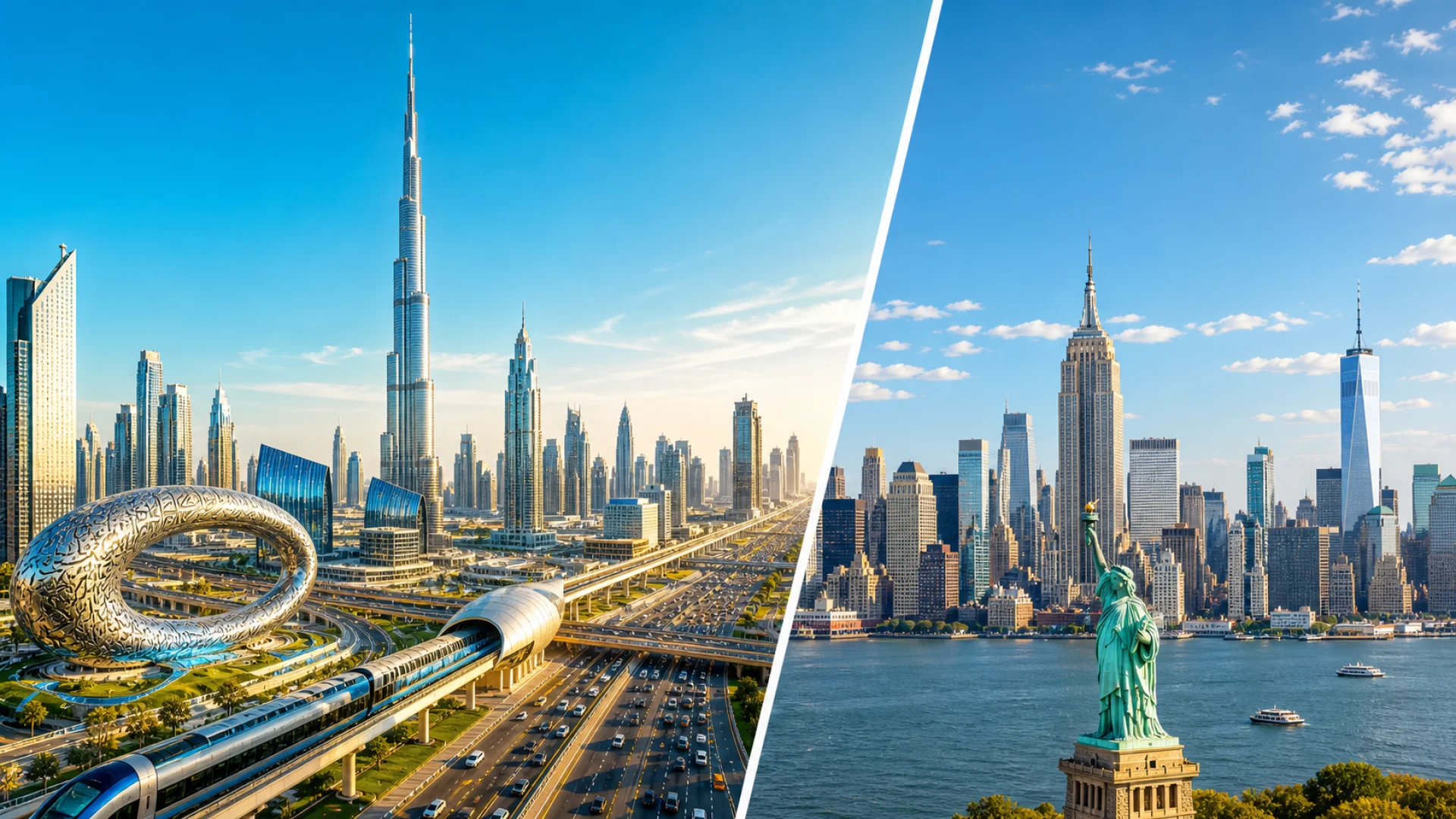

A door opens, a screen flashes, a payment clears—Dubai’s city life increasingly feels like one continuous, frictionless check-out line. In a global smart-city ranking, Dubai has moved ahead of New York to take second place, spotlighting years of investment in paperless government, integrated data platforms, and tech that shows up in daily routines rather than glossy demos. The leap reflects execution at scale: services that work across agencies, mobility that’s coordinated, and AI used as a practical engine, not a buzzword. In Dubai, “smart” isn’t a future promise—it’s how the city keeps time.
The metro doors seal with a soft hiss. Outside, Dubai’s heat shimmers like a mirage; inside, the carriage is cool enough to make you forget the sun is even there. A screen above the aisle blinks: next station, transfer options, service notices. A man beside me taps his phone twice.
“Done,” he says, almost surprised at how little the word weighs.
Done can mean a bill paid, a permit renewed, a document signed, a booking confirmed. In many cities, it’s a morning’s worth of errands. Here, it’s a tiny movement of the thumb.
That feeling—speed without fuss, systems that don’t argue back—is the human side of a headline that traveled fast: Dubai has overtaken New York in an international smart-city ranking and now sits at number two worldwide. Rankings like these don’t just reward futuristic prototypes; they typically measure how thoroughly technology is woven into the essentials: government services, infrastructure, mobility, safety, health, education, and—most importantly—whether residents and businesses actually feel the difference.
In Dubai, you feel it at the first touchpoint. At arrivals. At the hotel desk. At the parking meter. At the moment you realize there isn’t really a “counter” anymore—only a service, delivered where you already are: on your phone, on a kiosk, on a platform that knows what you’re asking before you finish typing.
Smart-city talk can get abstract—fiber networks, sensors, digital twins—until you meet the simplest metric of all: your time. Dubai’s approach has long leaned toward paperless, end-to-end services and a design philosophy that treats bureaucracy like a user experience problem. Fewer steps. Fewer repeat uploads. Fewer “please come back tomorrow.”
Listen to how people describe it. Not with grand adjectives, but with the language of errands: “quick.” “easy.” “two minutes.” The city’s digital ecosystem is built to reduce the small frictions that accumulate into stress—especially in a place growing as fast as Dubai, welcoming new residents, new companies, and new visitors at a pace that punishes anything slow.
Dubai’s rise isn’t only about digitizing forms; it’s about connecting systems. A smart city becomes truly smart when mobility, energy, public services, security, and planning don’t operate as islands. They share standards. They exchange signals. They learn from patterns.
Imagine a city that can hear itself. Where congestion isn’t just complained about—it’s measured. Where service demand isn’t guessed—it’s tracked. Where planning isn’t only a map—it’s a living model fed by real activity. This is the quiet logic behind higher rankings: integrated platforms that allow a city to steer, not just react.
At a midday intersection, the sun sits overhead like a spotlight. Yet the flow is oddly composed. Cars glide through phases, pedestrians cross in waves, information appears where you need it. Mobility is one of Dubai’s most visible smart-city stages: modern mass transit, digital ticketing, traffic management, and data-informed planning that tries to keep pace with expansion.
And expansion here is not a slogan—it’s a daily construction soundtrack. New districts, new towers, new communities. A city that grows at this speed has two choices: digitally coordinate itself, or get swallowed by its own momentum.
Say “AI” in some places and you’ll get a pitch deck. In Dubai, you’re more likely to get a shrug and a working feature: automated help, faster routing of requests, smarter analysis behind the scenes. The best technology often feels unremarkable because it removes the need to notice it.
That’s the point. Smart isn’t the drone in the sky. Smart is the absence of a line. The missing paperwork. The notification that arrives before confusion does. AI, used well, turns city administration into something closer to a utility—reliable, always on, rarely dramatic.
Smart-city indices tend to favor three things: strategy (a clear plan), execution (wide rollout beyond pilots), and impact (benefits that show up in everyday life). Dubai’s edge is that it treats technology as a competitiveness tool—something that attracts talent, companies, investors, and global attention.
Beating New York carries symbolism: a younger, fast-scaling city outpacing one of the world’s most iconic urban ecosystems. It doesn’t mean New York lacks intelligence; it underscores Dubai’s ability to decide quickly, implement broadly, and keep iterating.
In the evening, when the air finally softens, I sit on a terrace and watch the crowd stitch itself together—Arabic, English, Hindi, French, Tagalog—languages like streams meeting in one place. At the next table, someone holds up a phone and laughs.
“Look—two minutes,” she says. “No way.”
Her friend leans in. “Try it again.”
They’re not discussing technology. They’re discussing time—how much of it the city just handed back.
A city that runs faster changes the way property markets behave. Dubai’s climb to the world’s second-smartest city is not just a branding win—it can translate into stronger demand, sharper location premiums, and more efficient development cycles. For investors, the smart-city story matters because it touches the drivers of value: who moves in, how easily they live, and how smoothly capital can flow.
1) Location premiums follow connectivity
Neighborhoods with reliable public transport, strong last-mile options, and dense service ecosystems tend to gain an edge. As mobility becomes more coordinated and predictable, buyers and tenants often pay more for time saved—shorter commutes, simpler access, fewer daily frictions.
2) Smart buildings become the baseline
Digital access control, smart metering, energy-efficient systems, app-based community services—features that once felt “luxury” are increasingly part of a building’s credibility, especially for internationally mobile tenants. That can support occupancy stability and pricing power.
3) Faster processes can reduce project risk
Where permitting, registrations, and service connections are digitized, timelines can become clearer. Clarity reduces risk. Risk reduction improves underwriting. In practical terms, it can tighten the gap between a pro forma and reality.
4) PropTech opportunities expand
A city built on data creates space for PropTech: predictive maintenance, portfolio dashboards, tenant experience platforms, and AI-led operations. Owners can optimize operating costs, strengthen ESG reporting, and improve resident satisfaction—all levers that matter to institutional and private investors alike.
5) Investor checklist for a “smart-city” market
Ultimately, Dubai’s smart-city momentum is a compounding advantage: it attracts people, accelerates services, and upgrades the product itself—buildings, neighborhoods, and the experience of living in them. In property terms, that’s not a slogan. It’s a value driver.