
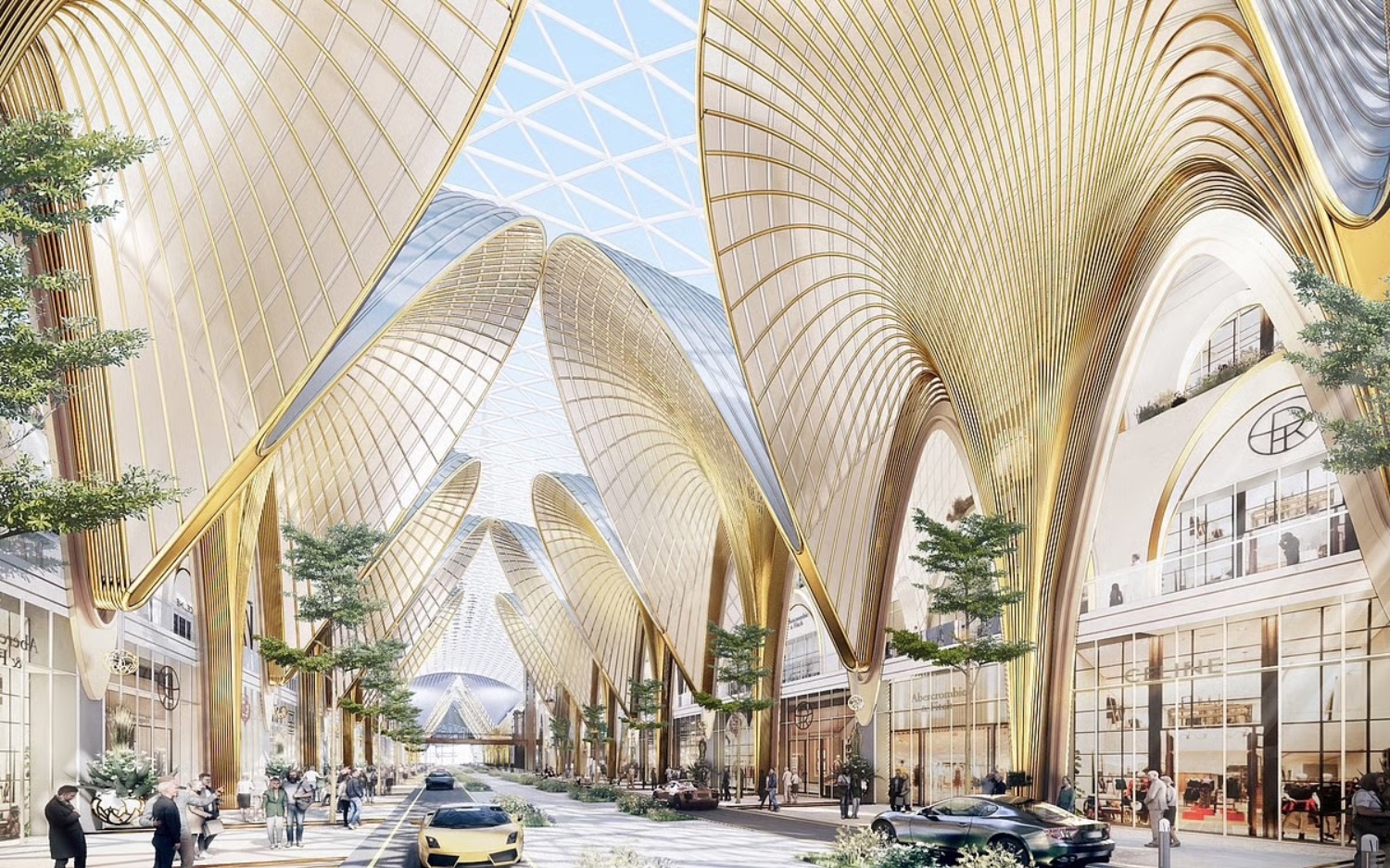

The construction dust at Dubai Creek Harbour still hangs in the air, but the vision is already crystal clear: in roughly three years, Dubai Square is expected to rise from this waterfront site as one of the most ambitious retail and entertainment destinations in the region. Conceived as a ‘retail metropolis’ rather than a traditional mall, the project blends streets, plazas, homes and hotels into a single, tech-infused urban stage. Developers behind Dubai Creek Harbour have revived the mega-plan with a concrete opening horizon, betting that people will still travel for breathtaking, physical experiences even in a digital-first era. For residents, retailers and real estate investors, the three-year countdown has started – and it is set to reshape an entire piece of the city.
The late-afternoon sun burns orange over Dubai Creek Harbour. Cranes draw sharp lines against the sky, workers move like dots across the sand, and the wind carries the mixed scent of saltwater and wet concrete. Somewhere between the growl of trucks and the clink of steel, an engineer lifts his helmet and says quietly: “In a few years, this will all be shops, cafés, people.”
He is pointing at what will become Dubai Square – not just another shopping centre, but an entire mini-city under a glass sky. For now, it is a gigantic worksite. In roughly three years, if all goes to plan, this stretch of land is expected to transform into one of Dubai’s most talked-about destinations.
Dubai Square is not a brand-new name. The project was first unveiled several years ago as part of Dubai Creek Harbour, the vast waterfront community being developed along the historic creek. From the beginning, the idea was deliberately audacious: instead of a conventional boxy mall, create a walkable, climate-controlled “downtown” filled with storefronts, apartments, hotels and entertainment venues, all woven together by technology.
Then came the quiet years. Global uncertainty, construction reprioritisations and a pandemic that emptied malls worldwide raised an uncomfortable question: was such a grand, physical retail destination still the future? For a time, it seemed as if the dream might stay on the rendering board.
Now, the narrative has flipped again. Recent updates from the developers behind Dubai Creek Harbour have put Dubai Square back into the spotlight, with a clear message: the mega-mall is moving forward, and the aim is to welcome its first visitors in around three years. After years of speculation, the project once again has a ticking clock.
On site, the renewed momentum is visible in the choreography of machinery and surveyors. Design teams have been fine-tuning layouts, circulation, façade concepts and the delicate balance between indoor comfort and outdoor atmosphere. Construction teams, in turn, are planning the phasing so that the first wave of retail and entertainment can open while other parts of the district continue to grow around it.
The timeline is ambitious but not unusual by Dubai standards. In roughly three years, the target is to open a first phase substantial enough to stand on its own: a dense grid of retail streets, flagship stores, dining terraces and entertainment anchors, wrapped in a climate-controlled environment and plugged into the wider Dubai Creek Harbour transport and road network.
From the outside, Dubai Square is expected to look less like a closed box and more like an urban quarter. Think wide, shaded boulevards instead of endless corridors, plazas rather than atriums, and a constant play between indoor comfort and outdoor views of the creek and skyline.
Ask ten people what Dubai Square will be, and you might hear ten different answers. “It’s a mall.” “No, it’s a neighbourhood.” “It’s an entertainment hub.” In truth, it is all of these at once – deliberately blurring the lines between shopping, living, working and playing.
Early concept visuals showed streets running beneath a vast glass canopy, digital façades shifting like theatre sets, and a central plaza big enough to host concerts and large-scale events. Instead of pushing people through a linear path from entrance to cinema, the plan is to let visitors wander, explore, linger and discover.
The experiences are designed to be layered:
Every corner is conceived to feel like a “place”: a quiet courtyard with a fountain and a bookshop; a buzzing street lined with pop-up kiosks and street food; a polished avenue where window displays spill light onto the pavement at night. The goal is to treat retail not just as transaction, but as theatre.
All of this is happening in a world where the swipe of a finger can deliver almost anything to your door. So why double down on a physical mega-mall in 2020s Dubai?
The answer lies partly in tourism and partly in lifestyle. Dubai has positioned itself as a global leisure capital, and shopping remains one of its biggest draws. In recent years, the city has attracted well over 17 million international overnight visitors annually, and its long-term strategies continue to target strong tourism growth. Those visitors want more than a basic row of stores; they want places to wander, take photos, dine, be entertained – and yes, shop.
The other driver is how residents actually live. For many Dubai families, the mall is a de facto town square: the place to spend Friday evening, to meet friends, to celebrate a birthday, to entertain guests from abroad. Against this backdrop, a development such as Dubai Square is not an anomaly, but an evolution. It promises a richer version of the familiar ritual.
Developers are also betting that the future of bricks-and-mortar retail will be hybrid, not dead. Stores become showrooms, stages and brand experiences, tightly integrated with online channels. Imagine trying on a jacket in a Dubai Square flagship, customising it via a digital mirror, and having it delivered to your hotel or home the next day – while your visit itself becomes a social-media moment.
To understand what Dubai Square could mean in everyday life, walk along the existing promenade at Dubai Creek Harbour at sunset. Children ride scooters along the water. Couples lean on the railing, watching flamingos in the distance. Café terraces fill up as the sky turns pink.
Now, imagine adding a full-fledged urban centre a short stroll inland. A young couple living in a nearby tower might finish work, step into the shaded streets of Dubai Square for groceries, pick up a take-away coffee, and be seated in a cinema ten minutes later. On weekends, the same streets might host a farmers’ market or a pop-up design fair, with buskers playing soft jazz under the glass canopy.
Retailers are already picturing the possibilities. A regional fashion brand manager walks the site with a tablet in hand, tracing imaginary shopfronts on the masterplan. “We learned a lot from Downtown and Dubai Mall,” she muses. “Here, we can design the store for a new generation – more experience, more digital, more flexibility.”
Residents who bought early in Dubai Creek Harbour talk, half-jokingly, about living “next to the next big thing.” For them, the opening of Dubai Square is not just about new coffee spots; it is a signal that their neighbourhood is maturing into a complete, self-contained part of the city.
Big projects in Dubai rarely exist in isolation. The rise of The Dubai Mall helped turn Downtown Dubai into a postcard skyline and pushed surrounding property values upwards. Mall of the Emirates did something similar for Al Barsha and surrounding districts. Dubai Hills Mall has started to anchor a whole new green corridor of communities.
Dubai Square is set to play a similar anchoring role for the eastern side of the city. Once open, it will not only serve the immediate residents of Dubai Creek Harbour, but also neighbouring districts and even visitors arriving from the airport corridor. Its shops, restaurants and public spaces will help to “complete” a part of the city that, until recently, was mainly sand and sketches.
Traffic patterns will adapt, new bus and taxi flows will emerge, and waterfront promenades will link into shaded streets and sky-lit plazas. Over time, the sentence “Let’s meet at the Creek” may acquire a whole new meaning.
For real estate investors, Dubai Square is more than a glossy architectural rendering; it is a potential value engine. Mega-destinations of this scale tend to reshape their surroundings, and Dubai has already provided a textbook case of what can happen when a powerful retail anchor plugs into a mixed-use master community.
In Downtown Dubai, for example, the presence of The Dubai Mall and the associated lifestyle ecosystem contributed to sustained demand for nearby apartments, branded residences and hotel rooms. High visitor footfall, strong global recognition and a steady calendar of events translated into both premium pricing and attractive rental levels.
Dubai Creek Harbour is now positioned to write a similar story, with Dubai Square as one of its central characters. Several real estate dynamics are worth watching closely:
Of course, opportunities come with questions. Timelines for very large projects can shift, and global economic conditions can influence retail demand and travel flows. Investors will want to monitor construction progress, infrastructure roll-out and leasing activity in the run-up to opening.
Yet the broader pattern is hard to ignore: in Dubai, landmark lifestyle destinations tend to leave a lasting imprint on the property map. As cranes continue to trace the outline of Dubai Square against the creekside sky, many investors are already imagining the moment when lights replace floodlamps, music replaces machinery – and a new urban magnet starts pulling people, and value, towards this once-empty stretch of waterfront.