
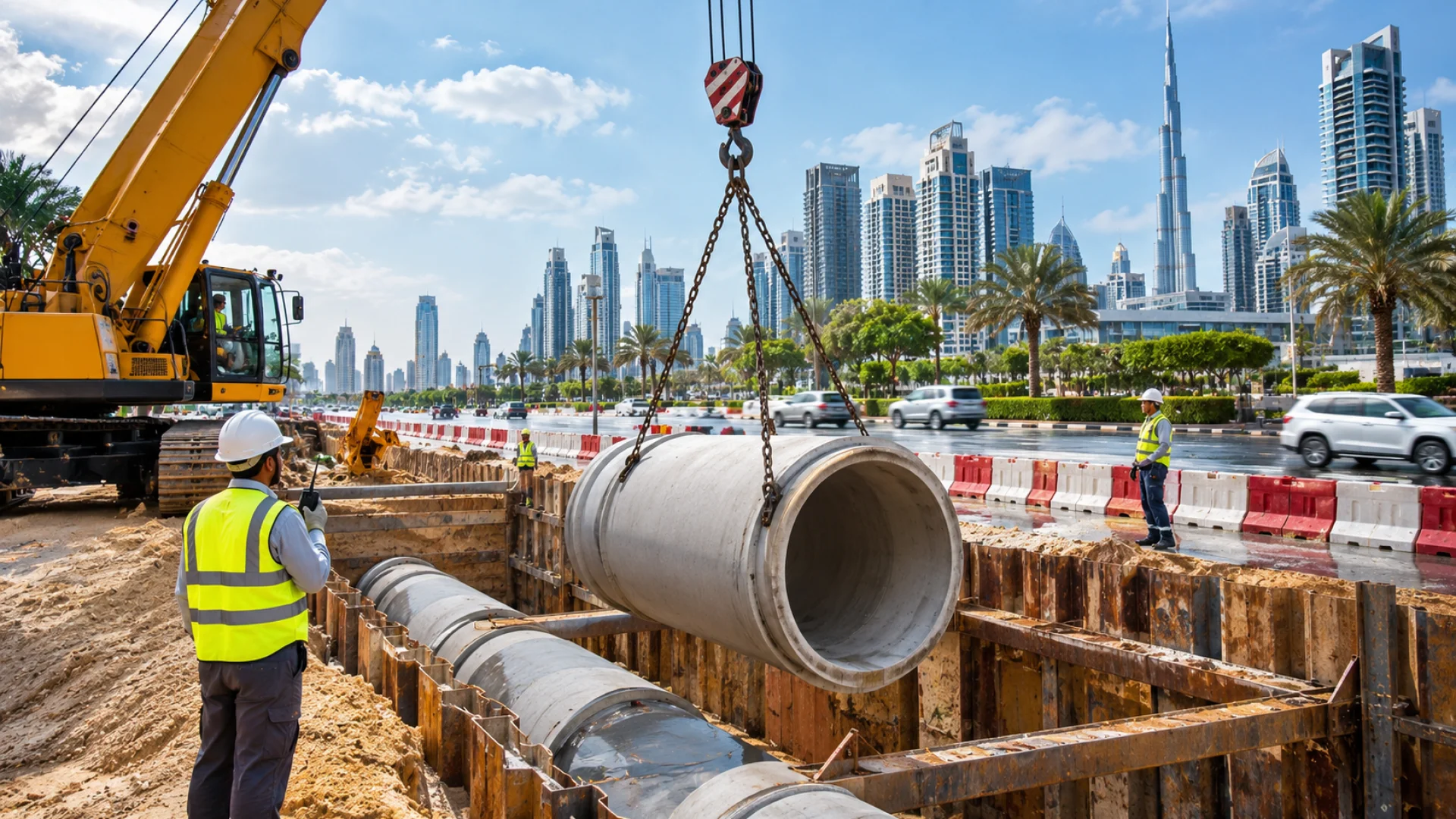

Beneath Dubai’s highways, towers and new neighbourhoods, a second city is taking shape: a network of large drainage lines, pumping facilities and collection systems designed to move stormwater safely and quickly. The third phase of the Tasreef programme continues this long-term infrastructure effort. It is intended to make the emirate more resilient to intense rainfall while supporting future housing, commercial development and critical transport links.
For a few minutes, the road belongs to the rain. Water races along the kerb, gathers beneath streetlights and turns the surface of the asphalt into a dark mirror. Then, somewhere below ground, a pump starts. The city breathes out.
That hidden movement is the story of Dubai’s Tasreef programme. The emirate is expanding and upgrading its stormwater drainage system, not through one isolated fix but through a citywide network of pipes, pumping stations, collection points and major drainage lines. With phase three, the work moves into another important chapter.
Dubai has transformed at extraordinary speed. New residential communities, hotels, offices, roads and logistics districts continue to reshape the urban map. But development also changes how rain behaves. Sand and open land can absorb water. Roofs, parking areas and paved roads cannot. They send it running across the surface, often towards the same low points and underpasses.
Most days, rainfall is not a major event. But when an unusually intense storm arrives, every part of the city’s drainage chain is tested. A blocked inlet, a low-lying road or an undersized connection can quickly become a bottleneck. “The water is already rising,” a driver might say while watching the traffic slow. For engineers, that moment begins much earlier – in maps, models and capacity calculations.
Tasreef is designed to address the challenge at system level. The programme brings together new and upgraded drainage infrastructure, links urban districts to larger networks and improves the ability to collect and move stormwater away from vulnerable locations. Phase three extends that effort across additional parts of Dubai as the city continues to grow.
Large drainage projects are easy to underestimate. A headline may mention a line or a phase, but on the ground the work is a complex choreography. Roads have to be opened in carefully managed sections. Existing electricity, telecommunications and water services must be protected. New chambers and pumping facilities have to fit into an already crowded underground environment.
Above ground, residents may see barriers, excavators and temporary diversions. Below ground, crews are building a chain that must work under pressure. Water needs somewhere to enter, somewhere to travel and somewhere to go next. Each connection matters.
The principle is straightforward: do not wait for water to become a crisis on the street. Capture it early, guide it deliberately and move it away from sensitive areas as quickly as possible.
A bridge announces itself. A metro station becomes a landmark. A drainage system is different. Its best performance is almost invisible. Roads remain open. Building entrances stay accessible. Deliveries continue. Residents go about their day without thinking about the network beneath their feet.
That invisibility is not a lack of ambition. It is the point. Hospitals, schools, hotels, shopping centres and apartment buildings depend on reliable access. A flooded underpass can interrupt an entire district. A disrupted road can delay emergency services and supply deliveries. A vulnerable junction can affect thousands of daily journeys.
By expanding the network, Tasreef is intended to reduce those weak points and improve the resilience of the urban system as a whole. This matters in a city where new neighbourhoods are planned, built and occupied at remarkable speed.
Heavy rain is uncommon in the Gulf, but that does not make it irrelevant. In an intense storm, water can fall over a short period and collect faster than local drains can handle. Underpasses become basins. Access roads turn into narrow channels. Basement entrances suddenly matter.
A modern stormwater system therefore has to do more than remove ordinary runoff. It must cope with peaks, manage different flow routes and coordinate with the shape of the city. Storage can buy time. Pumping can keep water moving. Monitoring can help operators identify pressure points before they become failures.
That is why Tasreef represents a wider shift in urban planning. Drainage is no longer a background utility considered only after roads and buildings have been designed. It is part of the city’s strategic infrastructure, alongside transport, power, water and digital connectivity.
The most difficult part of the work may be its location: underneath a city that never really stops. Traffic has to keep moving. Businesses need access. Construction must be coordinated with other projects, from new roads to residential master plans. Every excavation has consequences at the surface.
For residents and businesses, temporary disruption can be frustrating. Yet the construction has a long horizon. Once the road is resurfaced and the barriers are gone, the machinery disappears from view. The drainage line remains, ready for the next severe storm and for the next wave of development.
Stormwater infrastructure may not appear in a property brochure, but it can influence the experience and value of a location. Buyers, tenants and institutional investors increasingly consider resilience alongside transport access, amenities and energy performance. A district that remains reachable during difficult weather has a practical advantage.
For developers, a stronger drainage network can support the planning of new residential, hotel and commercial districts. It can improve confidence in areas still being built out and reduce the risk that a single weather event interrupts construction, access or daily operations. For owners, reliable public infrastructure can support long-term usability and marketability.
The significance of phase three, then, is larger than the visible construction footprint. It is part of the foundation beneath Dubai’s next cycle of growth. The city cannot stop the rain. But it can decide whether the rain becomes a disruption – or simply another brief scene beneath the lights.
For investors, the Tasreef programme is an important infrastructure signal. Locations where upgraded drainage connects with new roads, housing communities, hotels and employment districts may benefit from stronger long-term fundamentals. Resilient infrastructure can support development schedules, protect access and improve the operating environment for occupiers.
When assessing a Dubai property, investors should therefore look beyond the plot and the building. Connectivity to drainage, roads and wider municipal networks is part of location quality. Tasreef underlines a simple fact: real estate value is shaped not only by what rises above ground, but also by what keeps the city functioning below it.