
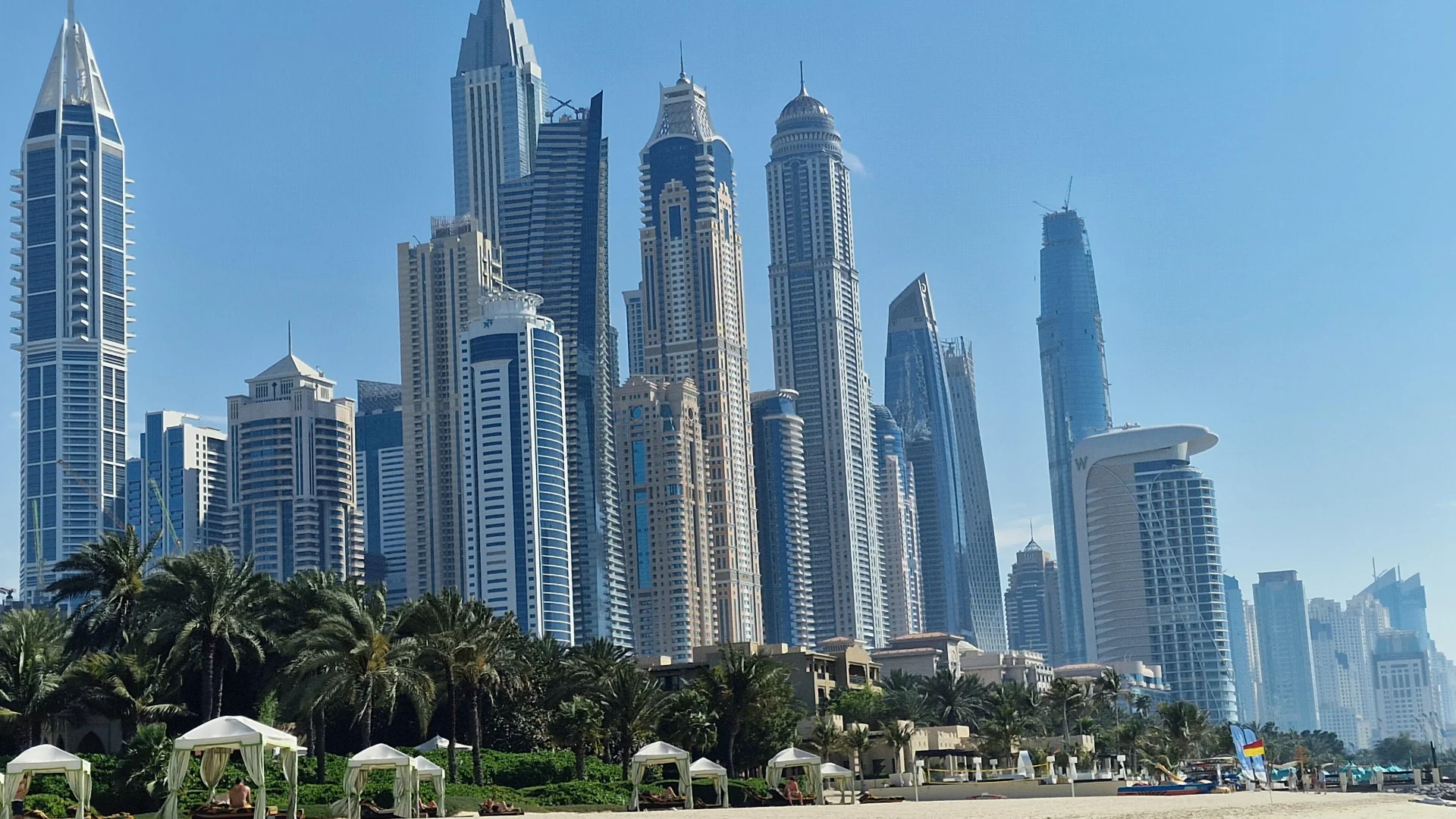

Dubai is not growing at some distant point in the future—the change is happening now. More than 4.6 million people live in the emirate today, while the average number present during the day rises to around 6.4 million. You can feel that scale on the roads, in the metro, across new communities and in the demand for homes. With ‘Dubai Population Now’, this development is tracked continuously. For residents, businesses and investors, the question is no longer whether Dubai is growing, but how the city turns that growth into quality of life, infrastructure and sustainable opportunity.
The first coffee is still steaming, but Dubai is already in motion. Commuters move onto metro trains, traffic thickens along Sheikh Zayed Road, and another day begins across new communities—between school runs, offices and construction sites. The city feels fuller because it is fuller.
Today, more than 4.6 million people live in Dubai. During the day, commuters, visitors, tourists and other temporary populations lift the average number of people present in the emirate to around 6.4 million. This is not an abstract statistic. It is the scale at which transport, utilities, schools, healthcare and housing must work every day.
The important point is not the final decimal place, but the new order of magnitude. Dubai is now a metropolis of more than 4.6 million residents—and it keeps changing. Through the ‘Dubai Population Now’ initiative, the emirate is moving to continuously updated, register-based population measurement. Administrative records and smart systems are designed to reveal demographic shifts faster than a traditional census conducted years apart.
For urban planning, that is a meaningful change. When authorities can see more quickly where people live, work and move, they can plan capacity with greater precision—from roads and metro links to schools, clinics, energy, water and public space. Population data becomes more than a headline; it becomes a working tool.
Growth has already reached everyday life. Metro services carry heavier loads, more journeys converge on key roads, and new communities become part of the city at speed. At the same time, Dubai grows more diverse as professionals, entrepreneurs, families and international teams bring different routines, languages and expectations.
That momentum creates energy, but also friction. More residents mean greater demand for mobility, education, healthcare, leisure and everyday services. Dubai therefore has to do more than become larger. It must keep routes, systems and services reliable as utilisation rises.
There is no single reason for the inflow. Dubai combines global connectivity with a broad labour market, entrepreneurial opportunity and infrastructure that can make it relatively quick for newcomers to get established. For many families, safety, schools, healthcare and the predictability of daily life also matter.
The result is a feedback loop: companies expand and hire, people relocate, new households create additional demand, and more businesses follow. This strengthens the city’s economic base—but it also requires housing and public infrastructure to keep pace with demand.
In a city of more than 4.6 million residents, quality of life is often decided by ordinary details. How reliable is the commute? How close are schools, groceries and healthcare? How well is a community connected to metro and bus services? How quickly do utilities and public spaces scale?
Because far more people are present in Dubai during the day than permanently live here, resident population alone is not enough for planning. Roads, public transport and essential services must also withstand peak demand. Good planning means responding to today’s needs while building capacity for the next stage of growth.
Population growth becomes tangible in the property market. People need apartments, families look for larger layouts, and many residents prioritise short journeys to work, schools and daily services. Well-connected locations and functional communities gain importance as a result.
But more residents do not mean every project or district benefits equally. Dubai builds at scale, handovers arrive in waves, and demand varies by price, quality, layout and micro-location. To understand the market, population growth must be considered alongside new supply, affordability and real-world rentability.
For property, population growth is a strong fundamental demand signal. It can support leasing and resale, especially where residents can organise daily life efficiently. But it does not replace due diligence. A growing city can have undersupplied segments and high-supply clusters at the same time.
Dubai lives today with more than 4.6 million residents—and a daytime population that is considerably larger. Behind those figures are millions of individual decisions: to arrive, stay, move, build a business, rent or buy.
For the city, the task is to translate growth into quality of life. For residents, it means choosing routes and locations more deliberately. And for investors, it means treating population dynamics as an important market rhythm—not a shortcut, but the starting point for a precise decision.