
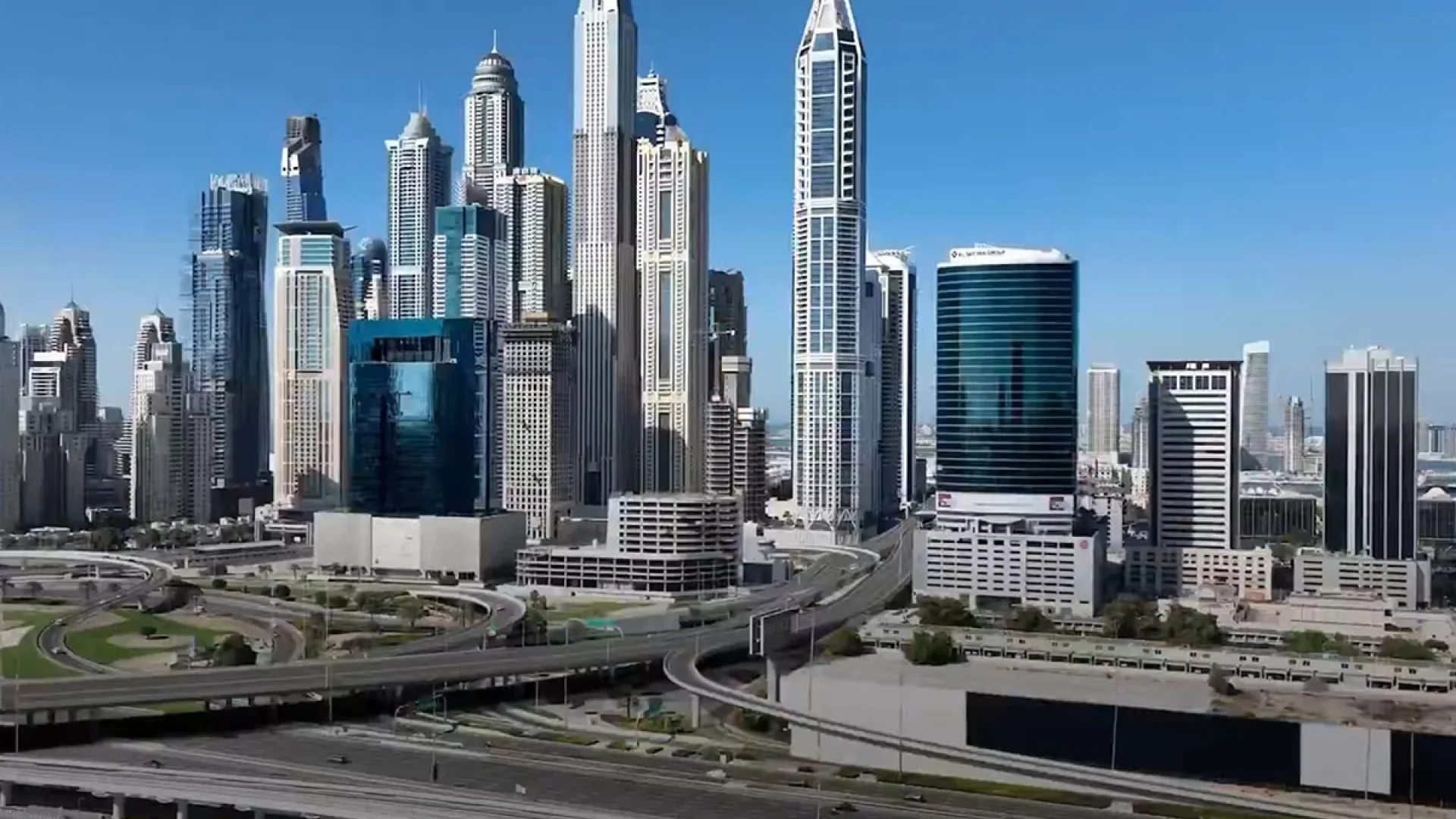

On the hottest stretch of midday asphalt—where brake lights ripple like a red tide—Dubai is moving to loosen its tightest traffic knots with a roads and traffic project package worth about $544 million. The plan brings a cluster of upgrades—new links, bridges, intersection redesigns and improved access points—aimed at smoothing flow through high-demand areas and cutting daily journey times. It’s not one headline-grabbing mega-road, but a targeted set of fixes designed to make the city’s mobility feel more predictable, safer and faster. For a metropolis still expanding in every direction, this is infrastructure as a promise: arrive on time, more often.
The heat in Dubai doesn’t sit politely in the air—it presses down. At noon, the road surface looks almost liquid, and the city’s soundtrack turns metallic: tires hiss, engines hum, and somewhere ahead a chorus of brake lights flickers on like a warning flare.
Under a flyover, a maintenance truck idles with amber lights ticking. Two workers in reflective vests stand near a barrier, talking in short bursts—half words, half hand signals. One points toward an on-ramp where cars bunch up as if the lane itself has narrowed from stress.
“This is where it starts,” a taxi driver says, nodding at the tangle. “You lose thirty seconds here… and suddenly you’re late everywhere.” He doesn’t sound angry. He sounds resigned—the way commuters do when a city moves faster than its own arteries.
Dubai’s answer is a broad, practical push: a $544 million roads and traffic project package designed to ease congestion, improve traffic flow and reduce pressure at key bottlenecks. Think of it less as a single monumental ribbon of asphalt, and more as a toolkit—bridges, new connections, intersection upgrades, access improvements—applied where the city feels tightest.
Traffic rarely fails because there are “too many cars” in the abstract. It fails in specific places: the short on-ramp that doesn’t give drivers time to merge; the exit that spills too close to a signal; the intersection designed for yesterday’s volumes; the new neighborhood that suddenly pours thousands of extra trips into an older grid.
Dubai’s $544m program targets those friction points. By separating conflicting flows with bridges and flyovers. By redesigning junctions so turning movements don’t choke the straight-through lanes. By creating new links that offer alternatives—so one overloaded corridor doesn’t dictate the tempo of an entire district.
It’s the urban equivalent of tuning an engine: you don’t replace the whole car. You fix what’s making it hesitate.
In Dubai, minutes matter. A ten-minute delay can mean a missed school drop-off slot, a late meeting, a longer queue at a parking ramp, a transfer that becomes a sprint. Multiply that by thousands of people across the day, and congestion becomes more than an inconvenience—it becomes an economic drag and a quality-of-life tax.
That’s why these projects are framed around improving journey times and raising network efficiency. The goal isn’t just speed for speed’s sake; it’s reliability. The feeling that you can leave at 8:10 and still arrive at 8:40, not 9:05.
The package brings a set of infrastructure interventions typically centered on busy corridors and high-demand nodes. While each component is engineered for its exact location, the logic is consistent: remove choke points, add capacity where it’s structurally needed, and make access smoother so queues don’t “spill back” and paralyze surrounding streets.
From the driver’s seat, these changes can feel small—an extra lane here, a reworked slip road there. But small geometry changes have outsized effects. A longer merge lane can reduce sudden braking. A rebalanced junction can keep a queue from reaching the mainline. A new link road can siphon off local traffic that never needed to be on the primary corridor in the first place.
Some cities apologize for construction. Dubai wears it like a badge. There’s a confidence to the way cranes stand in the skyline and barriers line the shoulders: a public acknowledgement that the city is still becoming itself.
But there’s also a quiet pragmatism in choosing a package approach. A single mega-project can be transformative, yes—but it can also concentrate disruption in one place. A distributed set of upgrades spreads the benefits and lets planners go after the most stubborn pinch points with surgical precision.
And because Dubai’s growth isn’t limited to one district, its traffic solutions can’t be either. New homes, new offices, new tourism zones—each generates movement. Roads are the hidden framework that makes that movement possible.
There’s a particular moment on any commute when stress spikes: you see the brake lights ahead bloom into a solid red band, and you already know—before you slow down—that you’ll pay for it in minutes you can’t get back.
Infrastructure investment tries to remove that moment. Or at least push it farther away. It’s not glamorous, not in the way a record-breaking tower is glamorous. But it’s intimate. It touches your day. It changes how your city feels.
“If the road flows,” the taxi driver says, easing into a clearer lane, “you don’t even notice.” He pauses, then adds, “That’s the best kind of upgrade.”
In Dubai, accessibility is value. Not theoretical access—the “10 minutes away” on a brochure—but real-world travel time at peak hours. When road projects reduce bottlenecks, they effectively pull locations closer together, shrinking the city in practical terms. That can lift rental demand, strengthen tenant retention, and improve the performance story for both residential and commercial assets.
Investor takeaway: Track which corridors and nodes are being upgraded, then compare peak-hour travel times—not distances—to major employment centers and lifestyle anchors. In Dubai, one redesigned junction can change the investment logic of an entire micro-market.