
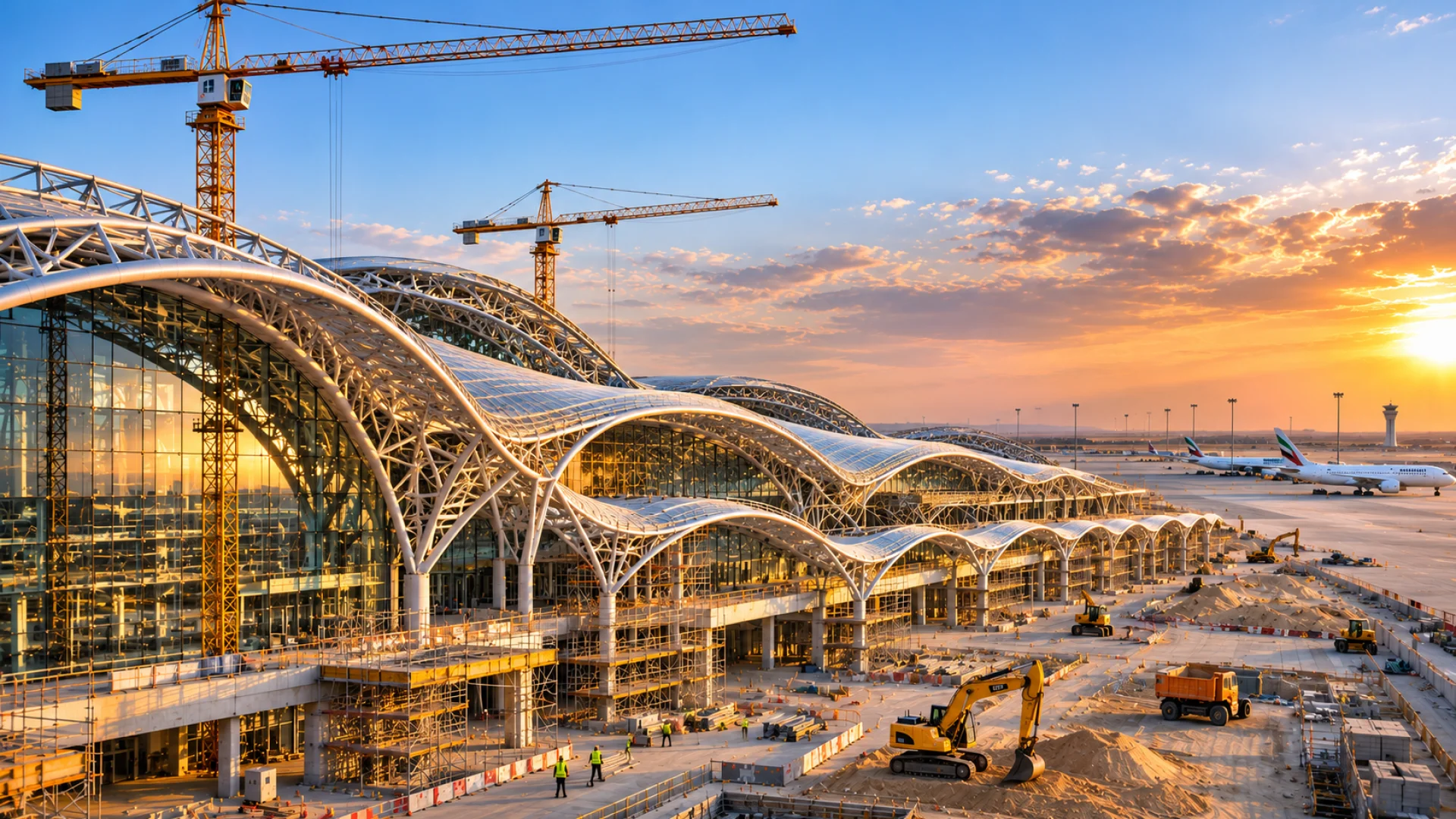

Dubai is accelerating its next chapter of growth with the award of contracts valued at approximately AED 5 billion. The infrastructure and transport projects are designed to improve mobility, connect emerging districts and support the emirate’s long-term development strategy. Behind the headline figure is a practical promise: smoother journeys, stronger links and a city prepared for its next wave of expansion.
The road is already moving before the first new lane opens. In Dubai, growth can be seen in the smallest details: a tower rising behind a low-rise neighbourhood, a temporary diversion beside a construction site, a new cluster of cranes appearing beyond the skyline. The city may look complete from a distance, but at street level it is constantly being redesigned.
Hamdan bin Mohammed bin Rashid Al Maktoum, Crown Prince of Dubai and Chairman of the Dubai Executive Council, has announced the award of contracts worth approximately AED 5 billion for infrastructure and transport projects. The programme is intended to strengthen the city’s networks, improve access to developing areas and support Dubai’s ambitions as a global centre for business, tourism, logistics and innovation.
The number is striking. The effect, however, will be measured in everyday moments. A journey that takes fewer minutes. A new neighbourhood that feels connected rather than distant. A bus route that becomes more reliable. A logistics vehicle that reaches its destination without losing time in a bottleneck. Infrastructure rarely makes the headlines after completion, but it shapes how a city is experienced every day.
Dubai’s development model is built around anticipation. Roads and services must often be planned before the buildings they will eventually serve are visible. An empty plot can become a residential district, a business hub or a mixed-use destination within a remarkably short period. If the transport network arrives late, congestion follows. If it arrives early and is integrated properly, the new district has a stronger start.
The newly awarded contracts are part of that forward-looking approach. They focus on the systems that allow urban growth to function: road capacity, connections between districts and the relationship between private vehicles and public transport. The aim is not simply to build more asphalt. It is to create clearer, more efficient movement through a rapidly changing metropolitan landscape.
At a busy junction, planning becomes personal. A missed signal can add ten minutes. A missing connection can turn a short trip into a long detour. A new road can change which areas are convenient for families, companies and visitors. What appears on a technical drawing eventually becomes part of someone’s daily routine.
The programme is expected to contribute to several priorities:
These are familiar goals in any major city. Dubai, however, faces them at an exceptional pace. Its urban edge keeps moving. New employment centres appear alongside new homes. Tourism districts, logistics zones and residential communities must share the same transport system. Every new connection therefore has a wider effect than the length of the road itself.
Walk beside a major construction zone and the future feels surprisingly physical. There is the metallic clatter of equipment, the sharp smell of hot dust and the brief pause when a worker checks a plan before directing a vehicle through. Nothing looks polished yet. But the outline of tomorrow is already there.
The announced contracts support Dubai’s broader vision of a connected, competitive and liveable city. Landmark buildings may define the skyline, but the invisible architecture beneath and between them determines whether the city works. Utilities, road systems, intersections, pedestrian routes and public transport links form the underlying structure of urban life.
That structure matters for residents and visitors alike. A city can offer spectacular destinations, but its reputation is also shaped by the ease of reaching them. From the airport to a hotel, from a business district to a residential community, from a warehouse to a port, every journey becomes part of the Dubai experience.
For businesses, connectivity is a competitive advantage. Offices with reliable access attract talent. Retail destinations benefit from stronger footfall. Industrial and logistics facilities depend on efficient links to major routes. Residential developments gain appeal when schools, workplaces, services and public transport are within practical reach.
That is why infrastructure investment has an effect far beyond traffic. It supports productivity, helps businesses plan and can open new areas to development. It also gives investors greater confidence that today’s emerging district will remain connected as the city expands around it.
Dubai’s latest package arrives as the emirate continues to prepare for further growth. Population, tourism, trade and investment all place pressure on transport systems. The decision to invest at scale reflects a simple calculation: the cost of preparing early is often lower than the cost of trying to repair a network after growth has already arrived.
The announcement is the starting line, not the finish. Plans must become designs, designs must become construction phases and construction must eventually become infrastructure that people can use safely and comfortably. Delivery, coordination and integration will determine how strongly the projects are felt on the ground.
There will be dust before there is convenience. Temporary diversions before smoother journeys. Noise before the quiet efficiency of a completed route. That is the familiar rhythm of a city building its future while remaining fully operational in the present.
When the work is complete, few people may remember the contract announcement. They will simply notice that a trip is easier, a district is closer or a road no longer feels stretched beyond its limits. That is the quiet success of infrastructure: it disappears into the rhythm of urban life.
Infrastructure is one of the most important long-term drivers of real estate value. Better roads and public transport can improve the accessibility of residential communities, offices, retail destinations and logistics hubs. They can also shift attention towards emerging districts that previously appeared peripheral.
For property investors, the key question is not only what is being built inside a project, but what is being built around it. Access to major corridors, public transport, schools, employment centres and everyday services can strengthen a location’s practical appeal. Improved connectivity may support demand from both residents and businesses, although the impact will vary by district and project quality.
Developers, meanwhile, gain a clearer framework for planning future communities. A well-connected district can offer stronger fundamentals for mixed-use development, rental housing and commercial activity. The AED 5 billion programme therefore represents more than a transport commitment. It is also an investment in the spatial structure of Dubai’s next real estate cycle.
Ultimately, the announcement is about links: between homes and jobs, airports and hotels, new districts and established centres, today’s city and tomorrow’s opportunities. Dubai is not only adding infrastructure. It is reinforcing the network that turns rapid expansion into a coherent urban future.