
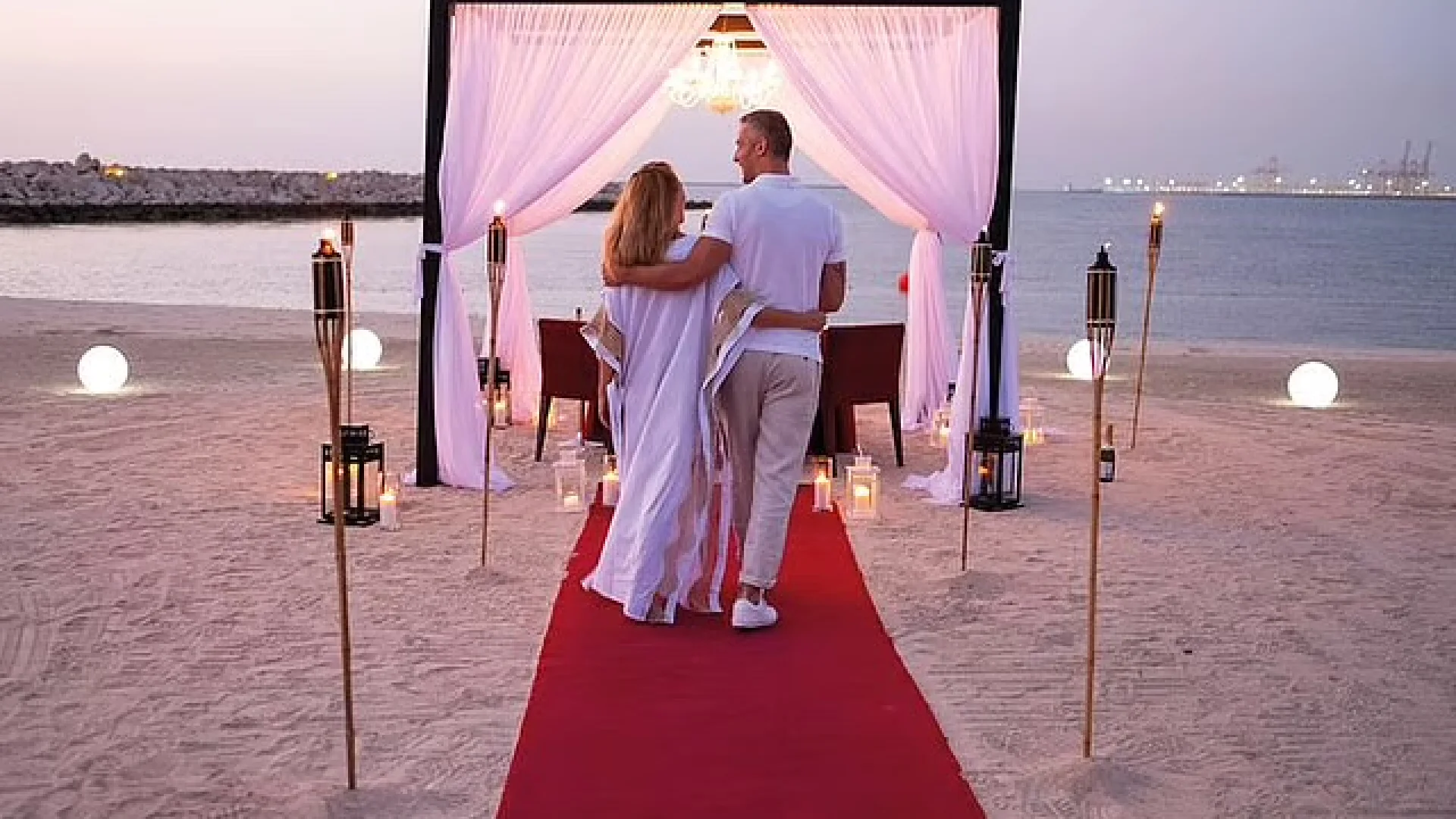
In Dubai, Valentine’s Day isn’t just a date on the calendar—it’s a spectacle with a budget line. Gulf News spotlights what roughly Dh500,000 can buy when romance meets the city’s supercharged luxury machine: a Rolls‑Royce-style grand entrance, diamond jewellery that speaks in carats, and a private yacht drifting past a neon-lit skyline. It’s not only about objects, but about orchestration—chauffeurs, reservations, curated surprises and that perfectly timed reveal. The result is a portrait of Dubai’s experience economy, where love is packaged as an unforgettable scene—and where high spending ripples into hospitality, retail and the prime property districts that host it all.
The car doesn’t roar. It arrives like a secret.
Outside a hotel entrance polished to a mirror sheen, a Rolls‑Royce glides into the drop-off lane as if the city itself has lowered its voice. A valet steps forward. A door opens with slow certainty. For a second, the night feels staged—because in Dubai, on Valentine’s Day, it often is.
Some places do romance with handwritten notes and a single rose. Dubai does it with choreography. You can feel it in the lobby air—cool, perfumed, faintly electric—where couples move like they’re following cues only they can hear. A phone buzzes. A concierge nods. An elevator dings. And somewhere in the background, a jeweller’s lights sparkle as if they’ve been waiting for this exact moment all year.
We capture the mood by asking a deliciously Dubai question: what does Dh500,000 get you for Valentine’s Day? The answer reads less like a shopping list and more like a film treatment—luxury wheels, diamond statements, private yacht time, and the kind of curated service that turns a simple “I love you” into a scene you can step into.
Start with the entrance. Because in Dubai, the entrance matters.
There’s a particular kind of silence inside an ultra-luxury car—soft leather, gentle suspension, the outside world muted into a moving postcard. Whether it’s a Rolls‑Royce booked for the night or a similar top-tier chauffeur-driven experience, the point isn’t just transport. It’s transformation. You leave ordinary behind at the curb and arrive as the version of yourself that belongs under crystal lights.
“Where to?” the driver asks, voice low, as if loudness would crease the moment.
And that’s the Dubai difference the article hints at: the city’s luxury ecosystem isn’t built only to sell things. It’s built to make moments happen—smoothly, quickly, and with maximum visual impact.
Then comes the jewellery. The pause before it. The weight of it in a pocket. The way a hand reaches for a bag, then stops, then tries again.
In Dubai, diamonds are not just decoration; they’re a language. Carats and clarity do the talking when words feel too thin. A diamond ring, a statement necklace, a bracelet that catches every stray beam of candlelight—within a Dh500,000 Valentine’s budget, the article points to high-end pieces that don’t merely sparkle, they announce.
“Open it,” one partner says—softly, urgently.
The lid lifts. A tiny click. The table disappears for a second. There are only eyes and light and that ridiculous, wonderful rush of meaning we attach to things that last.
Dubai’s luxury retail has mastered this theatre. The boutiques don’t feel like stores; they feel like galleries where the items are waiting for a story to adopt them. Valentine’s is when those stories are purchased at speed.
The city looks different from the water. It always has.
You step onto a private yacht and the noise of the boulevard fades into a distant hum. A crew member smiles like they’ve been expecting you personally. Glasses clink. The marina lights tremble on the surface like spilled jewellery. Then the lines come off, and the skyline—sharp, impossible, glittering—slides into a new frame.
This is the kind of luxury the article describes as part of Dubai’s Valentine’s menu: not only buying a thing, but buying space. Privacy in a city that thrives on being seen. Time that feels insulated from the rush. A few hours where the horizon is yours.
On deck, a micro-dialogue happens in every couple, everywhere: “Is this real?” / “It is tonight.”
It’s tempting to reduce it all to numbers. Car rental. Yacht charter. Jewellery invoice. Dinner add-ons. But the more accurate description is this: Dh500,000 buys you orchestration.
Dubai’s concierge culture turns romance into a sequence you can walk through without friction. Reservations appear. Cars arrive on time. Flowers show up not as a bouquet, but as an installation. Desserts arrive with names written in chocolate. The city doesn’t just offer luxury; it offers control—the ability to dial an evening up to “unforgettable” and have the details land where they should.
And yet, the most striking part isn’t the extravagance—it’s how normal the extravagance can feel in Dubai’s February air. In a dining room where multiple tables are celebrating, where designer boxes appear like punctuation marks, the standard for “enough” shifts. Not necessarily because people are trying to compete, but because the city’s baseline is already high-gloss. Dubai is a place where the extraordinary is available on a menu, and Valentine’s is when many decide to order it.
The scene that stays with you is rarely the most expensive one.
It’s the moment in the elevator when someone checks their reflection and exhales. The pause before the ring box opens. The way warm February air brushes your wrists at the marina. The waiter leaning in—“Your table is ready”—as if announcing the next act.
Dubai’s genius, as the article suggests, is that it sells not only luxury goods but cinematic memory. The city provides the set. You bring the nerves, the hope, the person you want to impress. And for one night, it all clicks into place.
Valentine’s Day luxury at the Dh500,000 level is more than seasonal glamour—it’s a live indicator of Dubai’s high-spending visitor base and resident wealth, both of which feed directly into real estate performance. When consumers are willing to pay for premium transport, fine jewellery, private charters and curated dining, the benefits concentrate in the same districts where prime property also concentrates: waterfront marinas, iconic downtown corridors, five-star hospitality clusters and high-footfall luxury retail zones.
For real estate investors, the takeaway is strategic: Dubai’s luxury economy is not a side story—it’s an engine that reinforces the city’s global positioning, supports tourism and lifestyle migration, and helps prime submarkets outperform. Properties that sit near the city’s “experience infrastructure”—marinas, flagship retail, signature dining, and landmark attractions—or that replicate it internally through amenities and services, are often better placed to capture sustained demand and pricing power.