
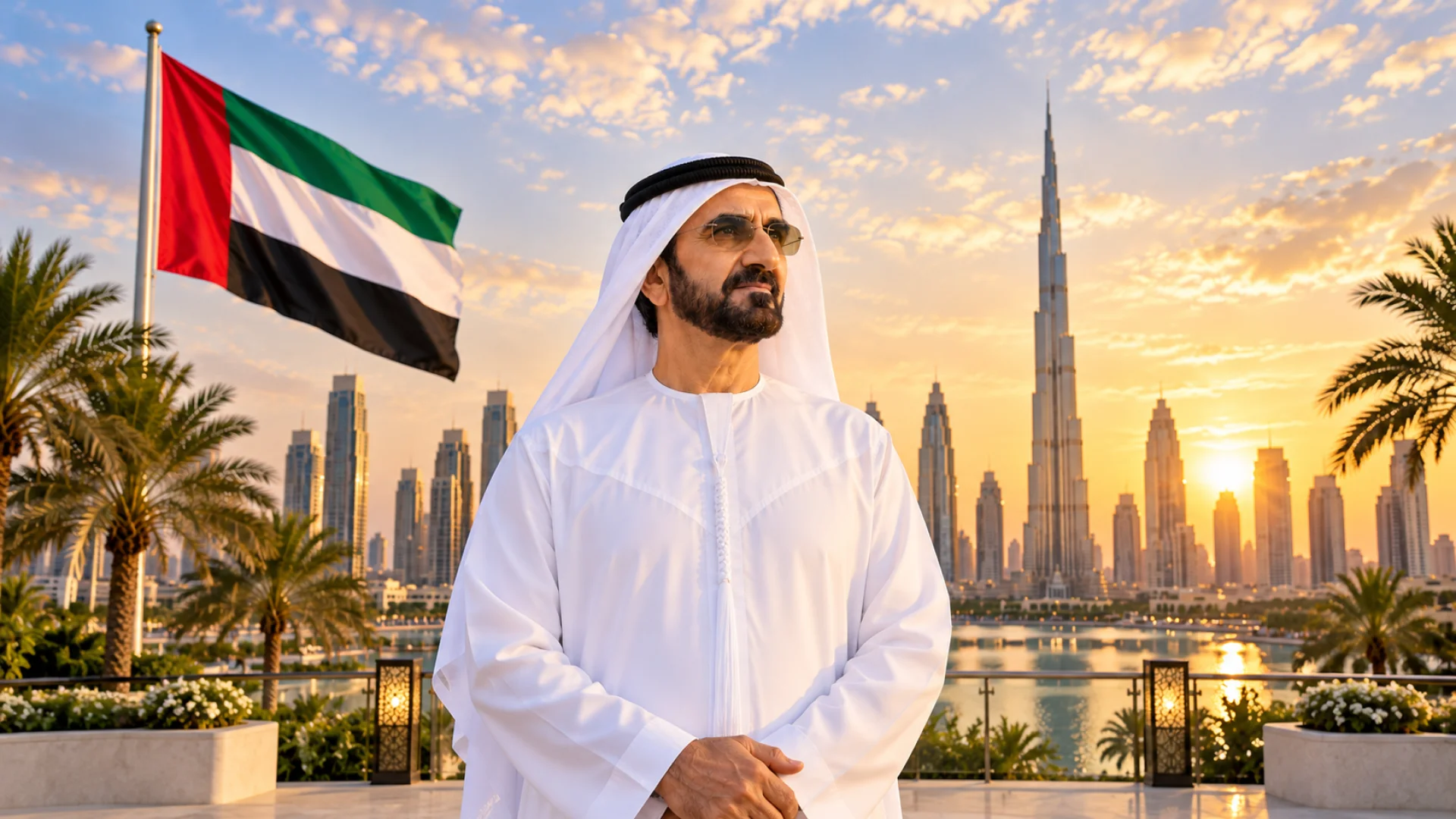

Dubai’s rise is not explained by its skyline alone. Sheikh Mohammed bin Rashid Al Maktoum presents seven principles that capture the emirate’s operating spirit: openness to people and ideas, security, speed, hard work and the conviction that the future must be built rather than awaited. Together, the rules offer a vivid portrait of why Dubai continues to attract residents, entrepreneurs, investors and visitors from across the world.
Before the heat settles over the boulevard, Dubai is already moving. A delivery van stops outside a café. A lift opens in a glass tower. Someone orders coffee in Arabic; the reply comes in English. On the road, a taxi carries a passenger from one continent toward an office built by people from several more. This is not a special event. It is simply morning in Dubai.
That daily collision of cultures, ambitions and journeys sits at the heart of Sheikh Mohammed bin Rashid Al Maktoum’s seven rules for life in the emirate. They are not framed as a legal code. They read more like a compass – a compact explanation of the attitudes that have helped Dubai turn desert, trade and ambition into a global city.
Dubai’s first defining idea is its openness. The city is built around movement: people arriving for work, companies entering new markets, families looking for opportunity and visitors passing through on their way to somewhere else. The population’s extraordinary international mix is not a footnote. It is one of the emirate’s central strengths.
Walk through a business district, a hotel kitchen or a construction site and the principle becomes tangible. Different languages overlap. Skills travel across borders. Professional networks form quickly. Dubai’s message is direct: people should be judged by what they can create and contribute, not only by where they began.
Openness also applies to ideas, trade and investment. Dubai has long positioned itself as a meeting place between regions. Its ports, airports, free zones and digital infrastructure turn geography into an advantage. A visitor may arrive for a conference and leave with a business partner. A small company may enter through a free zone and reach customers far beyond the Gulf.
In this city, a chance encounter can have consequences. A conversation over coffee becomes a proposal. A proposal becomes a pilot project. The next meeting happens in another tower, another neighbourhood, perhaps another country. Dubai’s openness is active, not passive: it creates conditions for connections to become momentum.
Ambition needs a firm floor beneath it. That floor is security. Residents need to feel comfortable moving through the city. Families need confidence in their neighbourhoods. Businesses need predictable conditions in which they can plan, hire and invest.
Security in Dubai is experienced through ordinary details: connected roads, efficient public services, modern airports, digital government and the sense that major plans will actually be pursued. The result is a form of confidence that allows people to take risks elsewhere – in their businesses, careers and investments.
Dubai has made a habit of challenging the first answer. Islands have been created where there was water. A metro has crossed the desert city. Towers have climbed higher, districts have expanded and large stretches of sand have become destinations, workplaces and homes.
The point is not that every dream arrives easily. Ambition requires engineering, finance, patience and a willingness to solve difficult problems repeatedly. But the city’s instinct is to ask how a goal might be achieved before deciding that it cannot be. In Dubai, the word impossible often sounds less like a warning than the beginning of a conversation.
Dubai does not like standing still. Plans move from drawing board to construction site, from pilot programme to public service, at a pace that can feel startling to newcomers. The city treats infrastructure as a living system. Roads, airports, districts and digital platforms are upgraded because the next stage is already being considered.
That speed creates opportunity and pressure in equal measure. Businesses must adapt quickly. Professionals must keep learning. Developers must anticipate how people will live, work and move tomorrow. Dubai’s competitive edge is therefore not only what it has built, but how quickly it is prepared to build the next thing.
Vision alone does not create a city. Results do. Behind every illuminated façade are thousands of workers: engineers checking a structure, cleaners preparing a hotel, teachers opening classrooms, programmers refining an application, drivers keeping the city connected.
This emphasis on effort and delivery is central to Dubai’s story. Entrepreneurship is valued because it can generate jobs, services and new solutions. Achievement is not presented merely as personal success; it is expected to add something to the wider city. The skyline is the visible layer. The real engine is the work beneath it.
The seventh rule brings the others together. Dubai does not want to wait for change and then respond. It wants to anticipate it. Artificial intelligence, renewable energy, smart mobility, healthcare, education and digital government all form part of that forward-looking agenda.
At the edge of the city, the symbolism is especially strong. Solar fields, research facilities and new communities emerge where the horizon once seemed empty. Dubai’s message is unmistakable: a future is not a distant destination. It is a project, and projects require decisions today.
Together, the seven rules describe a city that prizes openness without losing direction, ambition without abandoning discipline, and speed without forgetting long-term goals. They explain why Dubai appeals to people seeking a fresh start, companies seeking a regional base and investors seeking a market with international demand.
As evening arrives, the towers light up one by one. Traffic becomes a ribbon of red and white. On a terrace overlooking Downtown, a visitor watches the scene and says, “It feels as if the city is still being built.” That may be Dubai’s most accurate rule of all. Change is not treated as an interruption here. It is treated as everyday life.
These principles have a direct relationship with property. International openness supports demand from residents, professionals, visitors and global companies. Security and infrastructure strengthen confidence in both residential and commercial assets. Speed and future planning create new investment zones as transport links, business districts and community amenities expand.
For investors, the lesson is to look beyond the most recognisable tower. The stronger question is how a location fits into Dubai’s next phase: Is it connected? Does it serve a growing population? Will it benefit from new employment hubs, mobility projects or lifestyle amenities? Properties aligned with these wider forces may be better positioned than those relying on appearance alone.
Dubai’s seven rules therefore function as more than a civic message. They form a lens through which the real estate market can be read – as a story of people, infrastructure, confidence and continuous reinvention.