
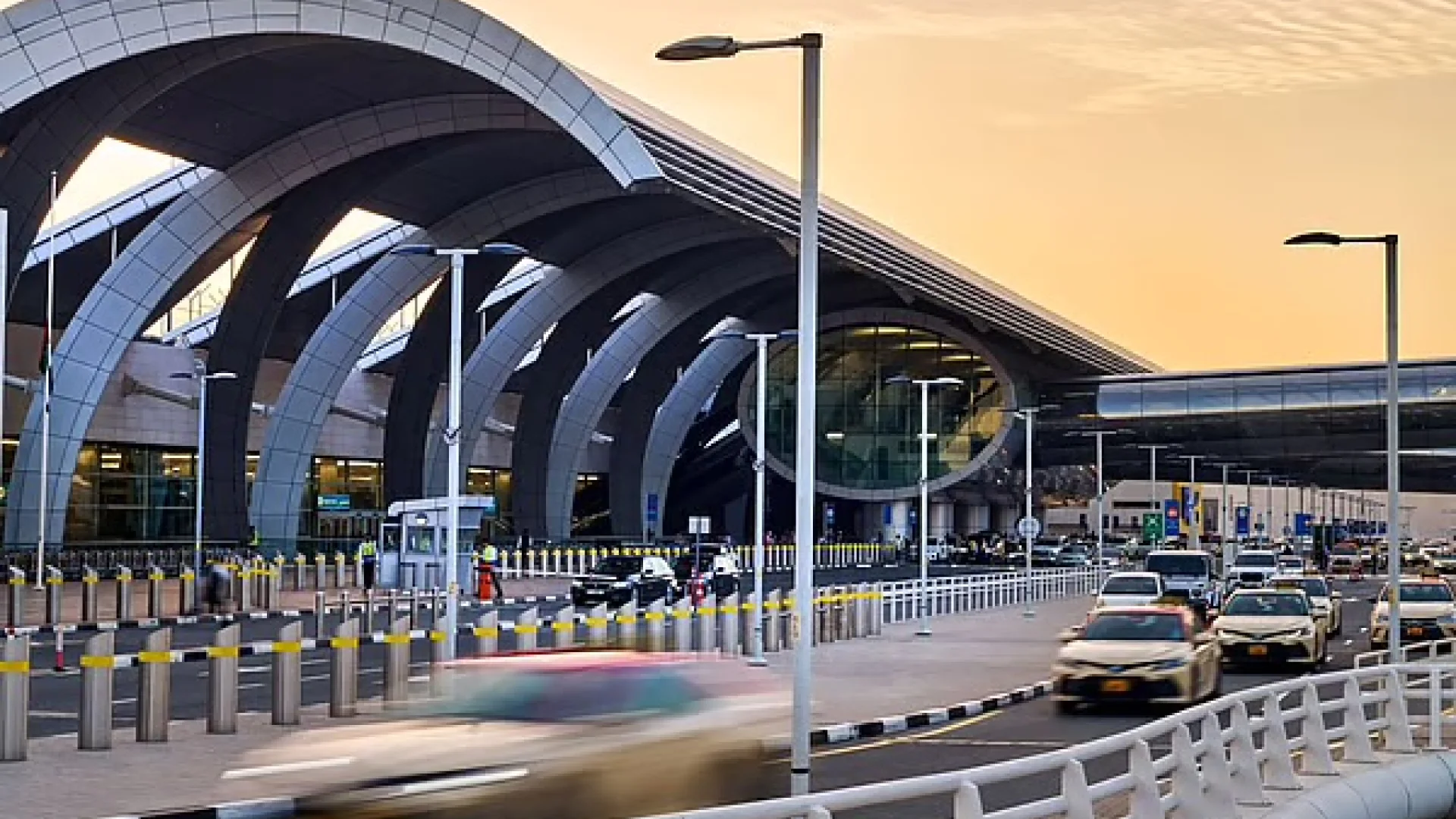

Before the city fully wakes, DXB is already roaring—jet engines, rolling suitcases, and boarding calls stitching continents together. New 2025 schedule data puts that daily rush into a single headline number: 62.4 million international seats, keeping Dubai International (DXB) the world’s busiest airport for international capacity. London Heathrow follows with 51.5 million seats, narrowly edged by Singapore Changi at 51.4 million in a near tie for second. The rankings underline how the Gulf and Asia continue to shape global connectivity—and why airport capacity is increasingly a proxy for investment gravity in the city around it.
The day at DXB doesn’t begin with sunrise. It begins with sound.
A low, confident rumble rolls through the terminal glass as the first long-haul departures line up outside—widebodies blinking, tug vehicles darting like small fish around whales. Inside, coffee hits the air. Perfume trails follow hurried footsteps. A suitcase wheel clicks once, twice, then finds rhythm. “Which gate?” a man asks, breathless, phone in one hand, passport in the other. “A… something,” his partner says, laughing at the absurdity of living by letters and numbers.
This is what global connectivity looks like when it’s not a chart. It’s a scene. And in 2025, the scene has a statistic big enough to match its scale: 62.4 million international seats scheduled through Dubai International (DXB)—the figure that keeps Dubai in the #1 position as the world’s busiest international airport by capacity.
“International seats” sounds clinical until you watch a boarding area fill like a tide. It’s not just how many flights exist; it’s how much room there is for the world to move—how many people can realistically be carried, routed, connected. Airlines don’t publish those seat counts as poetry. They publish them because they intend to sell them. And in 2025, the intent is loud: DXB remains the planet’s most packed gateway for international travel.
Behind Dubai, the chase is tight at the top. London Heathrow (LHR) is listed with 51.5 million international seats. Singapore Changi (SIN) follows with 51.4 million. Second and third are separated by the kind of margin that feels like a single delayed turnaround—or one more daily frequency to a high-demand route.
At DXB, the choreography is the message. The airport is built around the idea that you are almost never finished here—you are in transit, even when Dubai is your final stop. Screens glow with a constant promise of onward motion: Muscat, Mumbai, Milan, Manila. A family clusters around a carry-on like it’s a campfire. Two consultants compare calendars. “Fifty-five minutes,” one says, eyes widening at the connection time. “We’ll make it,” the other replies, already walking.
Dubai’s advantage is part geography, part strategy, part infrastructure. As a hub, it sits in an enviable position between Europe, Asia, and Africa, enabling airline networks to stitch together far-flung city pairs efficiently. Add to that a decades-long focus on international traffic and a hub model that prioritizes connectivity, and the result is resilience: DXB continues to concentrate global flows even as aviation shifts around it.
Heathrow is the heavyweight with a crowded ring. Demand is immense, yield is premium, and the airport remains a critical node for transatlantic and global business travel. But Heathrow also carries the unmistakable feel of constraint—slots, capacity debates, and the constant art of doing more with less space.
Changi, by contrast, feels like the future wearing a calm expression. It is designed to make travel feel smooth, even delightful—an airport that behaves like a city lounge. The fact that Singapore’s international seat capacity in 2025 sits just a fraction behind Heathrow signals something broader: Asia’s hubs are not merely growing; they are consolidating status as global organizers of traffic.
Read the rankings as a travel diary and a new map appears. The Gulf is no longer a stopover story—it is a main character. Asia isn’t simply “recovering”; it is shaping the cadence of international movement. Europe remains powerful, but its biggest airports increasingly operate as mature systems balancing demand with limits.
And the implications aren’t abstract. Seat capacity translates into choices made every day by airlines, businesses, and travelers:
Near a window, a teenager watches the apron like it’s a live-stream. A pilot walks past, uniform crisp, pulling a small suitcase that looks identical to a hundred others. A child presses fingers to the glass. “Is that ours?” he asks. “Yes,” his mother says softly. The child’s face changes—fear, wonder, pride, all at once.
Multiply that moment by millions and you begin to understand why 62.4 million matters. It isn’t just the sum of seats. It’s the sum of reasons: reunions, contracts, holidays, hospital visits, graduations, conferences, relocations—life events compressed into boarding passes.
Airports are often described as infrastructure. But the biggest ones behave more like operating systems for entire regions. High international capacity increases a city’s “reachable market” in hours, not days. It makes same-week meetings realistic. It turns weekend tourism into a scalable industry. It supports supply chains that rely on speed and certainty. And it attracts the kind of businesses that choose places where the world feels close.
DXB topping the international capacity chart again in 2025 is, therefore, not only a travel headline. It’s a statement about Dubai’s role as a global convening point—and about the Gulf’s continued confidence in building and maintaining the connections that modern economies depend on.
For real estate investors, DXB’s 62.4 million international seats is a demand indicator disguised as an aviation metric. High, sustained connectivity typically correlates with deeper, more diversified real estate demand—because people don’t just fly in and out; they sleep, meet, shop, hire, ship, and sometimes decide to stay.
Hospitality and short-stay living: A dominant international hub feeds multiple layers of hotel demand: stopovers, airline crews, corporate travel, MICE events, and “bleisure” stays that blend work and leisure. Assets that combine strong transport access with flexible room/apartment inventory—hotels, branded residences with rental programs, serviced apartments—often benefit from this steady churn of arrivals.
Office and mixed-use districts: International seat capacity supports the case for regional HQs and project teams based in Dubai. When executives can reach three continents efficiently, face-to-face becomes less expensive in time. Mixed-use neighborhoods near major transit corridors can capture both daytime business energy and evening lifestyle spending, reinforcing footfall for retail and F&B.
Logistics and light industrial: While the ranking is about passenger seats, hub airports frequently catalyze logistics ecosystems—couriers, time-sensitive supply chains, and last-mile distribution. Investors tracking industrial and flex space should watch for “airport city” spillover effects: rising land values, tighter availability, and premium pricing for well-connected warehouses and light-manufacturing units.
Residential rentals: Large hubs attract and retain international workforces across aviation, hospitality, retail, tech, and professional services. That can underpin demand for rental apartments in well-connected areas—especially turnkey units that match international tenant expectations on amenities, mobility, and service.
What to monitor: Seat capacity is planned, not guaranteed. Investors should track route stability over multiple quarters, shifts in airline network strategies, macroeconomic headwinds, and any redistribution of traffic driven by new infrastructure. Still, DXB’s repeat leadership suggests structural strength in Dubai’s connectivity—supportive for long-term strategies in hospitality, mixed-use, and income-focused residential assets.