
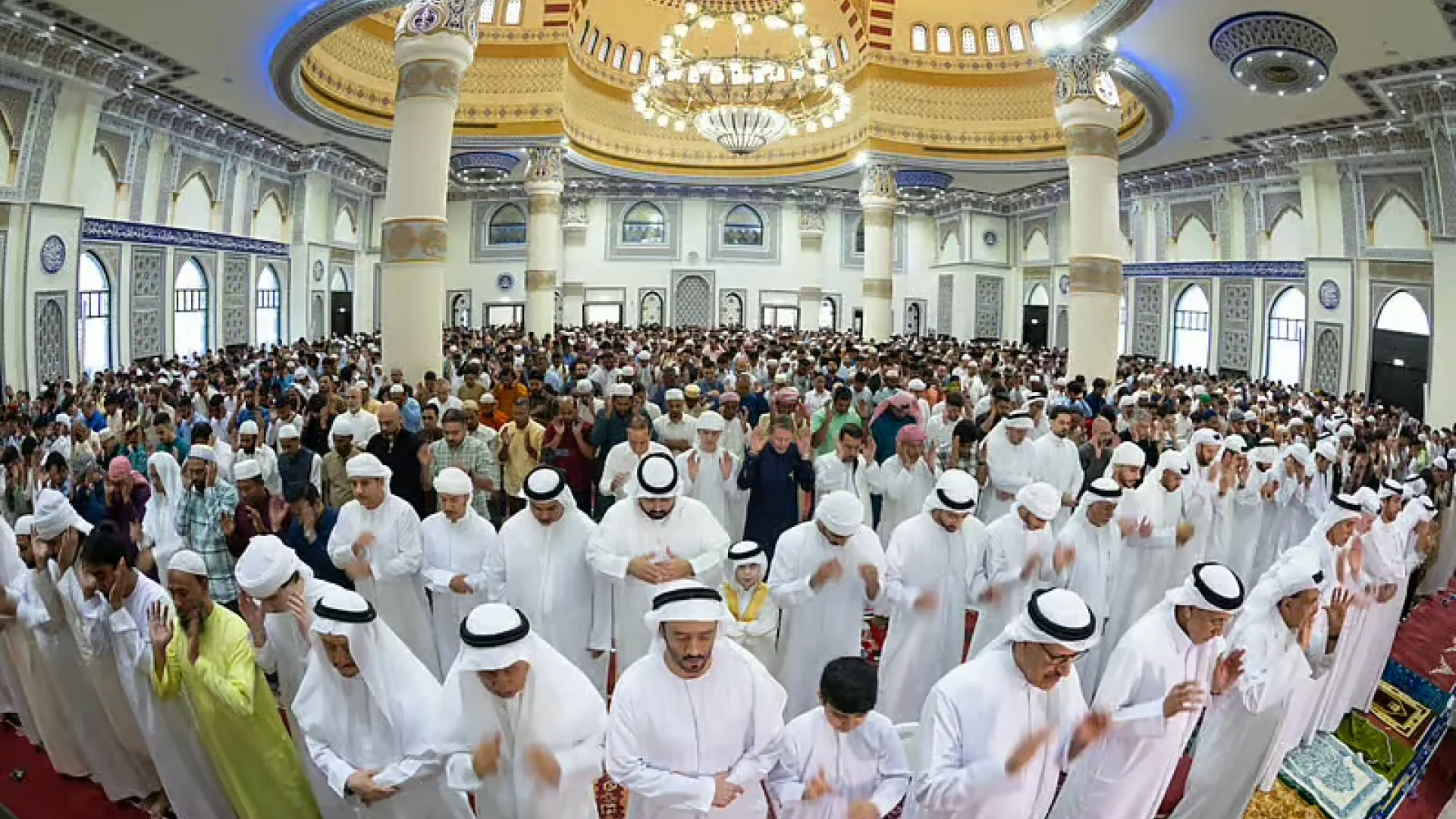
Before the sun clears the skyline, the UAE is already on its feet: thousands move toward mosques and designated prayer grounds for Eid Al Adha 2026. Families arrive in crisp kanduras and abayas, children clutch water bottles, volunteers guide rows into perfect lines—then the takbir rises and the crowd becomes one voice. The morning is both intimate and immense, spilling from worship into embraces, visits, charity, and the day’s tradition of sacrifice and sharing. The scale of attendance reveals not only devotion, but a country skilled at turning peak moments into calm, well-run public life.
The city looks different when it wakes for Eid.
Streetlights still glow like tired stars. The air carries that early warmth that belongs to the Gulf—soft, persistent, already promising heat later. And yet the sidewalks are busy. Not the rushed kind of busy. The purposeful kind. A father tightens his grip on a small hand. “Come on,” he murmurs, half to the child, half to himself. “We’ll miss the front rows.”
It’s Eid Al Adha 2026 in the United Arab Emirates, and the day begins the way it has for generations: with people moving together toward prayer. Thousands gather at mosques and at designated prayer grounds, filling courtyards, parking lots, and open-air spaces that, for this one morning, become vast, temporary sanctuaries. The scene is big enough to feel cinematic—yet close enough to catch the small details: a sandal adjusted, a scarf pinned, a whispered reminder to silence a phone.
From a distance, the rows look like patterns—human geometry. Up close, they’re made of individual stories. A young man smoothing the edge of his prayer mat. An older neighbor leaning on a cane, eyes bright, insisting he’s fine. Two friends exchanging a quick greeting, then stepping apart into their places with the practiced respect of people who know exactly what this moment asks of them.
Volunteers and mosque staff move along the edges, guiding the flow. “This way, brother.” “Please keep the aisle clear.” Their voices are calm, almost gentle. It’s the kind of organization you don’t notice until you imagine the alternative. The UAE has become adept at managing large gatherings—major events, busy weekends, holiday peaks. But Eid has its own texture. It’s not about spectacle. It’s about belonging.
And then, somewhere in the front, hands lift. The takbir begins. The words travel fast, wave after wave. A boy tries to follow, slightly out of sync, watching his mother’s lips for cues. She doesn’t correct him. She just nods—an invisible reassurance that learning is part of the prayer too.
The original report describes thousands gathering across the UAE for Eid Al Adha 2026 prayers, at mosques and designated prayer grounds. The scale matters because it changes the atmosphere of whole neighborhoods: roads temporarily quieter, then suddenly crowded; parking lots full before sunrise; the usual weekday rhythm replaced by a shared schedule written in faith.
Yet the most striking part isn’t the number. It’s the softness that sits inside it.
There are micro-dialogues everywhere—short sentences, familiar as family photos. “Did you call your dad?” “He’s already on the way.” “After this, we go to my sister’s.” “Don’t forget the sweets.” A teenager lifts his phone for a quick sky shot, the pale blue stretching wider each minute. His sister taps his arm. “Later.” He slips it away without argument, like he’s been waiting for permission to be fully present.
When the prayer ends, the crowd doesn’t explode into noise. It exhales. People turn to each other with the warmth that makes Eid feel like a doorway between private life and public space. “Eid Mubarak.” A hand to the heart. A quick embrace. An older man holds a younger one by the shoulders for an extra second, as if to check—wordlessly—that he’s doing okay.
This is where the morning shifts from worship to celebration, from rows to circles. Families begin to regroup. Someone calls out a name across the crowd and laughs when a cousin answers from two rows away. Children, freed from the stillness of prayer, bounce back into motion. The city wakes fully now, and it wakes smiling.
Eid Al Adha carries a deep theme of sacrifice and sharing. For many households, the hours after prayer are filled with practical plans that feel almost ceremonial in their own way: visiting relatives, preparing meals, distributing gifts, and giving to those in need. In kitchens, spices bloom in hot oil. In living rooms, trays appear—dates, coffee, sweets—because hospitality on Eid is not an accessory; it’s the main language.
Outside, you can read the day through movement. Cars roll out of neighborhoods in small convoys. Elevators in residential towers run nonstop. Lobbies fill with people carrying neatly wrapped boxes, the kind that say, without words: I thought of you.
Big public moments reveal what a place is made of. Eid prayers in the UAE show a society that can scale intimacy. That sounds contradictory until you’ve seen it: thousands standing shoulder to shoulder, yet the experience feels grounded—almost quiet—because everyone knows their part.
There’s also something uniquely urban about it. Designated prayer grounds don’t appear by accident; they are a planning choice. They signal an understanding that faith is not separate from city life but woven into it. On Eid morning, open spaces become sacred. Traffic patterns become choreography. And the skyline—glass, steel, neon—serves as a backdrop to an ancient rhythm of words.
For real estate investors and developers, Eid Al Adha is more than a holiday—it’s an annual “live test” of neighborhood design, mobility, and community infrastructure. When thousands converge on mosques and prayer grounds before sunrise, the built environment either absorbs the demand smoothly or exposes friction points. That has measurable implications for tenant satisfaction, asset reputation, and, ultimately, pricing power.
1) Micro-location premiums: walkability to mosques and community amenities. In many UAE residential markets, proximity to mosques and community facilities is a consistent preference driver, especially for family-oriented segments. Assets that offer safe pedestrian routes, shaded sidewalks, clear crossings, and short walking distances can command stronger demand and reduce vacancy risk—particularly in master-planned communities where lifestyle positioning matters.
2) Retail footfall and seasonal resilience. Eid periods typically boost neighborhood retail: groceries, bakeries, sweet shops, florists, gifting, and casual dining. For investors in community centers and ground-floor retail, a well-curated tenant mix aligned with seasonal peaks can improve sales performance and support rent sustainability. Locations near mosques and prayer grounds often benefit from predictable spikes in foot traffic.
3) Operations matter: traffic, parking, and crowd management. Eid exposes how well a property’s access and circulation work under peak load. Mixed-use assets and large residential communities can protect long-term value by planning “event-mode” operations—temporary drop-off zones, additional security, signage, coordinated delivery windows, and resident communication. These measures reduce complaints and help maintain brand strength.
4) ESG and wellbeing: comfort in public space. Shade, water availability, seating, and barrier-free access are not just conveniences; they increasingly align with ESG and wellbeing criteria used by institutional capital and corporate tenants. Communities that invest in humane, climate-adapted public realm design can differentiate in a competitive market.
5) Development upside: flexible open spaces as community assets. The use of designated prayer grounds underlines the value of multi-functional open space—areas that can serve daily recreation and, at peak times, accommodate large gatherings. Developers who integrate flexible plazas, parks, and community hubs can strengthen placemaking narratives and support long-term absorption.
Investor takeaway: Treat Eid-driven mobility and community patterns as part of due diligence. Assets in neighborhoods that handle peak moments calmly—through walkability, operations, and thoughtful public space—often deliver more stable occupancy and more resilient cashflows.