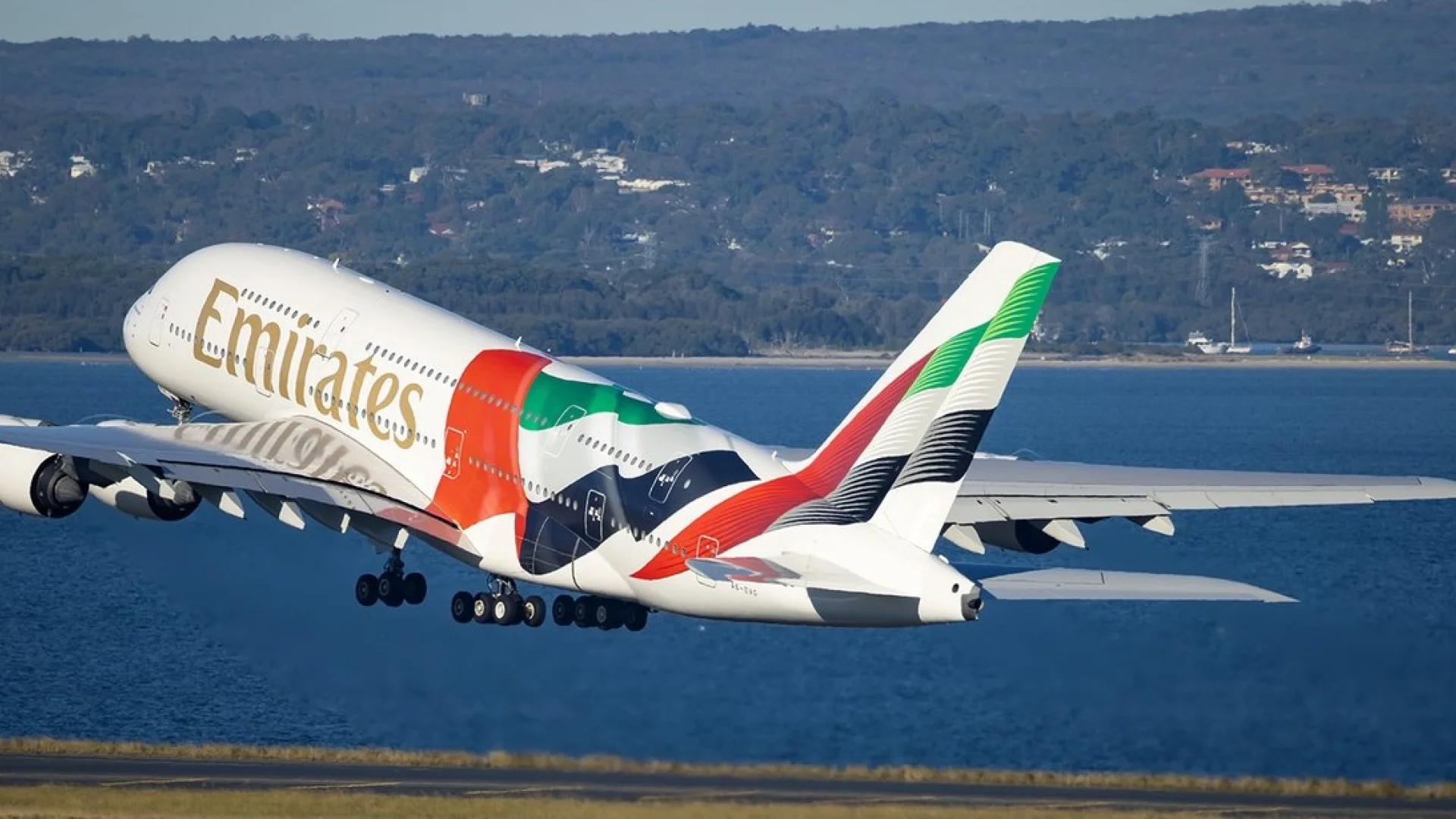
An Emirates A380 has always been impossible to ignore—but now it arrives like a national banner in motion. With a new special livery in the colors of the UAE flag and the words “Unity, Strength,” Emirates turns several of its double-deck giants into flying symbols timed around UAE National Day. The result is part celebration, part brand power move: a message that travels on one of the world’s most visible aircraft types to the very airports where global attention congregates. For passengers, it’s a window-seat moment; for the UAE, it’s a high-altitude statement of identity and confidence.
You don’t first notice it in a headline.
You notice it in the way people stop walking.
At the gate, the usual airport choreography is playing—rollers humming, boarding passes flashing, voices echoing off glass. Then the aircraft noses into view and the rhythm breaks. A double-decker silhouette, huge and slow, like a cruise ship learning to glide. But today it isn’t just the size that pulls your eyes. It’s the color.
Red. Green. White. Black. The UAE flag—stretched big across an Emirates Airbus A380 as if the sky itself has been draped for a national celebration. And there, clear enough to read from the terminal windows, two words sit like a signature: “Unity, Strength.”
Someone near me murmurs, “That’s new, right?” Another voice answers without looking away: “Yeah… that’s the UAE flag livery.” Phones rise. A kid presses their face to the glass. For a moment, the airport feels less like a transit zone and more like a viewing deck.
Emirates has introduced a new special livery on multiple A380s, wrapping the world’s most recognizable passenger giant in the colors of the UAE flag and pairing it with the slogan “Unity, Strength.” It’s timed to the spirit of UAE National Day, when the country’s streets, towers, cars, and social feeds fill with flags—symbols of federation, pride, and shared direction.
Only this flag doesn’t hang from a balcony. It lands at major global airports.
The A380 is an inspired choice for this kind of message. It’s not subtle by design. It’s the aircraft you can spot from the highway outside the airport, the one that makes other jets look like props. And for Emirates, it’s more than equipment—it’s identity. Two decks. Long-haul reach. An unmistakable silhouette that says “Dubai” before the wheels even touch the runway.
In marketing, slogans can feel weightless. In aviation, they’re harder to dismiss—because flight itself is a lesson in interdependence. An A380 doesn’t lift because one component is strong. It lifts because everything works together: engineering, maintenance, dispatch, weather, air traffic control, crew coordination, passenger flow. One weak link and the schedule collapses.
So “Unity, Strength” reads as more than patriotic poetry. It reads like a principle.
And it aligns neatly with how the UAE wants to be seen: a federation that moved quickly from desert margins to global center, stitched together by infrastructure, ambition, and a certain kind of forward momentum. Emirates, as one of the country’s most visible global brands, is a natural messenger. When its A380s wear the flag, the airline and the nation briefly become the same picture.
Airports are built to keep you moving—lines, arrows, gates, time stamps. But put something remarkable on the ramp and you get a pause. That’s what this livery does.
A pair of plane spotters stands a little apart, lenses mounted like patient instruments. “The text is huge,” one says, almost approvingly. A business traveler glances up from a laptop, and for a second their expression softens—an unguarded oh on the face, the kind you can’t fake.
It’s a reminder that travel is still emotional, even when it’s routine. That a departure can still feel like a scene instead of a task.
Part of the genius is that the message is mobile. A billboard sits in one city. An A380 crosses continents. It shows up at the airports that function like the planet’s meeting rooms—places where business, tourism, migration, and diplomacy overlap in the same waiting areas.
This is why a livery matters. Not because paint changes performance, but because it changes perception. The aircraft becomes a moving piece of national branding, photographed and reposted by passengers, airport staff, and spotters who treat every rare scheme like a collectible.
In that ecosystem, attention compounds. One image becomes ten. Ten become a news clip. A news clip becomes part of the background story people tell themselves about a place: modern, confident, cohesive.
Emirates is famously tied to the A380. For years, the superjumbo has been its signature—an airborne proof that Dubai’s hub model could fill big aircraft at big scale. Even as the wider industry evolved, Emirates kept the A380 as a flagship experience, a marker of capacity and comfort.
So when Emirates chooses the A380 for the UAE-flag concept, it’s a deliberate amplification: take the most visible aircraft, dress it in the most recognizable national symbol, and let it do what it already does—turn heads—only now with a message attached.
Special liveries come and go in aviation, often tied to sports teams, anniversaries, or partnerships. This one is different in tone. It’s not niche. It’s national. It’s designed to be read instantly—even by someone who doesn’t know a thing about aircraft registrations or route networks.
And because it’s on multiple A380s, it’s not a one-off novelty. It’s a repeatable sighting—a motif you can encounter again, which is how symbols become familiar and familiarity becomes brand strength.
At first glance, paint on a jet looks like pure aviation theater. For investors, it’s more interesting as a signal: a country and its flagship airline spending to amplify confidence, cohesion, and global connectivity. Those are not abstract virtues in property markets—they translate into demand drivers.
1) Destination branding supports pricing power. Real estate—especially prime residential, hospitality, and trophy commercial—feeds on perception. When the UAE’s national story is broadcast through an ultra-visible asset like the A380, it reinforces a premium narrative: stability, ambition, and international relevance. Premium narratives tend to support premium rents, stronger absorption in new launches, and deeper liquidity at the top end.
2) Connectivity is a hard advantage. Emirates’ A380 network symbolizes long-haul capacity and hub strength. For Dubai and the wider UAE, that connectivity underpins:
3) Soft-power visibility widens the buyer pool. Cross-border property capital is partly psychological. Familiarity reduces friction. When Dubai and the UAE repeatedly appear in positive, modern imagery—on aircraft, in airports, across media—it normalizes the market for international buyers who might otherwise stay on the sidelines.
4) Practical investor takeaways (2026). In a world where many major cities are grappling with permitting bottlenecks and political noise, markets that project operational competence often attract mobile capital. This kind of campaign is a small but telling indicator of strategic consistency. Investors may want to watch sectors most levered to global mobility—quality hospitality assets, well-located serviced residential, and mixed-use projects in established corridors—while also tracking exit liquidity: the stronger the hub narrative, the broader the resale audience tends to be.
In short, the livery is an image—but images shape expectations. And in real estate, expectations are often the first draft of demand.