
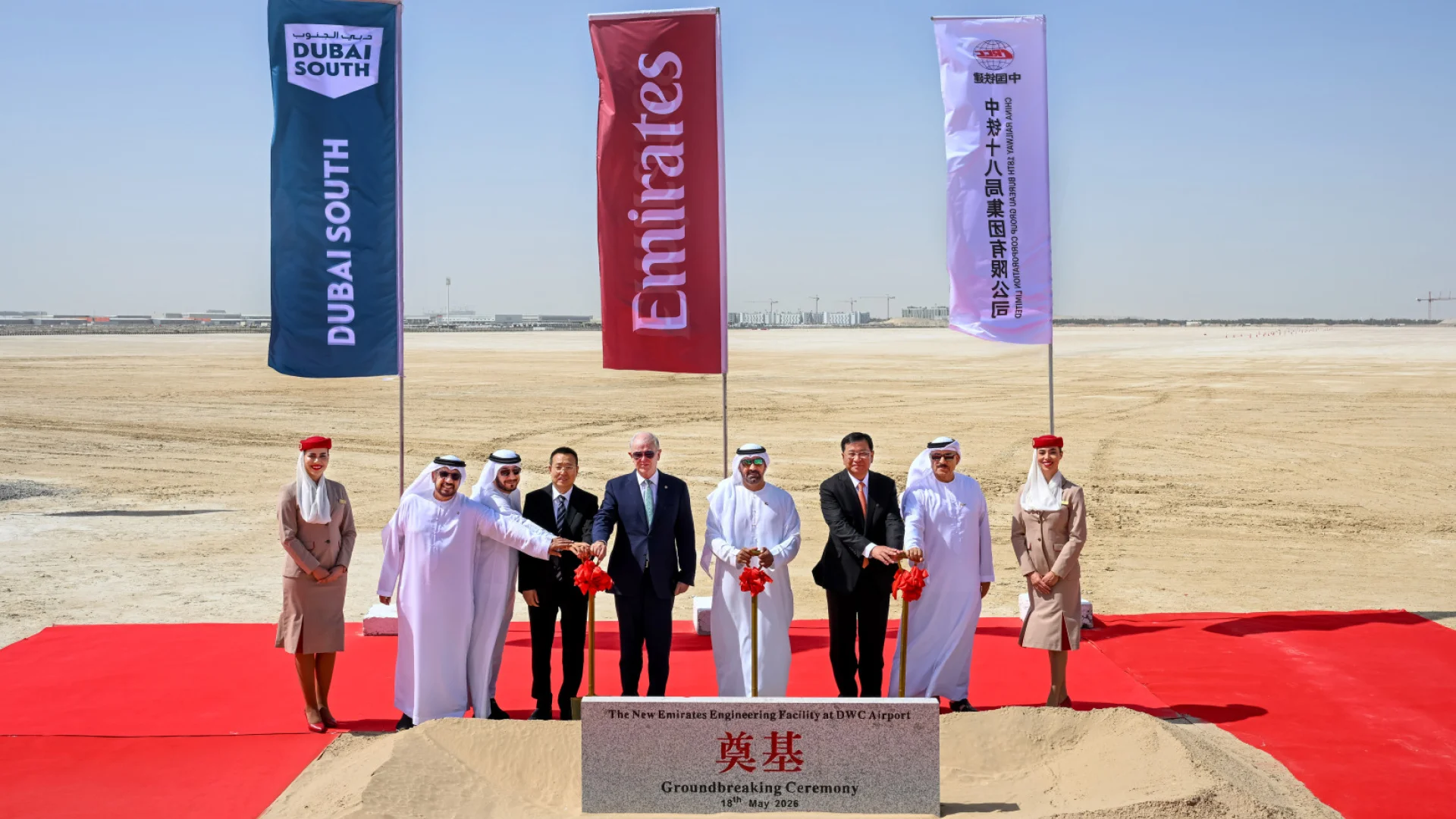
In Dubai South, where desert light flattens everything into clean lines, Emirates has broken ground on a AED 51 billion (about US$ 13.9 billion) ultra-modern engineering complex. Spanning roughly 1 million square metres, the facility is designed to scale with fleet growth and new aircraft generations—bringing hangars, workshops, component support, and advanced, digital-first maintenance workflows into one consolidated hub. The project strengthens Dubai South’s role as an aviation-industrial corridor linked to Al Maktoum International Airport (DWC), with ripple effects across jobs, suppliers, logistics, and nearby development. It’s not just a new building site—it’s the quiet infrastructure behind on-time performance, safety, and global connectivity.
The desert out here doesn’t whisper. It glows.
In Dubai South, the morning sun lays a hard sheen over the sand, turning tyre tracks into thin silver lines. A few metres away, a row of helmets catches the light like a scatter of polished stones. Someone adjusts a safety vest. Someone else points at a set of markers pushed into the ground—small flags that look almost too fragile to announce what’s coming next.
Then the moment arrives: Emirates breaks ground on what it calls an ultra-modern engineering facility, a project valued at AED 51 billion. If that figure feels abstract, stand here for a second and let the emptiness do the math. This is where a “site” becomes a system—where a blank horizon is about to turn into hangars, workshops, paint bays, tool cribs, training rooms, and corridors of parts moving with the precision of a metronome.
The scale is the first thing that lands. Emirates’ new engineering complex is planned across approximately 1 million square metres. Not a single building, but a spread-out ecosystem designed to handle the rhythms of modern aviation maintenance—routine checks, heavy maintenance, structural work, component support, and the countless inspections that keep a long-haul fleet moving.
Think of it as a city with one purpose: to return aircraft to the sky safely, efficiently, and on schedule. In aviation, minutes matter. A delayed release from maintenance can ripple through flight rotations, crew duty times, gate slots, and passenger connections on the other side of the world. Infrastructure like this is the part of the airline business most travellers never see—yet it quietly decides whether their day runs smoothly or unravels at 35,000 feet worth of distance from home.
Dubai South is not a backdrop. It’s a strategy.
The area has been positioned for years as Dubai’s next powerhouse zone for aviation, logistics, and light industry—closely linked to Al Maktoum International Airport (DWC) and the surrounding free zone and industrial districts. Emirates placing its next engineering centre here is a vote of confidence not only in the airport’s trajectory, but in the idea of clustering: maintenance, parts distribution, specialist suppliers, and freight-adjacent services co-located for speed.
A driver slows near the perimeter fence, glancing at the gathering. “Big one?” he asks, half to himself. A colleague nods. “Big,” he says. Then, after a beat: “Long time.” Because that’s what an AED 51 billion investment really signals—decades, not quarters.
Emirates frames the complex as ultra-modern, and the implications are clear: consolidated workflows, higher capacity, and space designed around today’s maintenance realities—complex aircraft systems, tighter operational windows, and the need to integrate digital tools into every layer of planning and execution.
Picture a hangar door rolling open. The aircraft nose appears first, then the fuselage—a white curve that catches the light like porcelain. Underneath, technicians move with purposeful calm. Tools are placed, checked, counted, logged. Someone calls out a measurement. Another answers without looking up. Micro-dialogues that sound simple, but carry the weight of safety.
Fleet growth isn’t just about ordering aircraft. It’s about everything that follows: more inspections, more component cycles, more cabin refreshes, more engine-related events, more planning complexity. Maintenance capacity becomes a bottleneck long before passengers notice it. Emirates is building to avoid that bottleneck—creating a hub designed to scale with new deliveries and evolving aircraft technology.
And the benefits aren’t only operational. Large engineering centres pull in skills. They create career gravity. Engineers, avionics specialists, planners, quality managers, safety auditors, logistics coordinators—an entire labour market forms around the heartbeat of maintenance. Training facilities and support infrastructure matter because the war for talent is real, and aviation talent is global.
Where maintenance grows, supply chains reorganise.
Parts need to move fast. Consumables need to be stocked smartly. High-value components require secure handling and efficient customs processes. Specialist vendors—everything from non-destructive testing services to cabin interior suppliers—prefer to be close to their biggest customers. An engineering complex of this scale doesn’t just create demand; it reshapes geography.
In practical terms, Dubai South becomes more than a name on a planning map. It becomes a predictable destination for industrial footprints: warehouses, bonded storage, light manufacturing, and service yards that thrive on proximity.
The last few years taught aviation a blunt lesson: global systems can wobble. Supply disruptions, labour constraints, parts shortages—maintenance networks worldwide felt the strain. In that context, investing in large, integrated facilities is also an investment in resilience. More in-house capacity, more control over workflows, and more ability to adapt when external channels tighten.
Modern maintenance isn’t only spanners and scaffolding anymore. It’s data, scheduling intelligence, predictive planning, and tight documentation. Ultra-modern facilities are as much about information flow as they are about floor space. You can feel that ambition even at a groundbreaking—where the ground is still bare, but the blueprint already hums with movement.
As the ceremony wraps, the site doesn’t fall silent. Surveyors walk out again. A pickup reverses with a short beep-beep-beep, then stops. Someone unrolls a plan that goes pale under the sun, the edges lifting in the breeze. In the distance, infrastructure lines—roads, utility corridors, the distant logic of the airport—frame the scene like an unfinished sentence.
Emirates isn’t just adding another facility. It’s setting down a long-term marker: a commitment to scale, to precision, and to the industrial engine behind global travel. Today it looks like sand and flags. Soon it will look like steel—and the kind of quiet competence that keeps the world moving.
For real estate investors, Emirates’ AED 51 billion commitment is a classic “anchor signal” for Dubai South: a long-duration, capital-intensive project that strengthens the district’s identity as an aviation-industrial cluster tied to DWC. Historically, when an anchor of this magnitude accelerates development, it tends to lift occupier confidence, attract supplier ecosystems, and increase demand for logistics, industrial, and workforce housing in nearby catchments.
Key investment implication: Dubai South’s narrative becomes less speculative and more operational as major employers lock in. That can compress risk premiums for well-located industrial assets and strengthen underwriting assumptions around tenant demand—provided investors remain disciplined about access, utilities, zoning, and the pace of DWC-linked infrastructure expansion.