
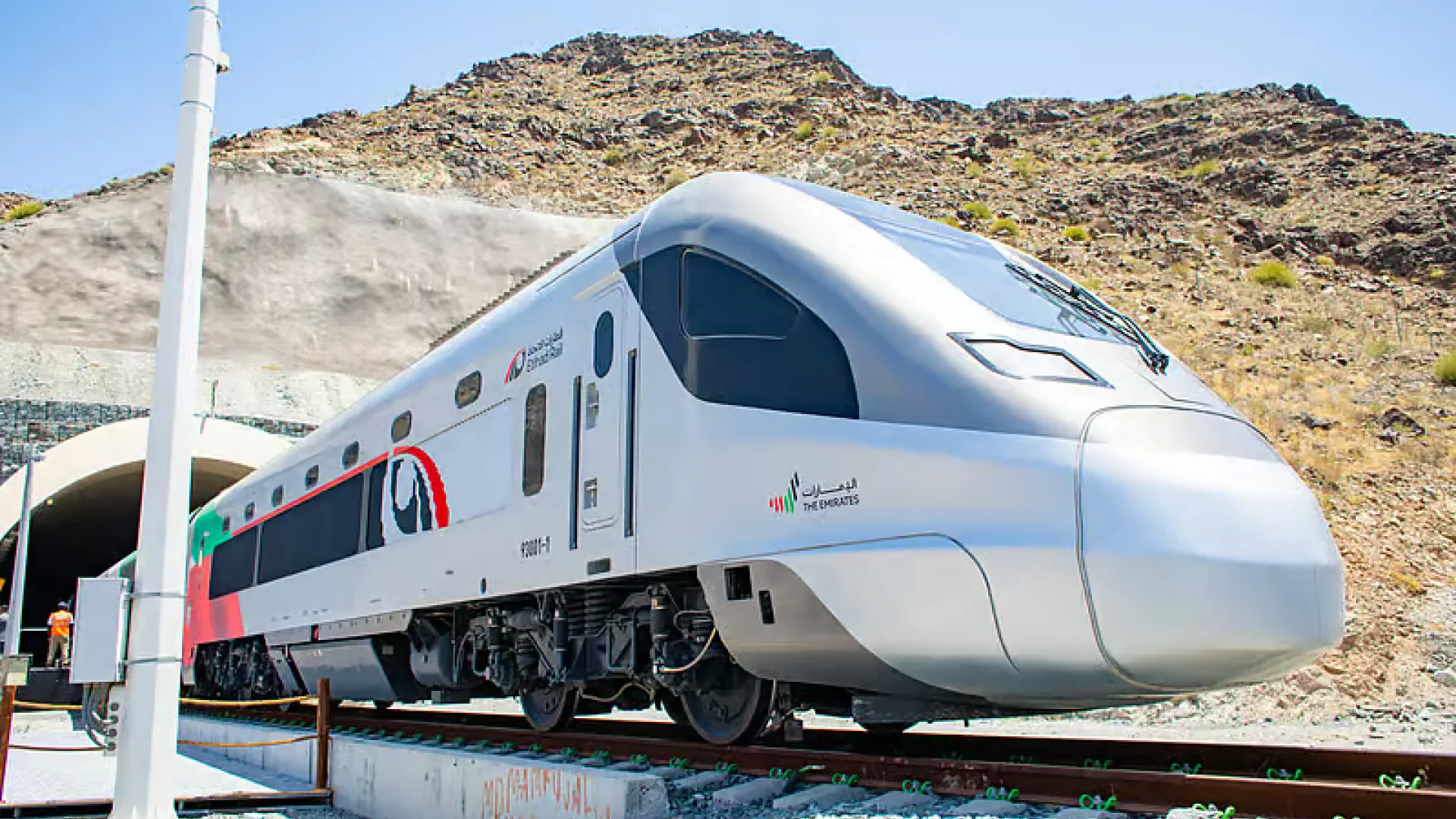

The UAE’s rail story is changing from freight muscle to people-moving rhythm: Etihad Rail is edging closer to passenger services and revealing what the ride will feel like on board. Expect modern, climate-controlled carriages with comfortable seating, practical luggage space, and distinct zones—family-friendly areas and quieter sections for focused travel. Digital ticketing and a streamlined journey are central to the promise, positioning rail as a serious alternative to highways and short-haul hops. Beyond convenience, the bigger shift may be psychological: once cities feel “minutes apart,” where people live, work, and invest can change fast.
The first thing you notice isn’t speed. It’s coolness.
Step inside and the desert heat disappears as if someone has pulled a curtain across the sun. Outside, the landscape shimmers—sand the color of toasted sugar, a hard blue sky, the occasional cluster of buildings—while inside the carriage everything settles into a calm, measured hum. No white-knuckle steering wheel. No impatient lane changes. Just a steady forward glide that feels, strangely, like relief.
This is the mood Etihad Rail is trying to bottle as it prepares for passenger trains in the UAE. Known so far for hauling freight across the country, the network is moving toward a new chapter: carrying people between emirates, turning long drives into seated, air-conditioned intervals you can actually use.
In the UAE, travel has long been a two-option habit. You drive—sometimes for hours—counting exits and watching the fuel gauge. Or you fly—terminal lights, security trays, gate announcements, the choreography of queues. Rail, if it lands as promised, offers a third routine: show up, board, breathe.
Etihad Rail’s preview of the on-board experience points to a system built around frictionless movement. Digital ticketing. Modern carriages. A layout that understands the simple truth of intercity life: not every passenger wants the same atmosphere at the same time.
Picture the small moments that make a journey feel expensive—or exhausting. A seat that nudges your shoulders forward. A bag that won’t fit anywhere, so you keep it pinned between your ankles. A noisy group when you’re trying to finish a report before a meeting. Rail doesn’t win hearts on grand statements; it wins on these details.
Etihad Rail’s on-board concept leans into comfort and practicality: generous seating, storage for luggage, and defined areas that respect different travel styles. A family section where kids can be kids. Quieter zones where laptop screens glow and voices drop to a low murmur.
“Is this the family area?” a father asks, shifting a backpack higher on his shoulder as a child bounces beside him.
“Yes—just down this way,” a staff member replies, a small gesture of direction that says: we expected you.
Every new train project eventually gets reduced to a number: top speed, travel time, minutes saved. And yes—time matters. But the real upgrade is what happens to your body when you’re no longer driving.
Your shoulders drop. Your hands stop gripping. Your mind stops scanning mirrors and brake lights. You open your phone. You answer messages. You skim a proposal. You look out the window and actually see the country passing by—flat stretches, industrial silhouettes, sudden green patches, a skyline that rises like a mirage made real.
That’s the quiet promise behind Etihad Rail’s passenger push: not just getting you there, but giving you back the part of the day that used to be lost to the road.
Great transport systems rarely feel dramatic. They feel obvious—as if they’ve always been there. The wayfinding is clear. The steps are intuitive. The logistics are tucked behind the scenes.
Etihad Rail’s emphasis on digital ticketing and streamlined travel reads like a blueprint for that kind of “obvious.” The goal is to make boarding and settling in feel natural, not like a puzzle to solve on your first ride.
“Which coach is mine?” someone asks, half-turning with a coffee cup in hand.
“Right ahead—middle doors,” comes the answer. Two seconds, problem gone.
Freight rail is economic infrastructure—you feel it in shelves that stay stocked and ports that move faster. Passenger rail is social infrastructure. It reshapes how people imagine distance.
When cities feel closer, decisions loosen. A job in another emirate becomes plausible without relocating. A weekend plan stops requiring a flight booking. A client meeting becomes a ride where you can prep instead of a drive where you can’t.
Over time, these small shifts create bigger ones. Labour markets stretch. Business networks thicken. And the map of “prime” locations can start to redraw itself—subtly at first, then all at once.
It’s early. The platform has that quiet, purposeful energy of people who know exactly where they need to be. A consultant in a crisp shirt scrolls through slides. A couple with weekend bags whispers about dinner plans. A student taps a foot to music only he can hear.
The train arrives with a clean, controlled sound. Doors open. Cool air slips out like a welcome.
Inside, the carriage feels like a corridor of small personal worlds. Someone flips open a laptop in the quieter zone. In the family area, a child points at the window and announces the obvious with delight: “Look—sand!” The parent laughs, relieved to have space where that laughter isn’t a problem.
And then you’re moving. Fast. Smooth. The UAE unspools outside in long, sunlit frames.
Based on the details shared so far, the passenger experience is being designed around modern comfort and operational simplicity: contemporary carriages, comfortable seating, luggage space, climate control, and clearly defined areas for families and for quieter travel. Digital ticketing and smooth processes are part of positioning rail as a practical alternative for intercity movement across the emirates.
Passenger rail is one of the fastest ways to turn “far” into “feels close.” For real estate investors in the UAE, Etihad Rail’s move toward inter-emirate passenger services is less about trains and more about time geography: once travel time becomes predictable and comfortable, demand can migrate toward new nodes—and values can follow.
1) The rise of ‘minutes-based’ location premiums
In mature rail markets, property value correlates strongly with door-to-door time to major employment centres. As Etihad Rail stations and timetables crystallize, investors should expect a similar dynamic: assets within a short, reliable “last mile” catchment can command stronger rents and tighter vacancy—especially in mid-market residential and workforce housing.
2) Station areas invite mixed-use density
Stations tend to pull everyday commerce toward them: convenience retail, cafés, clinics, co-working, gyms—services that benefit from footfall. The biggest winners are often well-planned, walkable mixed-use blocks rather than isolated towers. Look for masterplans that treat pedestrians seriously: shaded sidewalks, crossings, drop-off zones, and seamless links to buses and taxis.
3) Commuter elasticity reshapes housing demand
If inter-emirate commuting becomes easier, households may trade a central address for more space, better value, or a different lifestyle—without giving up access to core job markets. That can lift demand for family-sized units and community developments in secondary locations that are rail-connected.
4) Office strategy: dual hubs become practical
Companies may reconsider single-emirate footprints. Faster, calmer intercity travel supports a “dual hub” model—client-facing presence in one city, operational teams in another—boosting demand for Grade A offices near rail-linked nodes and smaller satellite spaces elsewhere.
5) Risk and cap rates: infrastructure as a stabiliser
Reliable mass transit can lower volatility tied to road congestion and parking constraints. Over time, that stability can support stronger institutional appetite and potentially improve pricing for assets that are demonstrably transit-oriented.
Investor lens: what to monitor now
In short: Etihad Rail’s passenger experience—comfortable, zoned, digital—signals a network designed to be used daily. For investors, daily use is the catalyst that turns infrastructure into value: once people build their routines around rail, the most convenient station-adjacent micro-locations can become the UAE’s next quietly powerful property story.