
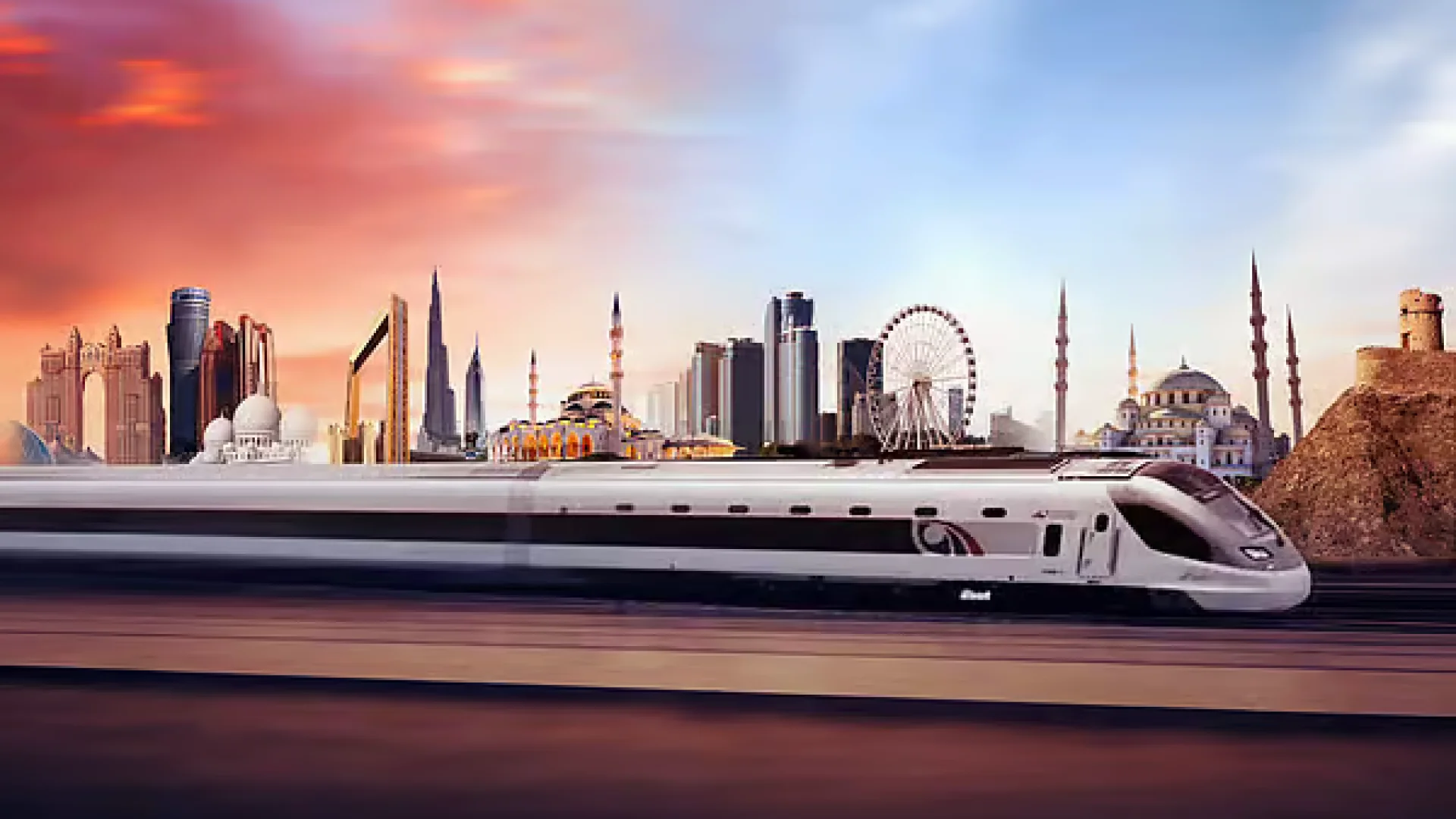

A new spine is taking shape in the UAE’s landscape: Etihad Rail is moving forward with the first phase of a rail connection intended to bring Abu Dhabi, Dubai and Fujairah closer together. The focus is sharper logistics, stronger links between ports and industrial zones, and a more reliable way to move across the country’s key economic corridors. What looks like quiet trackwork today could soon reshape commuting patterns, supply chains and—crucially—where people and businesses choose to locate.
The heat sits on the ballast like a weight. Sand skitters across a newly pressed corridor, trying to reclaim the line before it’s even finished. A worker squints down the alignment, lifts his hand and points—no grand speech, just a clear direction: “This way.” Somewhere behind us, an engine hums low. It’s not dramatic. But it feels like the UAE is drawing a new sentence across the map.
Etihad Rail, the country’s national rail project, is advancing the first phase of a network meant to connect Abu Dhabi, Dubai and Fujairah. In a place built on speed—highways, airports, ports—the idea of trains can sound almost old-fashioned. Yet rail has a modern power here: it turns distance into schedule. It takes the unpredictable—traffic, bottlenecks, convoy timing—and replaces it with something investors, planners, and commuters crave: reliability.
In the UAE, you don’t measure travel only in kilometers. You measure it in “Will Sheikh Zayed Road behave today?” and “How long will the trucks queue?” A rail line changes that conversation. It doesn’t just promise movement; it promises repeatability. The same departure. The same arrival. The same confidence.
This first phase, as reported, centers on pushing forward a rail corridor that links the major poles of the federation—Abu Dhabi and Dubai—and strengthens connectivity toward Fujairah on the Gulf of Oman. Put those three names together and the strategic logic clicks into place: governance and heavy industry; global business and trade; and an eastern gateway with port capacity and alternative maritime access. A rail backbone here is not a vanity project. It is an economic instrument.
On site, the language is practical. “We need the chain to hold,” a supervisor says, tapping a clipboard as if it’s a metronome. He’s talking about freight—containers, bulk materials, industrial inputs, the quiet volumes that keep cities fed and factories moving.
Etihad Rail’s rollout emphasizes the value of rail for logistics: moving goods more efficiently between ports, industrial areas and distribution hubs. If you’ve ever watched trucks stack up at peak hours, you understand the appeal immediately. Rail doesn’t eliminate roads, but it can rebalance them—shifting heavy long-haul loads onto tracks, smoothing peaks, and giving supply chains another dependable option.
And here’s the part people miss: when freight moves better, land use changes. Warehouses migrate. Industrial clusters consolidate or expand. New service economies pop up around them—maintenance, staffing, food, housing. The train is rarely just a train.
Abu Dhabi and Dubai don’t compete so much as they orbit each other—different strengths, shared gravity. One morning in Dubai’s business districts, you can feel it: people checking meeting times in Abu Dhabi, planning site visits, calculating buffer minutes for traffic.
Now imagine a different kind of morning. You step into a station, the air-conditioning hits like a cool exhale, and the board above your head doesn’t offer guesses—it offers times. A commuter beside you mutters, half amused: “If this stays on time, it changes everything.” You don’t answer. You just watch the doors close and the city slide away.
Even in its first-phase framing, the message is clear: the UAE is building a mobility layer that is less about individual vehicles and more about networked movement. That matters for employers recruiting across emirate lines, for contractors moving equipment, for families choosing where to live.
Fujairah feels different the moment you arrive. The mountains rise; the air tastes a little more like sea. It’s not the glossy postcard many tourists picture first, and that’s precisely why it matters. Fujairah’s position on the Gulf of Oman makes it a strategic complement to the UAE’s west-coast ports—an eastern hinge that can broaden options for shipping and logistics.
Strengthening rail connectivity toward Fujairah signals more than convenience. It hints at a future where cargo routes and industrial planning factor in an additional, resilient gateway. That’s the kind of infrastructure thinking that attracts long-term capital: it reduces single-point dependencies and makes the economic system more shock-resistant.
Infrastructure announcements can sound abstract until you see the ripple in everyday decisions. A café owner near an industrial area wonders aloud if lunch traffic will increase once workers and shipments flow more steadily. A logistics manager recalculates safety stock because “deliveries might finally be predictable.” A developer asks a simple question at a meeting—“How close is the last mile?”—and the room goes quiet, because everyone knows the answer will shape the pro forma.
Etihad Rail’s first phase, linking the Abu Dhabi–Dubai axis and pushing connectivity toward Fujairah, sits right at that intersection of ambition and practicality. It’s about making the country’s key corridors behave—turning growth into something coordinated.
The UAE’s economic geography is built around nodes: ports, free zones, industrial cities, logistics parks. Roads and sea lanes have carried that system for decades. Rail adds a new layer—one that can move high volumes with lower friction across long distances, and do it in a way that makes planning easier.
In other words: tracks don’t just connect points. They change what those points are worth.
For real estate investors, Etihad Rail’s first-phase push is a classic catalyst: infrastructure that can reprice accessibility, strengthen logistics performance, and shift demand across asset classes. The most important lesson from global rail projects is simple—value often accrues not only where rails run, but where nodes form and where the last-mile connection is efficient.
1) Logistics & industrial real estate (highest conviction): Expect the clearest upside in modern warehouses, cold storage, light industrial, and distribution parks positioned near rail-linked logistics corridors and port/industrial interfaces. In the UAE, where trade volumes and rapid delivery expectations are structural, anything that improves throughput and reliability tends to translate into stronger tenant demand and longer leases—especially from 3PLs, e-commerce operators, and import/export businesses.
2) Land value and development optionality: Early-phase rail progress can lift land values through anticipation alone. Investors with land-banking strategies should track not just the corridor, but zoning, utility capacity, permitting timelines, and planned intermodal facilities. The “two-kilometer rule” matters: parcels slightly farther away but with superior road access can outperform parcels that are closer to the track but operationally constrained.
3) Residential markets and commuter economics (selective): If future passenger services and feeder connections make Abu Dhabi–Dubai movement more predictable, mid-market residential areas could benefit as households trade distance for space—but only where connectivity is seamless (parking, metro/bus links, station-area planning). This can support rental demand in emerging communities and stabilize occupancy in projects that previously felt “too far” for daily life.
4) Fujairah’s positioning and diversification: Stronger connectivity toward Fujairah reinforces the emirate’s role as an eastern logistics gateway. That can support demand for worker housing, serviced accommodation for project teams, and eventually mixed-use clusters tied to industrial and port activity. Investors looking to diversify beyond the core Abu Dhabi/Dubai markets may find Fujairah’s risk-return profile increasingly compelling—provided they underwrite tenant depth and pipeline carefully.
5) Timing, competition, and underwriting discipline: Infrastructure narratives can inflate expectations. The key is to underwrite with scenarios—base case, accelerated uptake, and delayed rollout—while monitoring competing supply in logistics parks and residential communities along the corridor. In fast-moving markets, the difference between buying “vision” and buying “cash flow” can be a full pricing cycle.
Investor checklist for the next 12–36 months:
Bottom line: the first phase of Etihad Rail along the Abu Dhabi–Dubai–Fujairah corridor is the kind of backbone infrastructure that can quietly, steadily rewire how the UAE works—and that rewiring tends to show up in logistics absorption, land pricing, and the next generation of location choices.