
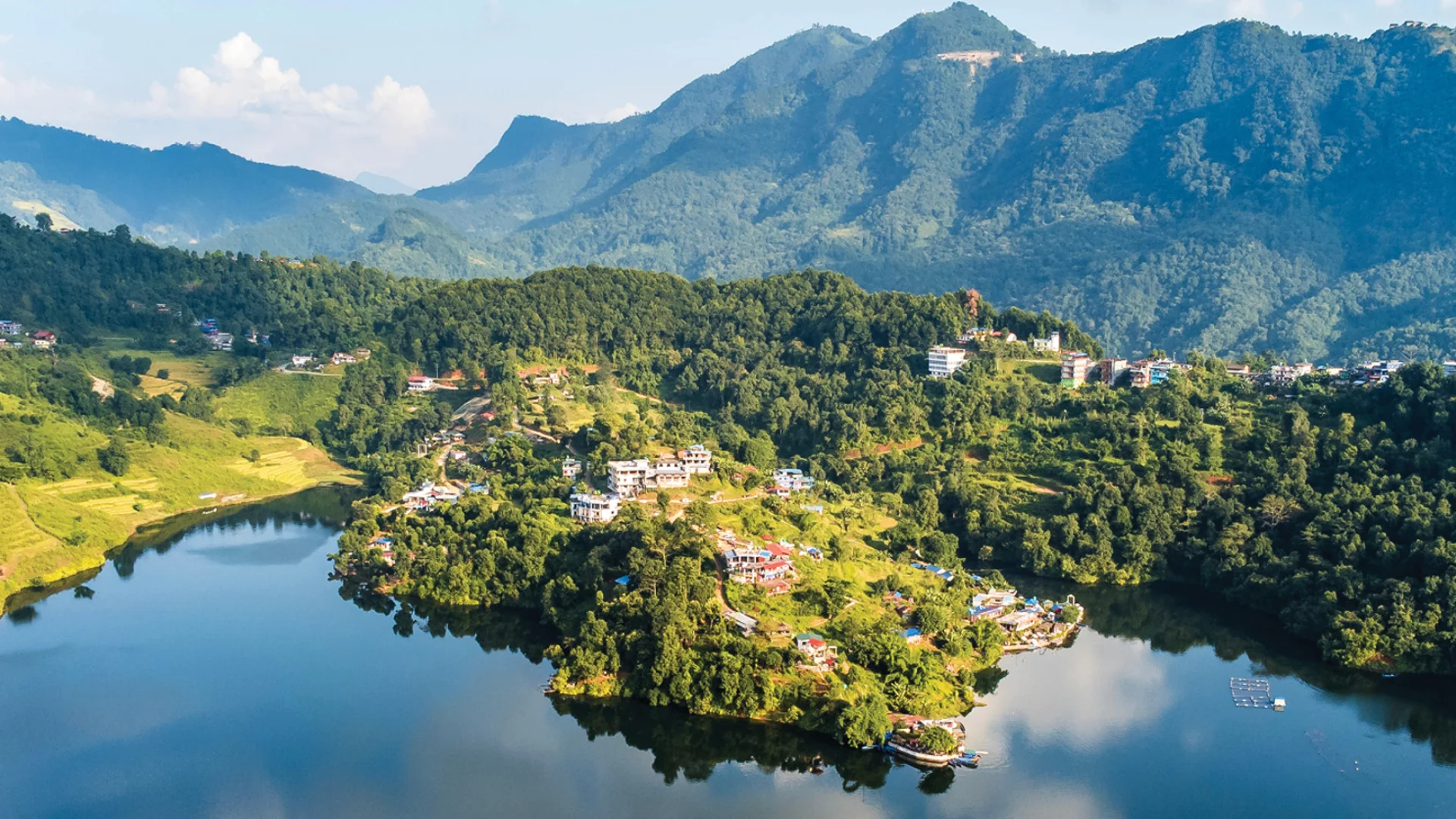

Pokhara wakes slowly—mist on the lake, prayer flags twitching, the Annapurna range suddenly turning gold—and now it wakes to a new rhythm in the sky. flydubai has announced a new daily service to Pokhara (PKR), strengthening Nepal’s links to the world through Dubai’s hub. With Pokhara joining Kathmandu as a regularly connected gateway, the move is set to make leisure, VFR and business travel easier to plan and faster to execute. It’s a route announcement with real-world consequences: more choice for passengers, more momentum for a destination, and new signals for investors watching Nepal’s tourism corridor.
The first thing you hear in Pokhara is water.
Not the dramatic kind—no roaring surf, no metallic city fountains—just the soft, persistent lap of Phewa Lake against a wooden boat. Oars creak. A kettle whistles behind a small tea stall. Somewhere, a shop shutter rattles up and a voice calls out, half-yawn, half-greeting: “Clear today?”
“Maybe,” another voice answers, looking toward the horizon. “The mountains decide.”
And then, as if on cue, the sky thins. The Annapurna range appears like a stage curtain lifting—white, sharp, almost too bright to be real. People pause mid-step. A cyclist slows down without thinking. Pokhara is like that: it doesn’t demand attention; it catches it.
Now, the city is about to catch a little more of the world’s attention—every single day. flydubai has announced a new daily service to Pokhara (PKR), expanding connectivity to Nepal through its Dubai hub and turning a once “you’ll get there somehow” destination into a place that can be reached with far less friction.
Nepal’s international story has long been told through one name: Kathmandu. Busy streets, incense and exhaust, business meetings wedged between temple visits and last-minute gear shopping. Kathmandu is a pulse.
Pokhara is a breath.
It’s lakeside cafés where conversations stretch. It’s paragliders floating overhead like bright punctuation marks. It’s the feeling that the Himalayas are not a distant postcard but a neighbor across the street. By adding Pokhara as a daily destination, flydubai effectively supports a more distributed tourism and travel flow—one that doesn’t bottleneck through a single arrival point.
Daily frequency matters in a way brochures can’t capture. It means you can plan. You can commit. You can tell your team you’ll be back on Sunday. You can book a family visit without crossing your fingers for the one flight that works. A daily service is not just access—it’s reliability.
Dubai airports have their own weather: cool air, polished floors, rolling suitcases, the hum of connections being made. People move with purpose. Gate numbers become tiny promises. You can almost feel the city’s global logic at work—routes and networks, time zones stitched together.
That’s where a route like this becomes powerful. Dubai is not simply a starting point; it’s a switching station for the planet. A new daily service to Pokhara means travelers can plug Nepal’s lakeside mountain city into a wider grid of onward journeys—more origins, more feasible itineraries, more “yes, that works” moments when comparing flights.
At a gate, someone scrolls through photos of snowy peaks. “Pokhara,” he says, testing the word like a new flavor. “Is that where people go before Annapurna?”
His friend smiles. “It’s where you wake up and the mountains are right there.”
That’s how routes become real—through small conversations that turn geography into intention.
Pokhara has been quietly building a reputation beyond trekking. Yes, it’s a launchpad for the Annapurna region. But it’s also a destination in its own right: wellness stays, short escapes, family travel, adventure sports, boutique hospitality, and increasingly, remote-work-friendly living for those who want café Wi‑Fi with a mountain view.
A daily international connection can amplify those trends. It lowers the threshold for travel organizers and individual passengers alike. It helps spread demand across the week and across the year, which is exactly what a destination wants if it’s aiming for healthier, more sustainable growth rather than a single crowded season.
In aviation, the difference between “sometimes” and “daily” is enormous. A daily flight is an invitation to be spontaneous and a tool for being efficient. It can reshape how tour operators package Nepal, how families schedule visits, and how businesses think about sending staff.
You don’t always see the impact in the sky first. Sometimes you see it on the ground.
A hotel manager starts talking about “shoulder season” with less anxiety. A café adds a breakfast menu because early arrivals suddenly matter. A driver’s cooperative reorganizes shifts around predictable flight times. A trekking guide stops bracing for one chaotic arrival day and starts spreading bookings more evenly.
More frequent air service doesn’t automatically mean a place loses its soul. But it does mean the place gains options. And options are what turn local economies from reactive to proactive.
For Pokhara, a daily flydubai service could help position the city as a true gateway—an entry point not only to mountain trails but to experiences that don’t require a backpack at all: lakeside weekends, wellness retreats, small conferences, destination weddings, and soft-adventure trips that are big on comfort.
There’s a moment in Pokhara just after sunset when the air cools and the lake turns dark, holding the last light like a secret. Music drifts from a rooftop. Someone laughs in a language you don’t recognize. A shopkeeper counts cash with practiced fingers. And above it all, the mountains disappear into night as if they were never there.
This is what connectivity can do when it’s done right: it doesn’t replace the magic. It makes it reachable. The new daily route is, in a way, a promise that Pokhara can remain itself—while welcoming more of the world to see it.
A new daily international air link is rarely “just tourism news” for property markets. In emerging and developing destinations, connectivity is a core variable: it influences demand depth, occupancy stability, tenant profiles, and ultimately valuations. flydubai’s daily service to Pokhara via Dubai can therefore be read as a signal—one that investors in hospitality and mixed-use assets tend to watch closely.
1) Hospitality fundamentals: occupancy stability over pure volume
Daily frequency can smooth demand across the week and across seasons. That matters because many hotel and serviced-apartment business cases fail not on peak nights, but on weak mid-week and off-season performance. More consistent arrivals improve revenue management (ADR strategies), staffing efficiency, and capex planning—key ingredients for financeable cashflows.
2) Likely winners: midscale hotels, lifestyle boutiques, serviced apartments
Pokhara’s demand is diversified—trekking, family leisure, short stays, wellness, and a growing segment of longer-stay travelers. Asset types that often benefit in such markets include:
3) Micro-location logic: airport–city–lakeside corridors
New air service tends to concentrate value along movement lines—areas that reduce transfer time and maximize experience. In Pokhara, investors typically map: proximity to the airport and major roads, access to Lakeside amenities, and ease of onward transfers to trekking corridors. Sites that sit at these intersections can command pricing premiums earlier than peripheral areas.
4) Infrastructure and standards: competitive differentiation
International arrivals raise expectations around backup power, water reliability, fire safety, building maintenance, and digital infrastructure. Properties that bake these standards into design and operations can outperform—especially when global booking platforms and travel operators increasingly score and rank assets based on consistency.
5) Risk lens: cyclicality, execution quality, resilience
Connectivity can be cyclical; travel demand can swing with macro conditions. Investors should stress-test underwriting for seasonality, capex needs, and operating partner capability. Resilient plays often combine diversified demand sources (leisure + VFR + small business segments), professional management, and adaptable unit mixes.
Investor takeaway: flydubai’s daily service strengthens Pokhara’s “reachability premium.” For real estate, that typically translates into improved hospitality performance potential, stronger feasibility for serviced-living concepts, and a clearer narrative for mixed-use projects in well-connected micro-locations—provided that execution quality and operational resilience are treated as non-negotiables.