
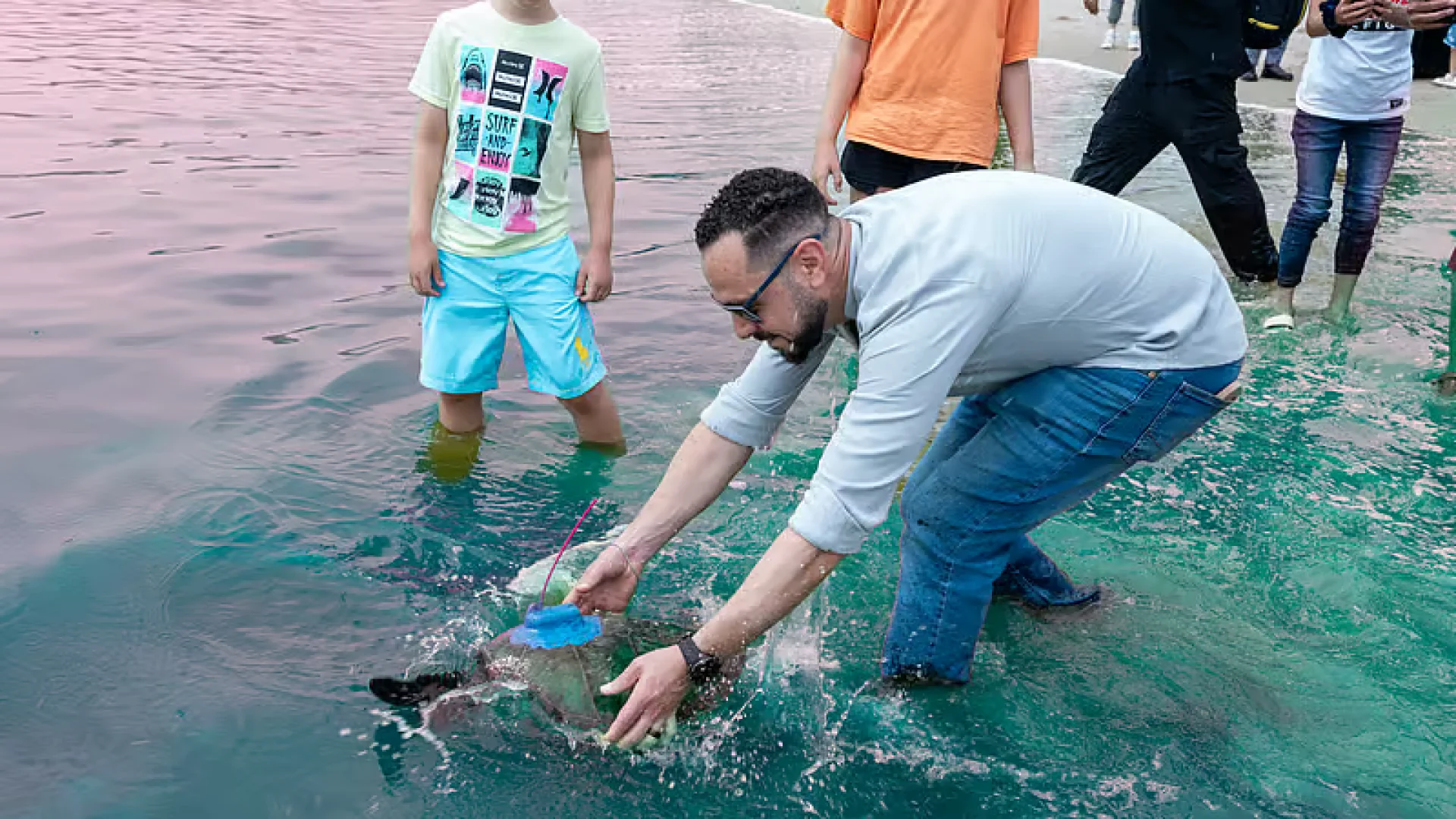
The shoreline in Fujairah turns into a quiet stage as rescued green sea turtles slide from sand to surf, returning to the Gulf of Oman after rehabilitation. Behind the release is a chain of rescue calls, careful handling, treatment, monitoring, and the final decision that each turtle is strong enough to swim, dive, and feed again. The story is a reminder that the UAE’s coast is both a lifestyle icon and a living habitat—one that can be harmed by plastic, fishing gear, and nearshore traffic in a single unlucky encounter. And it shows how conservation has become something you can witness in real time: not a slogan, but a journey that ends with a ripple and a disappearing shell.
The sea looks calm from a distance. Up close, it’s restless—small, insistent waves combing the sand, erasing footprints as fast as they appear. In Fujairah, the morning air tastes like salt and sun-warmed stone. Someone points toward a shaded spot where a small group has gathered. There’s a hush, the kind you hear before a curtain rises.
“Ready?” a voice asks—soft, practical. Not theatrical.
Then the stars arrive, not with noise but with weight. Green sea turtles. Real ones. Big enough that you instinctively respect the slow strength in their bodies. Their shells are scuffed like road-tested luggage. Their flippers press into the sand, testing it, remembering it. For a second they look almost puzzled—this bright beach after weeks of clinical light and careful hands.
The first turtle moves. A push. A pause. Another push. You can hear the scrape of shell against sand, the tiny gasp of the crowd when the surf finally touches its belly. The ocean seems to recognize it immediately. The turtle doesn’t hesitate. It leans forward and is suddenly less an animal on land than an idea returning to water—sleek, ancient, perfectly placed.
People love the word “release.” It sounds clean, instant, cinematic. But standing here, you feel the truth: a release is the last page of a long file. It’s the end of a chain of alerts, pickups, transport, examinations, treatments, feeding schedules, and patient waiting. It’s the moment everyone hopes for—and the one they don’t rush.
These green sea turtles were rescued after they were found in trouble—weak, injured, or compromised by hazards that don’t always announce themselves. In coastal waters, danger can be thin as fishing line. Plastic can masquerade as food. A drifting net can turn into a trap. And a busy nearshore corridor—jet skis, boats, weekend traffic—can become a gauntlet for an animal that needs calm to recover.
So the turtles went into care. Rehabilitation is not romantic. It’s meticulous. It’s restraint and routine. It’s learning the difference between a turtle that is simply stressed and one that is truly failing. It’s the quiet victory of a first proper meal, the relief of a stronger dive, the satisfaction of seeing a flipper move without pain.
On the shore, you see sand, sea, and a happy ending. You don’t see the weeks that came before: the water tanks, the monitoring, the notes recorded day after day. Rescue teams and veterinary staff don’t just “patch and send.” They stabilize. They treat wounds and remove hooks or entanglements when needed. They watch behavior closely—because behavior is the best interview a wild animal can give.
Is the turtle alert? Does it feed normally? Can it submerge with control? Is it buoyant in a way that signals internal distress, or balanced and strong? Each answer matters. A premature release is not mercy; it’s risk. The goal is simple: the turtle should leave care as a swimmer, not a survivor still in trouble.
Green sea turtles are not just charismatic. They are ecological punctuation marks. Where they thrive, the sea usually still has something worth protecting: healthy seagrass beds, workable water quality, coastal stretches that haven’t been flattened into pure utility. They feed, travel, and—when conditions allow—return to familiar areas. Their presence is a sign that the coastline is more than a postcard.
Fujairah, facing the Gulf of Oman, carries a different mood than the glittering west coast skyline. The mountains feel closer. The sea feels deeper. You can stand on a beach and sense the wildness still threaded through the modern. That’s exactly why moments like this release land with such force: they show the region’s natural heritage in motion.
A child edges forward, eyes locked on the second turtle. “Will it come back?” he asks, as if it might circle like a boomerang.
One of the handlers smiles—tired, proud. “It belongs out there,” he says, nodding toward the open water. “That’s the best place for it.”
The turtle’s flippers start to work the moment the wave lifts it. A few strong strokes and it’s suddenly a dark comma in the foam. Then it’s gone. The sea swallows the outline the way it swallows secrets.
Someone behind me exhales, loudly enough that I realize I’d been holding my breath too. These are not pets. They don’t look back. And that’s the point.
It reads like a checklist, but it plays out like a series of accidents that didn’t have to happen. Each rescue is a reminder that “coast” is not just a leisure zone. It’s a living border between human appetite and marine life.
In the UAE, conservation is increasingly something you can watch, not just read about in policy language. Releases like this one are public for a reason: they turn abstract concerns—biodiversity, marine health—into a tangible story. A turtle in a tank is an argument. A turtle in the surf is a conclusion.
And it’s not just about the animal. It’s about the culture that forms around it: the beachgoer who calls in a sighting instead of shrugging; the fisher who reports an entanglement; the facility that takes the animal in; the authorities coordinating the return. In a coastal economy, the ecosystem is an asset. You protect assets you plan to keep.
By the time the final turtle is carried to the shoreline, the sun has climbed higher and the water sparkles like shaken glass. The turtle’s shell catches the light—olive and bronze, darker near the edges. The handlers lower it gently. It rests for a breath, then moves with sudden purpose, as if a switch has been flipped inside it.
Wave. Lift. Push. Gone.
The group disperses slowly, reluctant to end the moment. The beach looks the same as it did an hour ago, but it doesn’t feel the same. You’ve seen the coast give something back. Not a building. Not a promise. A living animal returning to its world.
For real estate investors, Fujairah’s turtle release is more than a feel-good environmental vignette—it’s a market signal. Coastal property values are increasingly tied to environmental quality, regulatory readiness, and climate resilience. In the UAE, where waterfront living is a flagship product, nature protection is becoming part of the competitive toolkit for destinations and developers.
1) A rising “eco-premium” for waterfront assets: Clean water, well-managed beaches, and visible biodiversity efforts can strengthen a location’s brand and support pricing power in high-end residential, hospitality, and serviced-living segments. Buyers don’t only purchase sea views; they purchase the feeling that the sea is alive—and that access will remain desirable rather than degraded.
2) ESG affects financing and exits: Institutional capital and many private investors now assess biodiversity, waste management, and coastal impact as part of ESG underwriting. Developments that can document marine-friendly operations—waste controls, reduced plastic leakage, responsible marina practices, lighting management—may find smoother access to capital and stronger exit narratives, especially for internationally marketed assets.
3) Permitting, compliance, and reputational risk: As marine protection becomes more visible, the tolerance for poorly managed shoreline development shrinks. Investors should anticipate tighter requirements around environmental assessments, construction timing, nearshore activity, and ongoing operations. Early ecological due diligence—mapping habitats, understanding sensitive zones, engaging with local environmental frameworks—reduces delay risk and protects brand value.
4) Demand trend: wellness, nature, authenticity: Fujairah’s positioning—mountains plus open water, a less saturated feel than core urban hubs—aligns with growing demand for wellness-oriented destinations. That supports opportunities in boutique resorts, branded residences, low-to-mid density communities, and outdoor-amenity-led masterplans, where nature is not an afterthought but the main feature.
5) Climate adaptation and insurability: Waterfront assets face long-term exposure to erosion, storm surge, and sea-level trends. Investors should price in resilience CapEx and prioritize designs that work with coastal systems (dune protection, landscaping buffers, smart shoreline engineering). Strong coastal stewardship can influence operating costs, insurability, and long-term liquidity.
Investor takeaway: The turtles returning to the Gulf of Oman underline a simple truth: in tomorrow’s waterfront markets, ecological credibility is economic credibility. Developments that protect the coast—and prove it—are better positioned for durable demand and long-hold value.