
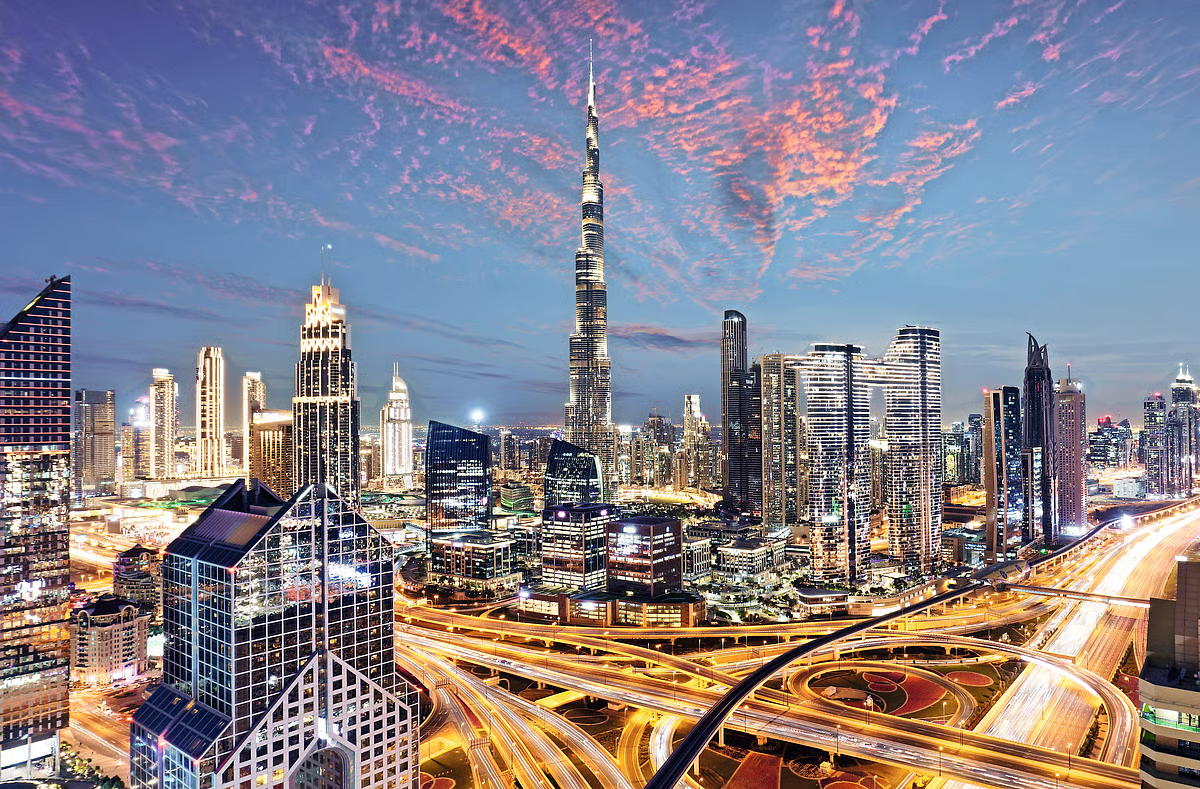
In the Gulf, the cranes don’t just build skylines—they measure momentum. The IMF sees GCC growth set to accelerate, with the UAE leading a push that’s increasingly driven by non-oil sectors such as services, trade, tourism, logistics and finance. Energy still matters, shaping fiscal room and sentiment, but the story is widening: reforms, infrastructure and a more competitive business environment are pulling private activity forward. For companies and investors, the message is less about a single cycle—and more about a region redesigning its economic base.
The lobby smells like espresso and polished stone. A suitcase wheel clicks across marble. Somewhere near the reception desk, a quiet negotiation happens in half-sentences: “Two meetings today… then Abu Dhabi tomorrow.” Outside, the heat presses against the glass, and beyond it—cranes, towers, flyovers—Dubai moves like a city late for its own appointment.
This is what “growth” looks like when it steps out of a spreadsheet. And it’s the atmosphere behind the latest outlook for the Gulf: the International Monetary Fund expects economic growth across the GCC to pick up speed, with the UAE out in front—pulling the region’s non-oil expansion like a locomotive that has learned to run on more than one fuel.
For decades, the world’s shorthand for the Gulf was a single word: oil. Even today, energy prices and production decisions still influence budgets, confidence and capital flows. But walk the business districts now and the soundtrack has changed. You hear the language of services—banking, logistics, hospitality, tech, consulting—spoken with the urgency of timelines and quarterly targets.
The IMF’s view reflects that shift. The Gulf’s growth, it suggests, is no longer a one-engine aircraft. Non-oil activity is expanding—especially in the UAE—supported by reforms that reduce friction for business, by infrastructure that makes scale possible, and by a policy direction that keeps the private sector in the frame, not on the sidelines.
In practical terms, “non-oil” isn’t a slogan. It’s a fully booked flight. A hotel breakfast room humming at 7 a.m. It’s a warehouse district where the loading bays never sleep. It’s a financial centre where compliance teams have become as essential as traders. It’s the steady rise of companies that don’t come to the UAE for a single deal—but to build a base.
In a co-working space with floor-to-ceiling windows, a founder rehearses a pitch. He speaks fast, as if the market might move on without him. Across the table, an investor stops him mid-slide. “How quickly can you replicate this in Saudi? In Qatar?” The founder doesn’t blink. “We’ll pilot here. Scale from here.”
That instinct—use the UAE as a launchpad—helps explain why the country is frequently singled out as a leader in the region’s non-oil momentum. Several ingredients reinforce each other:
From a balcony in Downtown, you can see the economic logic in concrete form. The skyline isn’t just a postcard; it’s a supply chain of offices, apartments, hotels, malls, metro lines and highways—built to host people who arrive with jobs, projects and plans.
The global backdrop remains complicated. Interest rates are higher than the ultra-cheap era many markets grew accustomed to. Geopolitical risk can change shipping routes overnight. Consumer confidence can wobble. In that environment, the IMF’s expectation of stronger GCC growth reads like a bet on resilience: that diversification is becoming more structural than cyclical.
Still, the Gulf doesn’t float above reality. Oil continues to matter, even when the story is “beyond oil.” Energy revenue shapes fiscal space—how much governments can spend on infrastructure, how confidently they can back strategic projects, how easily they can cushion shocks. The difference now is direction: the region appears determined to use energy income as a platform for reinvention, not as an endpoint.
In the late afternoon, when the sun turns the glass towers honey-gold, you can feel the confidence in the city’s rhythm. A taxi driver checks the navigation and says, almost like a daily mantra: “Traffic is heavy today—good for business.” It’s a small line, but it carries a big idea: activity is broadening. It’s not confined to one sector, one commodity, one story.
When economists talk about growth accelerating, they’re really describing decisions—thousands of them—made by companies, households and investors. A firm chooses the UAE for a regional headquarters. A family decides the move is worth it because schools and healthcare are improving. A logistics operator signs a long lease because the trade lanes look durable. A bank hires compliance and risk teams because the market is maturing.
Those decisions feed into the same loop: more people, more demand for space, more pressure on infrastructure, more need for planning. Fast expansion brings its own challenges—congestion, rising rents in certain pockets, competition for skilled talent, and the ever-present risk of oversupply if construction runs ahead of real demand.
But the IMF’s underlying message is that the Gulf—led by the UAE—is building a second, third and fourth engine. That doesn’t eliminate volatility; it changes the shape of it. The economy becomes less hostage to a single price chart and more anchored in multiple income streams.
At night, the city cools by a few degrees and the outdoor terraces fill. A waiter sets down a glass of water and asks, “Meeting or celebration?” The guest laughs: “Both.” That’s the Gulf’s current mood in miniature—work and ambition, stitched together.
If the GCC’s growth is indeed set to accelerate, as the IMF expects, the most important detail may be this: the region’s expansion is increasingly powered by sectors you can walk into, book, ship through, work in and invest behind. And in the UAE, that non-oil engine is not idling—it’s revving.
For real estate investors, faster GCC growth led by UAE non-oil expansion typically translates into broader-based space demand. A services-driven economy doesn’t just add GDP; it adds tenants—headquarter teams, hospitality staff, logistics operators, entrepreneurs, and the steady inflow of skilled professionals who rent first, then often buy.
Bottom line: if diversification keeps deepening, UAE real estate becomes less dependent on headline oil cycles and more tied to repeatable, tenant-led demand. That tends to reward assets with durable fundamentals—location, access, operating quality, and the ability to serve a growing mix of industries.