
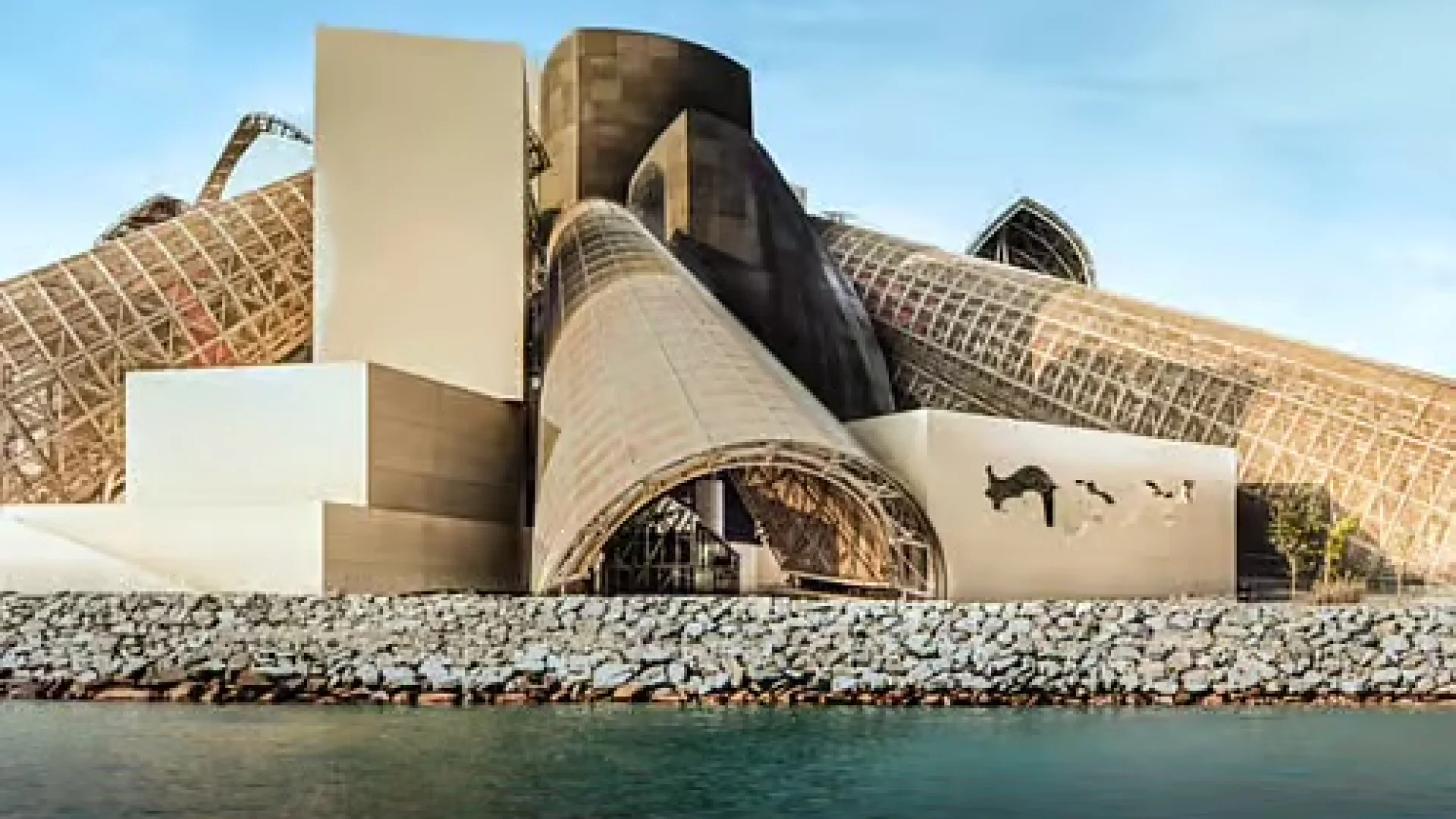
Mark the calendar: Guggenheim Abu Dhabi will open on December 11, 2026, anchoring Abu Dhabi’s Saadiyat Cultural District with a major new global art destination. Positioned as one of the most significant Guggenheim projects, the museum is expected to amplify the island’s growing constellation of cultural landmarks and draw international visitors, artists, and ideas. In a city that thinks in decades, this opening date is more than logistics—it’s a statement about identity, ambition, and the power of culture to reshape a coastline. From architecture to programming, the project signals a new chapter in how Abu Dhabi stages the contemporary world.
The first thing you notice on Saadiyat isn’t the noise. It’s the light.
It slides across pale stone and sea air, turning fences, cranes, and half-finished silhouettes into something strangely cinematic. A gust of wind flicks sand along the pavement like a nervous drumroll. I pause near a barrier and look out toward the cultural district—toward the promise of buildings that will soon hold the kinds of moments people travel for.
“Not long now,” a worker says, nodding toward the site. He doesn’t offer a countdown in days or months. He offers a date—clean, confident, almost ceremonial: December 11, 2026.
That is when Guggenheim Abu Dhabi is scheduled to open in the Saadiyat Cultural District, adding a new gravitational pull to a coastline already transforming into one of the region’s most concentrated cultural addresses. This isn’t just another ribbon cutting. It’s the kind of opening that changes how a city is mapped in the imagination—by tourists, by collectors, by residents, by investors, by anyone who wants to feel the future before it becomes ordinary.
In most places, an opening date is a detail buried in a press release. Here, it lands like a headline you can hear.
December in Abu Dhabi is a sweet spot: evenings soften, the air becomes walkable, and the city’s outdoor rhythm returns—terrace dinners, waterfront strolls, conversations that stretch longer because the heat is no longer pushing everyone indoors. Set an opening then, and you’re not merely inviting people to a museum. You’re inviting them into a season, an atmosphere, a whole itinerary.
Guggenheim Abu Dhabi is described as one of the most substantial Guggenheim projects—an assertion that signals scale and ambition. In practical terms, it means a new global museum brand taking a central place in a district designed to make culture feel like infrastructure: not a weekend pastime, but a permanent engine.
Saadiyat has a particular kind of quiet confidence. It doesn’t shout. It accumulates.
You can feel it while standing near the water: the island is being curated the way an exhibition is curated—by sequence, by contrast, by the promise of a reveal around the next corner. The Saadiyat Cultural District has been steadily building a narrative of international reach, and the Guggenheim’s announced opening date ties a bow around the next act.
A couple stops beside me, debating their future visit like it’s already booked. “We’ll do the museum in the morning,” one says, “and the beach after.” The other laughs: “Or the other way around. Depends on the mood.” That’s Saadiyat’s emerging proposition in a sentence—culture and coastline, art and leisure, all in one place.
Every major museum opening carries two stories.
The first is what happens inside: the exhibitions, the artists, the programming that turns a building into a living institution. The second is what happens outside: the way the city changes around it. New rhythms. New reasons to visit. New weekend habits for residents. New hotel packages. New conversations at dinner tables. “Have you been yet?” becomes a social question—and social questions, quietly, drive footfall.
In that sense, Guggenheim Abu Dhabi is not only a cultural project. It’s an urban project. A branding project. A tourism project. A talent project. It signals that Abu Dhabi wants to be experienced not just as a stopover or a business hub, but as a place that produces and hosts contemporary culture at the highest level.
Think of the Guggenheim name and you think of motion: spirals, ramps, sweeping galleries, visitors drifting like a river from one idea to the next. Even before you know the first exhibition, you know the mood it aims to create—curiosity with a bit of electricity in it.
That energy matters in a region where the contemporary conversation is expanding fast. A major institution doesn’t only display art; it sets a tone. It can legitimize new voices, commission work, frame debates, attract traveling exhibitions, and pull the global art calendar a few degrees closer to the Gulf.
And then there’s the human side—the small, private moment every big museum creates. A teenager stands in front of a piece that doesn’t make immediate sense, then suddenly it does. A visitor sees their own story reflected in a work made thousands of kilometers away. Two friends argue softly about what counts as art, and both leave smiling because the argument was the point.
Abu Dhabi is playing a long game. The city’s cultural investments are designed to compound—each new landmark adding density, credibility, and reasons to return. In that context, the Guggenheim’s opening date is a strategic marker: it gives the world a clear moment to look toward Saadiyat, and it gives the district a narrative milestone that’s easy to remember and easy to plan around.
There’s also something emotionally satisfying about a date. It turns an idea into an appointment. It transforms “someday” into “that day.”
On the waterfront, the wind keeps moving. The site remains behind barriers, not yet open to wandering feet. But the island already feels like it’s rehearsing—like the city is warming up for a night when the doors finally swing wide and the lights inside start doing what museum lights do best: making people stop.
Major cultural anchors often have an outsized influence on nearby real estate markets—not overnight, but through sustained visibility and lifestyle demand. With Guggenheim Abu Dhabi scheduled for December 11, 2026, Saadiyat’s positioning as a premium, culture-led neighborhood becomes even clearer, and that can ripple across pricing, rental demand, and development focus.
Bottom line: cultural infrastructure doesn’t just attract visitors—it attracts commitment. For Saadiyat, the Guggenheim opening date is not only a cultural countdown, but also a marker that the island’s long-term story is firming into a tangible, investable reality.