
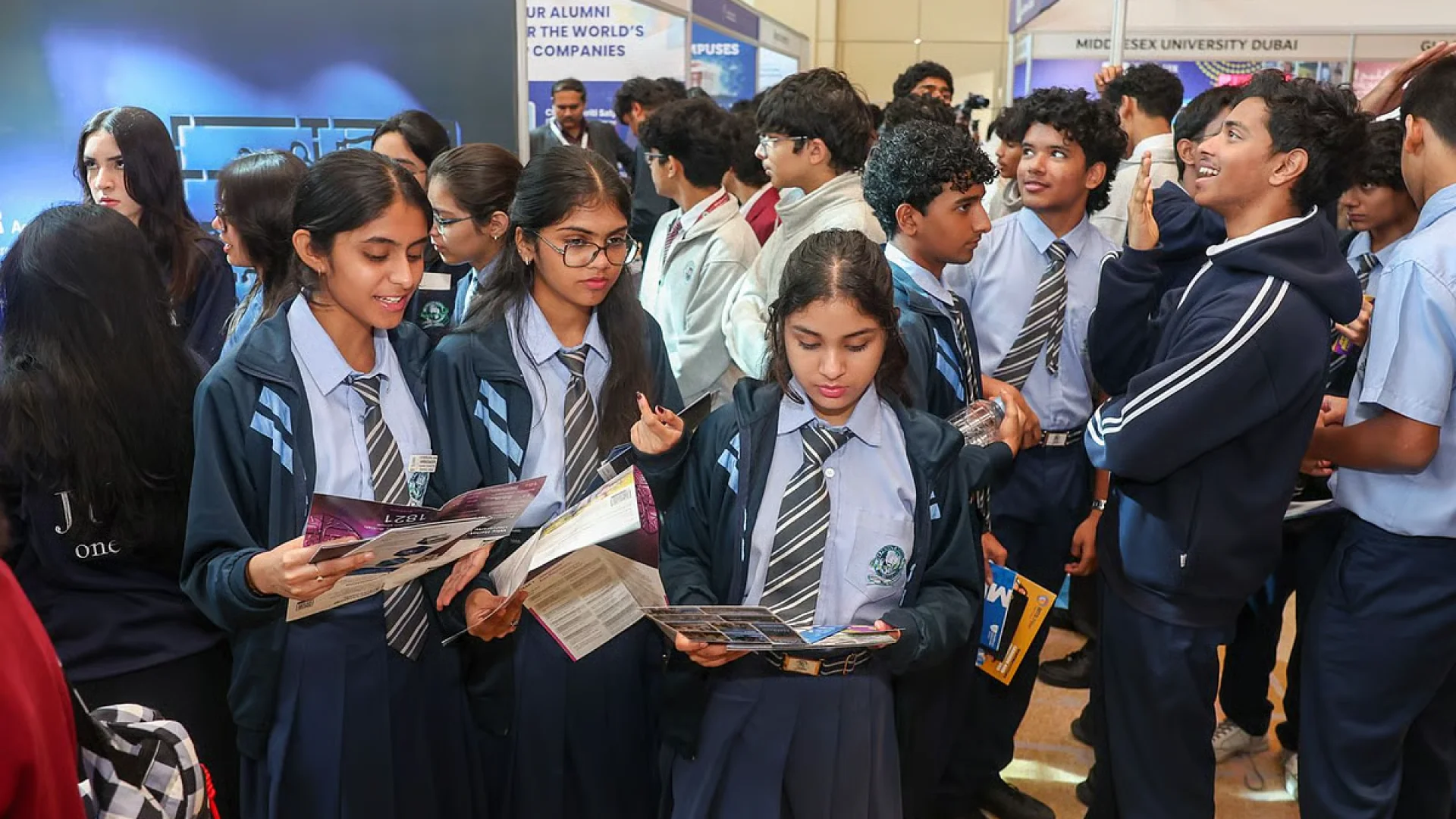

A university brochure becomes a conversation, and a vague ambition starts to look like a real plan. At the Gulf News EduFair, students from some of Dubai’s top schools met higher-education representatives and explored the choices waiting beyond the classroom. The event brought questions about subjects, applications and careers into one place – giving young visitors a clearer view of what comes next.
The future begins with a question. Sometimes it is whispered over a brochure. Sometimes it is asked across a busy exhibition stand: “What do you think I should study?” At the Gulf News EduFair, students from leading Dubai schools came looking for answers – and, in many cases, for better questions.
The education event gave students an opportunity to meet universities and education specialists, compare programmes and learn more about life after school. The atmosphere was practical and energetic. Visitors moved from one stand to another, collecting information about admission requirements, subjects, deadlines and the many routes into higher education.
For a teenager, those choices can feel enormous. Medicine, engineering, business, media, design, technology and countless specialised fields all compete for attention. One student may arrive with a firm ambition. Another may be interested in several subjects but unsure how they connect to a career. The EduFair creates a setting where both kinds of visitor can make progress.
At one stand, a student asks about artificial intelligence. The conversation quickly moves beyond a single degree title. What mathematics is required? Can computing be combined with healthcare or finance? Are there opportunities for research, internships or entrepreneurship? A subject that seemed distant begins to take shape as a series of possible paths.
Education fairs are often described as information events, but their most valuable moments are personal. Students can ask questions that are difficult to answer through a website. Parents can discuss costs, accommodation, student support and international mobility. Teachers and advisers can help young people distinguish between an attractive course name and a programme that genuinely matches their abilities and goals.
That matters in Dubai, an international city where families bring different curricula, languages and expectations. Students may be considering universities in the UAE or abroad. They may be comparing academic traditions, campus cultures and professional opportunities across countries. A face-to-face conversation helps turn a global education market into something more understandable.
The event also shows how quickly the idea of a career is changing. Students are not only asking where they can study. They want to know what skills will remain valuable, how technology will affect professions and whether a degree can lead to flexible work across borders. Universities therefore become more than places to earn qualifications. They are gateways to networks, experience and a changing world of work.
There is a quiet emotional pressure behind every university choice. Students want to make their families proud, but they also want to choose a life that feels like their own. Parents look for quality and security. Schools want their graduates to move forward with confidence. The EduFair brings these perspectives into the same room.
A short exchange can be surprisingly powerful. “This programme sounds like me,” a student might say. “Check the entry subjects,” a parent replies. Another visitor discovers that an initial plan is not the only option. A degree can lead in an unexpected direction, and a different subject combination may open a door that was not visible before.
That is why orientation matters before application season becomes urgent. Early conversations give students time to research, improve their subject choices, prepare documents and understand what institutions expect. They can return to school with a more focused plan rather than a pile of disconnected information.
The Gulf News EduFair also reflects the growing importance of accessible guidance. Young people are expected to make decisions in a world shaped by digital transformation, international competition and new professions. No single event can provide every answer. But a well-timed meeting can replace anxiety with curiosity, and curiosity with action.
By the time students leave, some carry brochures, some have taken notes and others have collected contact details. A few may already know which university they want to investigate next. Others leave with a new question. That is not a failure. It is often the beginning of a thoughtful decision.
In the end, the EduFair is less about choosing a label and more about discovering possibilities. The next step after school is not one identical road for everyone. It is a landscape of choices – and the first step is learning how to read the map.
Education hubs can influence property demand. International schools, universities and training centres attract families, staff and students, creating recurring demand for nearby apartments, family homes, furnished rentals and well-connected residences. For investors, neighbourhoods close to established education institutions may therefore deserve attention as part of a wider location strategy.
In Dubai, proximity to schools and universities is frequently an important factor in a family’s housing decision. Properties near education clusters may benefit from resilient rental interest, particularly when transport links, retail, healthcare and leisure facilities are also strong. Investors should still assess purchase prices, service charges, occupancy prospects, project quality and the long-term development of the area. Education is not a guarantee of returns, but it can be a meaningful demand driver in a balanced property analysis.