
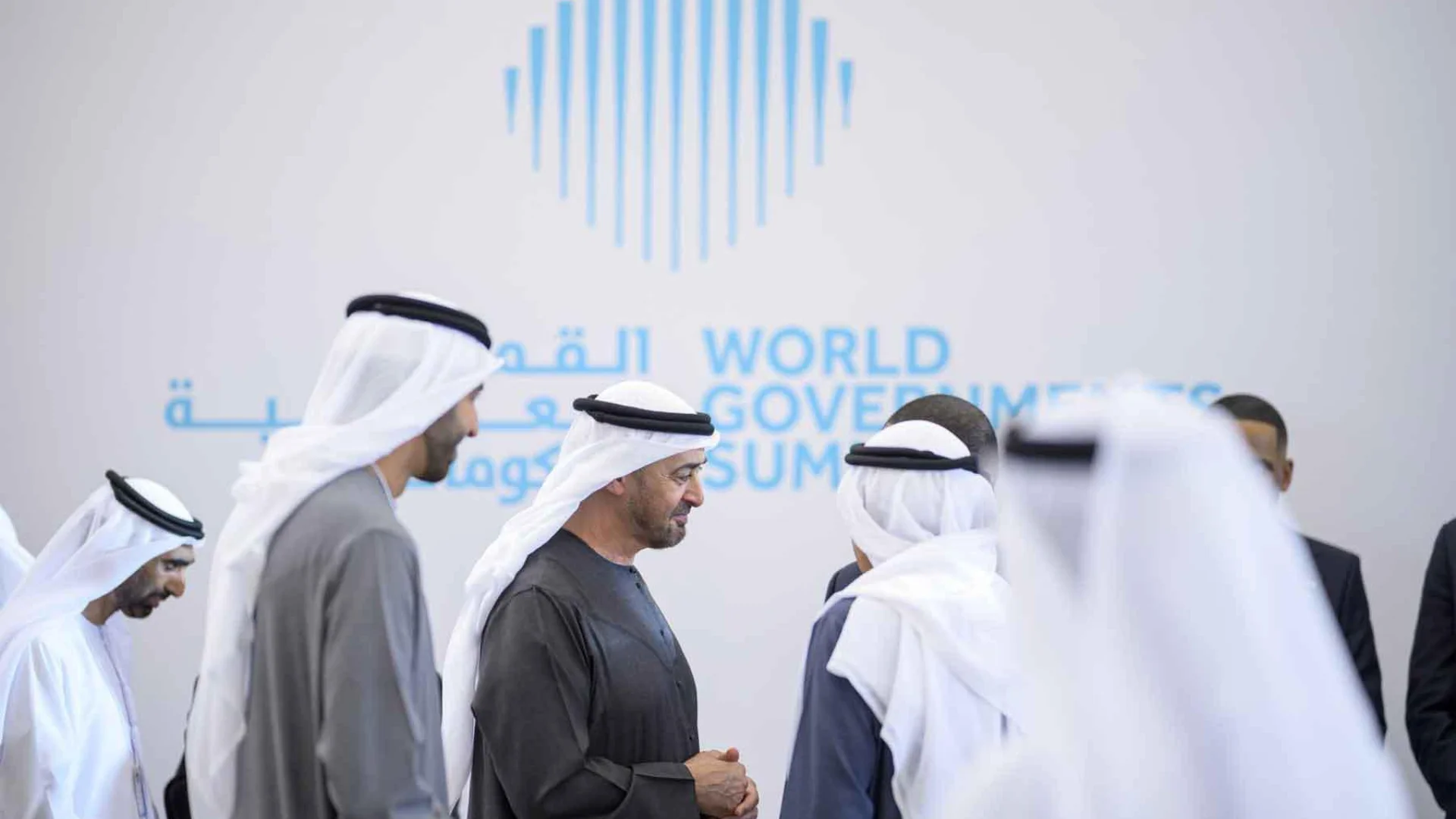

In Dubai, one message cut through the usual talk of growth and disruption: the UAE President framed “human happiness” as the true north of governance. Delivered at the World Governments Summit, the idea is both moral and practical—governments should be judged by how reliably they improve daily life, from service speed to trust and social stability. In a world of anxiety and acceleration, the UAE’s pitch is clear: progress only matters when people can feel it.
The room hums before the speech even begins. Translators adjust headsets. Cameras tilt, find their angles, hold still. Outside, Dubai moves at its familiar pace—glass, traffic, sunlight. Inside, the World Governments Summit feels like a control room for the future.
And then a phrase lands, simple enough to miss if you’re not listening: human happiness. Not as a slogan on a banner. As the center of the story.
At the summit, the UAE President places happiness—real, lived, daily happiness—at the heart of government. It’s a striking choice in a forum usually dominated by the vocabulary of speed: innovation, competitiveness, disruption, AI. Yet that’s precisely why it hits. When everything accelerates, the measure becomes human again.
The World Governments Summit is where leaders come to speak in verbs: transform, modernize, secure, digitize. In the corridors, you can hear the soft clink of badges and the hard edges of ambition. Delegations move in tight clusters. A minister leans in for a quick aside: “Send it tonight.” A consultant replies: “We’ll have it by morning.”
Against that backdrop, happiness sounds almost disarmingly intimate. But the President’s framing makes it operational: happiness as a government outcome, a benchmark that sits above spreadsheets and slogans. The point isn’t that governments should chase good vibes; it’s that they should build systems that make life work—smoothly, fairly, predictably.
Think of a citizen’s day. It starts with a commute, a school drop-off, a medical appointment, a business license renewal, a document that needs stamping—or better, a document that no longer needs stamping at all. Most people don’t experience “the state” as a constitution. They experience it as a queue. A website that crashes. A call center that never answers. Or the opposite: a service that clicks, a process that takes minutes, a city that feels safe at night.
That is where the President’s message aims. Put people at the center. Make services faster. Make decision-making closer to real needs. Treat public administration not as a fortress, but as a living interface between policy and everyday life.
At a summit that routinely showcases digital government and public-sector innovation, the happiness frame functions like a litmus test: if the technology doesn’t improve the human day, what is it for?
The word can sound soft, but its implications are sharp. A happiness-centered approach forces governments to care about trust, social cohesion, mental well-being, and the credibility of institutions. It also reshapes what success looks like. GDP still matters, but so does the quality of schools, the reliability of healthcare, the ease of starting a business, the sense of safety, the design of neighborhoods, the presence of parks, the dignity of public spaces.
In a world carrying more stress than it likes to admit—economic uncertainty, geopolitical shocks, climate pressure, technological upheaval—happiness becomes a resilience strategy. People who feel supported are less likely to panic. Systems that work are less likely to fracture. It’s not sentimental. It’s structural.
There’s also a clear positioning at work. The UAE competes globally for talent, capital, and attention. And the competition is no longer only about tax regimes or headline projects. It is increasingly about liveability: can people build a good life here? Can they move easily, access services quickly, feel safe, educate their children well, enjoy their weekends, trust the future?
By placing happiness at the center, the President ties governance to attractiveness. A government that listens, adapts, and delivers becomes part of the national brand—not in a marketing sense, but in the practical calculus of families and companies choosing where to relocate.
Imagine the difference between a business owner waiting weeks for an approval and one who gets clarity in days. Between a resident stuck in paperwork and one who completes a process on a phone during a coffee break. Between a parent anxious about road safety and a parent who watches cars slow down near a school because the street design makes them.
Happiness lives in these unglamorous details. It shows up as fewer friction points, fewer wasted hours, fewer moments where a system shrugs. The President’s message, delivered from the summit stage, is a reminder that the most impressive statecraft can be invisible: it’s the quiet absence of hassle.
The World Governments Summit thrives on future talk, but the President’s framing pulls the future back to the present tense. If happiness is the core, governments need feedback loops, service metrics that reflect real experience, and the humility to redesign what doesn’t work. They need to treat residents not as recipients but as users—people with limited time, high expectations, and a long memory for broken promises.
In that sense, the message is both aspirational and practical: build the kind of government people can feel—because when people can feel it, they are more likely to trust it.
For real estate investors, “human happiness” is not just a philosophical note—it is a directional signal for planning priorities, regulatory focus, and where future demand will concentrate. When governments explicitly elevate well-being, capital tends to follow the infrastructure and neighborhoods that translate well-being into measurable, rentable value: accessibility, safety, green space, public realm quality, and frictionless services.
1) Liveability becomes a pricing factor
Residential demand in Dubai and Abu Dhabi has increasingly rewarded communities that feel complete: walkable layouts, shaded streets, parks, waterfront access, schools nearby, retail that’s more than convenience. A governance narrative built around happiness supports the “place quality premium”—the gap between assets in well-designed, amenity-rich districts and those that offer only square meters.
2) Stronger tailwinds for mixed-use, community-first masterplans
Happiness-driven policy naturally favors urban planning that reduces daily friction. That typically benefits mixed-use districts and master developments where work, life, and leisure are integrated. For developers and investors, this can translate into more resilient absorption across cycles and diversified income streams (residential + retail + hospitality + office components).
3) Occupier markets: talent retention drives offices
Office leasing decisions increasingly track lifestyle. Firms follow talent; talent follows liveability. If the UAE continues to prioritize service quality and quality of life, Grade-A offices in transit-connected, amenity-rich areas may maintain stronger occupancy and rental tension than secondary stock that lacks surrounding experience.
4) Operational excellence matters more
A happiness-centered approach raises expectations for how buildings and communities are managed: response times, maintenance standards, customer service, digital resident portals. Assets with institutional-grade property management can outperform through lower churn, stronger reputational pull, and better long-run capex discipline.
5) ESG—especially the “S”—moves from reporting to reality
Well-being links directly to ESG performance: thermal comfort, indoor air quality, accessibility, inclusivity, and heat-resilient design. In Gulf climates, shading, greenery, and cooling strategies are not aesthetic extras; they are value drivers that affect retention and willingness to pay. A policy environment that celebrates happiness reinforces the market’s shift toward healthier, more resilient buildings.
Investor lens: The practical implication is to underwrite not only macro growth, but micro experience. Favor assets in districts with strong mobility, community amenities, and credible long-term public investment. In the UAE context, that often means prioritizing established or clearly funded growth corridors, mixed-use nodes, and projects that compete on lived quality—not just skyline presence.