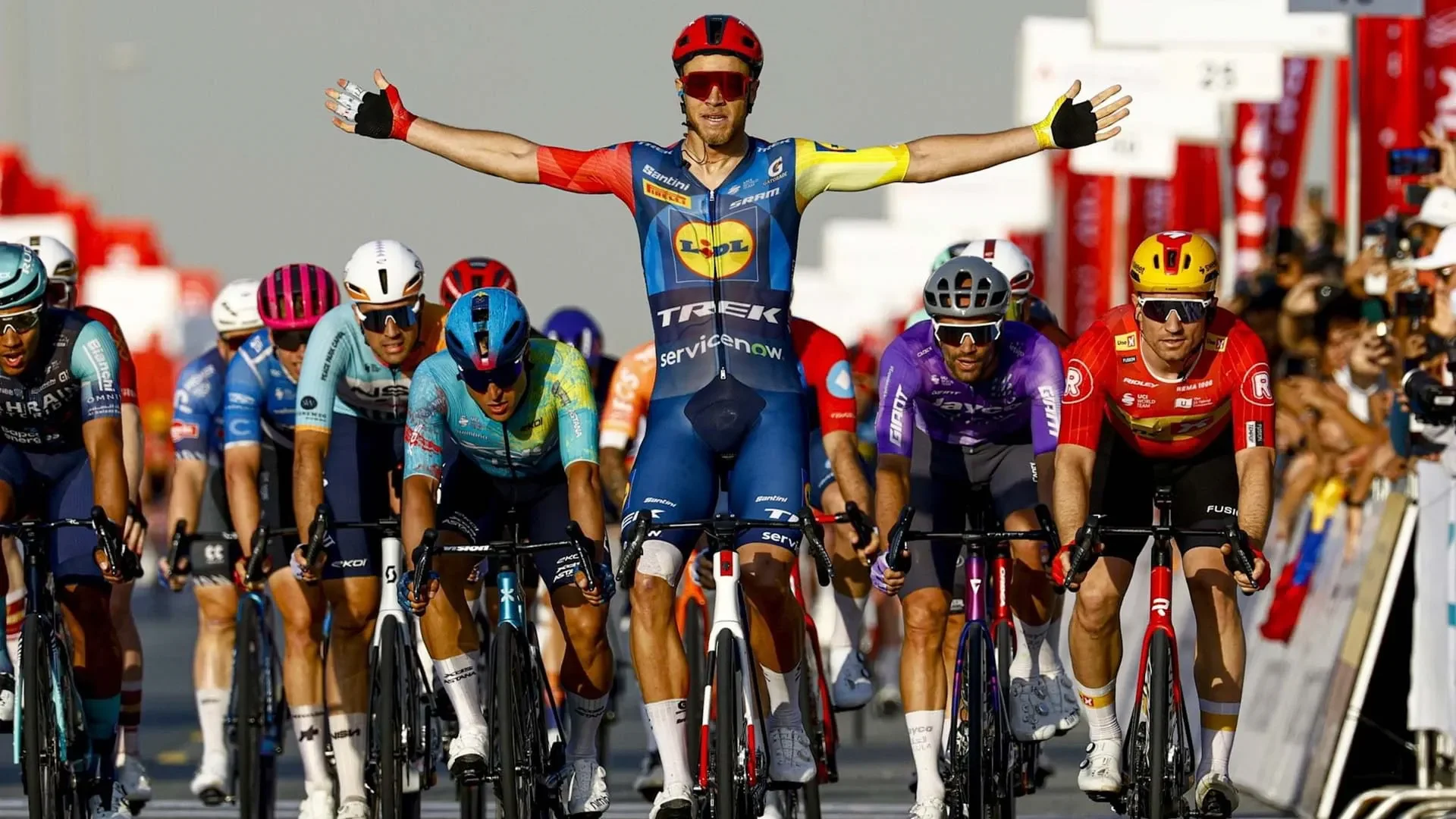
The road looks calm until it suddenly isn’t: Stage 5 of the UAE Tour 2026 detonates into a full-noise sprint, and Jonathan Milan times it to perfection. The Italian launches with unmistakable authority in the final meters, turning a day of controlled tension into a clear statement at the line. It’s the kind of finish the UAE Tour is built for—wide roads, nervous positioning, and one decisive burst of speed. Milan’s win doesn’t just add an этап victory; it reshapes the rhythm of the race, reminding everyone how quickly “steady” becomes “gone.”
You hear the finish before you see it.
A low, rolling hum climbs the road like approaching weather—carbon rims, chains under load, hundreds of tires skimming hot tarmac. The sunlight flashes off helmets. A rider snaps a quick glance over his shoulder. Another barks a word that gets swallowed by wind. And then the bunch tightens, as if an invisible hand has cinched a belt around the entire peloton.
This is Stage 5 of the UAE Tour 2026, the kind of day that can feel like a long, quiet breath—until the last minute turns it into a shout. The break is reeled in. The pace hardens. Teams rise to the front in neat, assertive lines. Lead-out trains appear like locomotives: heavy, purposeful, arriving right on time.
And in the middle of that controlled chaos sits Jonathan Milan. Calm. Massive in the saddle. Not twitchy, not frantic—waiting, reading, conserving. The sort of sprinter who doesn’t look like he’s hunting a win so much as he’s simply heading toward a moment that already belongs to him.
In a bunch sprint, every meter costs something. A match. A teammate. A small slice of courage. The speed climbs, and suddenly the road feels narrower than it looks on TV. Shoulders brush. A front wheel hesitates near a seam in the asphalt. Someone yells—half warning, half threat. The bunch is a living thing now, pulsing toward the line.
Milan stays protected, delivered forward with precision. There’s nothing accidental about a winning sprint here. It’s choreography: one rider pulls off, another hits the wind, a final escort opens a lane, and the sprinter is released like a stone from a sling.
When Milan goes, it doesn’t look like a scramble—it looks like a decision.
He stands just enough to load the bike, then drives it forward with a force that seems to push the air itself aside. The upper body remains almost still. The legs do all the talking. The effect is immediate: rivals respond, but response is always late in a sprint. You don’t “catch” a perfect launch; you hope the rider fades. Milan doesn’t.
The final meters compress into a blur of handlebars and painted road markings, and then the line is there—white, absolute, indifferent. Milan hits it first. A clean, emphatic win in the Stage 5 bunch sprint.
The UAE Tour is built on contrasts: open landscapes, long straight roads, shifting winds—and then these sharp, high-speed finishes where everything is decided in seconds. A sprint win here is not just about raw watts; it’s about surviving the build-up, trusting the lead-out, and choosing the exact moment when speed becomes irreversible.
Milan’s victory underlines that balance. He doesn’t simply outsprint the field; he and his team manage the tension of the day and turn it into a single, decisive move at the end. In a race where form is tested and reputations are measured, winning a stage like this is a statement: I’m here, I’m fast, and I can finish what my team builds.
For spectators, the long middle of a sprint stage can feel like a passing soundtrack: a distant helicopter, a sudden rush of color, then silence again. But inside the bunch, it’s constant calculation—wind direction, roundabouts, small splits, who’s moving up, who’s being boxed in. Riders sip from bottles, adjust sunglasses, listen for radio cues. It’s controlled, until it isn’t.
In the final ten kilometers, the nervous system takes over. Big teams assert themselves at the front, and the fight for the best wheel becomes relentless. The road may be wide, but everyone wants the same strip of shelter, the same clean line into the last corner, the same space to open the sprint.
Milan is exactly where he needs to be—close enough to the front to avoid trouble, patient enough to avoid burning too soon. He waits for the door to open. Then he goes through it.
Beyond the finish, the bunch exhales. Hands lift in small gestures—relief, frustration, respect. Riders coast down, chests heaving, faces tight with effort. A sprint is over quickly, but it empties you all the same.
Stage 5 belongs to Jonathan Milan: a victory carved out of timing, power, and a final straight that rewarded conviction. The UAE Tour 2026 rolls on, with new terrain, new tactics, and new opportunities—but today’s image is clear: Milan, first across the line, turning a quiet day into thunder.
International sporting events like the UAE Tour function as live, global advertising for cities and regions—showcasing roads, logistics, hospitality capacity, and lifestyle positioning. For real estate stakeholders, that visibility can translate into measurable demand signals.