
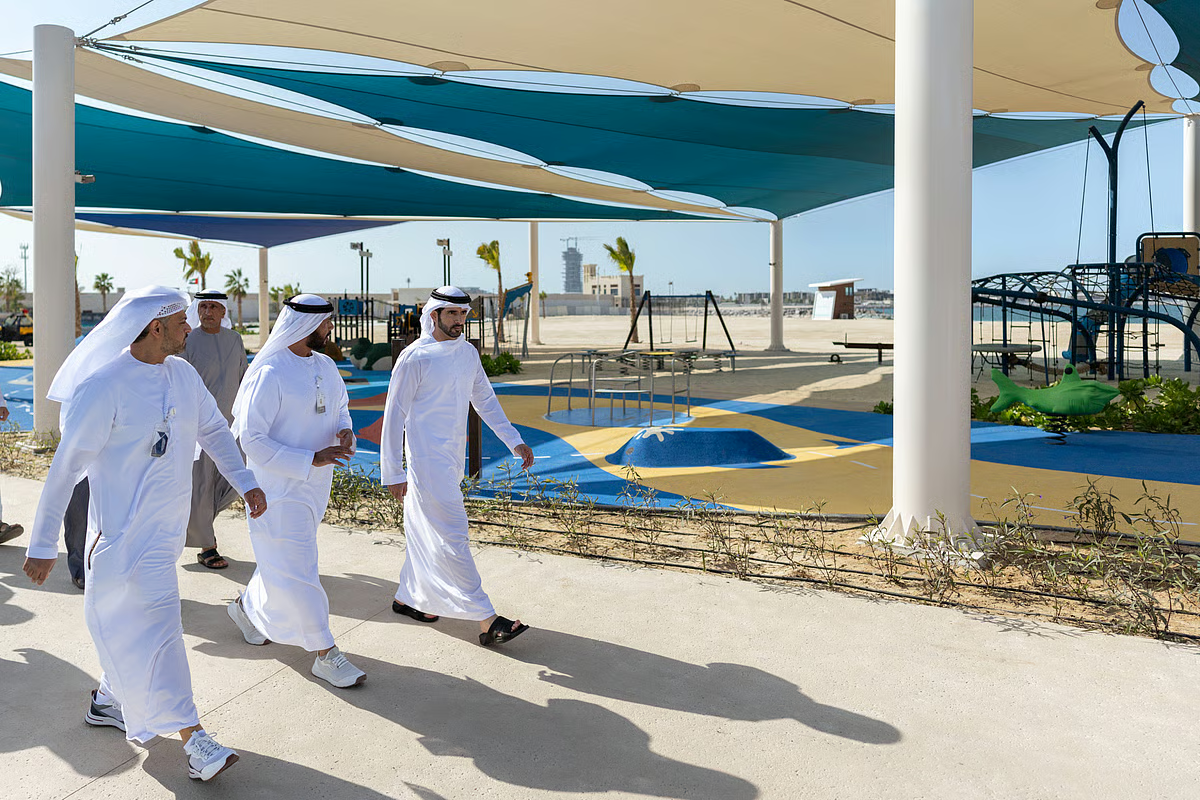

Salt in the air, footsteps on fresh pathways: Dubai is putting the finishing touches on the Jumeirah Beach1 upgrade in Jumeirah, a high-profile enhancement of one of the city’s most lived-in stretches of coastline. Sheikh Hamdan bin Mohammed bin Rashid Al Maktoum inspected the works as the project nears completion, underscoring how seriously the emirate treats public spaces that shape daily life. The upgrade focuses on smoother access, renewed beachfront services and a more comfortable, user-friendly experience for residents and visitors. It’s a reminder that in Dubai, the coast is not just scenery—it’s infrastructure, and it’s being tuned for the next chapter.
The first thing you notice is not a ribbon, or a speech, or a grand unveiling.
It’s the way the beach moves.
A runner glides along the edge of the sand, not weaving around awkward corners. A father balances two iced coffees and doesn’t have to stop to negotiate a messy bottleneck. A couple slows down, looks up, and—without saying much—just knows where the path leads next. That quiet confidence in a place is what good urban design feels like. And it’s exactly what Dubai is chasing as the Jumeirah Beach1 upgrade enters its final stretch.
Sheikh Hamdan bin Mohammed bin Rashid Al Maktoum, Crown Prince of Dubai and Chairman of The Executive Council, visited the site to review progress as the project nears completion. On paper, it’s a straightforward update: better access, upgraded facilities, improved services. On the ground, it reads like something else entirely—Dubai fine-tuning one of its most recognizable public landscapes so it works better for the people who actually use it.
In many cities, the beach is a backdrop. In Dubai, it’s a stage—and a system.
Jumeirah’s coastline isn’t only for tourists chasing the postcard moment. It’s where residents come to breathe between meetings. Where kids learn to ride bikes on weekend mornings. Where friends talk through life-changing decisions with their shoes in hand and the sea as a witness.
That’s why an “upgrade” here matters. It’s not a cosmetic touch-up. It’s the city adjusting a heavily used public space to match the pace of a growing population, stronger visitor numbers, and a lifestyle economy that depends on frictionless experiences.
The project is approaching completion, and its priorities are practical—built around movement, clarity, and comfort. The idea is simple: the easier it is to use the beach, the more it becomes part of everyday life.
You can almost hear the difference in people’s conversations.
“Is it this way?” someone asks, half expecting uncertainty.
“Yeah—look,” comes the reply, already walking.
That tiny exchange is the point. When an environment is designed well, it stops demanding attention. It lets you focus on the day: the sun, the water, the company, the calm.
High-level visits to infrastructure projects are never only about checking timelines. They are about priorities. When the Crown Prince shows up at a beachfront upgrade, it tells you something about how Dubai views public realm investments: not as optional extras, but as foundational to the city’s identity and competitiveness.
Dubai has built global recognition through spectacle—towers, museums, record-breaking architecture. Yet the next phase of city-building is increasingly about what feels good at street level. Shade. Walkability. Seamless access. Clean lines. Clear wayfinding. The kind of upgrades that don’t always trend online, but change daily routines in ways people remember.
Jumeirah is not a blank slate district. It’s layered. Villas and low-rise homes sit close to hotels. Schools spill traffic into morning streets. Cafés are busy before the heat rises. It’s the kind of neighborhood where the beach isn’t a destination—it’s a habit.
So when the beachfront improves, the effect is immediate and local. Better access means more spontaneous visits. Improved services mean longer stays. A more comfortable layout means the beach holds people gently instead of pushing them out with small inconveniences.
And those changes ripple outward. A thriving public realm feeds retail. It supports hospitality. It reinforces the idea that Dubai’s most desirable lifestyle isn’t confined to private clubs and gated experiences—parts of it are shared.
There’s a moment on any upgraded promenade when you realize you’ve stopped scanning for problems.
No more watching your step. No more calculating where the path ends. No more subtle stress of “Are we supposed to be here?” It’s replaced by a different sensation: ease. A sense that the city anticipated you.
That’s the emotional payoff of projects like Jumeirah Beach1. They don’t just add value; they remove friction. They take a beloved place and make it more legible, more welcoming, more consistent with Dubai’s promise of polished experiences—without turning it into something unrecognizable.
As the project nears completion, the shoreline feels like it’s preparing for a busier future: more residents, more visitors, more people choosing the coast not as an event, but as a routine. And in a city that moves quickly, the ability to slow down in a place that works—really works—is quietly priceless.
Beachfront public realm upgrades tend to act like “invisible elevators” for nearby property values: they lift perceptions first, then demand, then pricing—often without the volatility of headline-grabbing mega-projects. For investors, Jumeirah Beach1’s near-completion signals continued commitment to maintaining and enhancing mature, premium neighborhoods, not only launching new districts.
1) Lifestyle infrastructure translates into rent resilience: Improved access, better amenities, and a more comfortable beachfront experience strengthen the everyday appeal of the area. In rental markets, that often supports tighter vacancy periods and modest pricing power—particularly for units that can credibly market “walk-to-beach” convenience, not merely proximity on a map.
2) Micro-location outperforms macro-location: In coastal districts, the difference between a five-minute and a twelve-minute walk—and whether that walk is pleasant—matters. Enhancements to pathways and user flow can shift tenant preferences within the same neighborhood, favoring buildings and villas that connect most directly to upgraded access points.
3) Broader demand base (residents + visitors): Jumeirah is a hybrid market: long-term residents, corporate tenants, and hospitality demand overlap. A better public beachfront strengthens the area’s “all-day” economy—morning fitness, daytime leisure, evening strolls—which supports surrounding retail and short-stay appeal (where regulations and building rules allow), while also bolstering the long-stay story for families and professionals.
4) Exit narrative and capital value: Upgraded public spaces provide a clean, understandable resale narrative: not only “the unit is renovated,” but “the neighborhood experience is improved.” In premium markets, that experiential story can matter as much as finishes, especially for international buyers comparing Dubai’s coastal options.
5) Investor checklist right now:
Bottom line: the Jumeirah Beach1 upgrade reinforces the investment thesis that Dubai’s most established coastal locations are being actively curated, not left to age. That curatorship—especially when it improves daily usability—tends to support long-term demand, stabilize yields, and sustain premium positioning for surrounding residential and hospitality assets.