
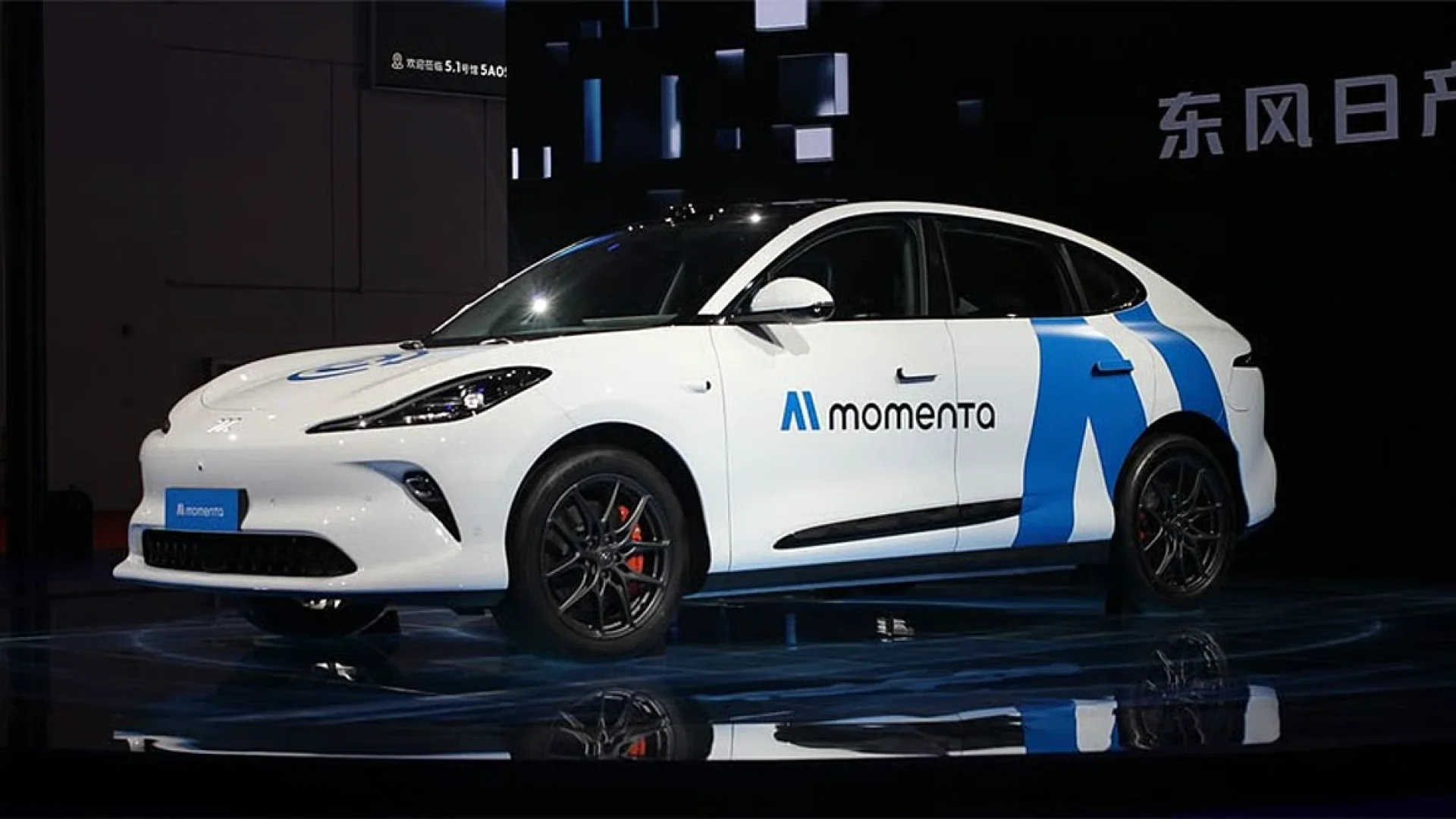

A driverless car crossing a Dubai junction may soon become less of a spectacle and more of an everyday sight. Momenta, the Chinese autonomous-driving company backed by Mercedes-Benz, is looking beyond its home market and targeting Dubai as well as Europe for the next stage of its robotaxi expansion. The move underlines how autonomous mobility is shifting from carefully controlled pilots to a global race for real-world scale.
The first thing passengers notice may be the silence. No driver clears his throat. No hand reaches for the gear selector. The car simply closes its doors, checks the road and moves into Dubai traffic. Outside, towers flash across the windows. Inside, the empty driver’s seat becomes the most striking detail.
This is the future Momenta wants to make ordinary. The Chinese autonomous-driving company, backed by Mercedes-Benz, is preparing to extend its robotaxi ambitions beyond its established markets. Dubai and Europe are at the centre of that international push. The idea is simple to describe and difficult to deliver: summon a car by app, climb in and let software handle the journey.
Dubai is an obvious stage. The emirate has built its reputation on bold infrastructure projects, digital services and a willingness to test new forms of transport. Its roads offer scale, while its authorities have set ambitious goals for autonomous mobility. For a technology company, that combination creates visibility, potential demand and a government actively interested in the next chapter of urban transport.
Robotaxis need more than impressive sensors. They need a city willing to integrate them into daily life. Dubai’s roads bring a demanding mixture of conditions: extreme heat, glare, dust, high-speed traffic, construction zones and sudden changes in visibility. A vehicle that handles a neat demonstration route must also understand the messy reality of a growing metropolis.
Imagine a passenger leaning forward at a red light. “Is it really driving itself?” The question captures the challenge. The software may be confident, but the passenger must be confident too. Public trust will be built one uneventful journey at a time.
Dubai also offers a potential bridge between regions. Its international population, tourism sector and large airport create a steady flow of travellers who are accustomed to app-based services. A successful robotaxi operation could therefore serve residents, visitors and business users at once. It could also provide a visible reference point as Momenta approaches other markets.
Momenta is known for developing software for automated and autonomous driving and for working with major automotive partners. Mercedes-Benz’s backing gives the company an important industrial connection. It also reflects a broader reality: established carmakers need software expertise, while technology companies need manufacturing, safety and market access.
Running robotaxis at scale is a far bigger task than building a capable vehicle. Cars must be serviced, charged, cleaned and positioned where demand is strongest. Remote operations teams need to monitor fleets. Local specialists must understand roadworks, emergency procedures and changing regulations. When a vehicle encounters something outside its operating envelope, the response must be quick and carefully designed.
That is why partnerships matter. Rather than building every piece of a new market alone, Momenta can work with local mobility operators, transport authorities and established platforms. Such cooperation can provide practical knowledge as well as a route to customers. It can also help adapt the service to local expectations.
Europe presents a different kind of challenge. Dense cities, expensive parking and strong demand for convenient short-distance travel could make robotaxis attractive. Yet the continent is not one regulatory market. Rules, road layouts, data requirements and approval processes differ from country to country and sometimes from city to city.
Safety will sit at the centre of every conversation. Who is responsible when an autonomous car makes a mistake? How should sensor data be stored? When can a vehicle operate without a safety driver? What happens to taxi and delivery workers if automated fleets expand? These are not side issues. They will shape the speed and scale of adoption.
For Momenta, entering Europe means teaching its systems to read a patchwork of environments. Road signs change. Lane markings fade. Tram tracks appear in the middle of streets. Cyclists move unpredictably. The technology must do more than recognise objects; it must understand local driving culture and legal context.
The competition is intensifying. Carmakers, technology companies and ride-hailing platforms are pursuing different routes into autonomous transport. Some develop the entire stack themselves. Others combine vehicle manufacturing, mapping, artificial intelligence and fleet operations through partnerships.
The winner will not necessarily be the company with the most spectacular demonstration. It will be the one that can deliver safe, affordable and reliable journeys repeatedly. A robotaxi that works once is a prototype. A fleet that works every day, during heat, rain, roadworks and peak demand, is a business.
For passengers, the appeal is practical. A driverless vehicle could offer consistent availability, predictable journeys and a new sense of privacy. For cities, autonomous fleets could improve vehicle utilisation and connect neighbourhoods to rail and metro networks. But these benefits are not automatic. If robotaxis simply add more vehicles to already crowded streets, they could make congestion worse rather than better.
Autonomous mobility could also reshape the way property is valued. If commuters can work, read or relax while travelling, distance from a central business district may matter less. Well-connected outer districts could become more attractive. At the same time, large parking areas and oversized parking structures might gradually lose some of their value.
New developments will need to think beyond roads and parking bays. Residential towers, hotels and offices may require dedicated pick-up zones, digital access systems and charging capacity. In Dubai, where entire districts are still being planned and built, autonomous transport can be integrated from the beginning rather than added as an afterthought.
Investors should look at the wider mobility ecosystem, not at robotaxis in isolation. Permits, demand, public transport connections, digital infrastructure and the reliability of local operations will determine which locations benefit. A dependable autonomous service could widen access to offices, airports, retail destinations and leisure districts. Over time, that may influence development corridors and tenant preferences.
The expansion will not happen overnight. Technology, regulation, public confidence and economics must move together. But Momenta’s focus on Dubai and Europe shows that the global robotaxi contest has entered a more practical phase. The question is no longer only whether a car can drive itself. It is whether an entire urban service can operate safely, repeatedly and profitably.
The first sign of success may be almost invisible: an ordinary ride, an ordinary conversation and an empty driver’s seat. That is how radical technologies become part of the city. Not with a roar, but with a quiet arrival.