
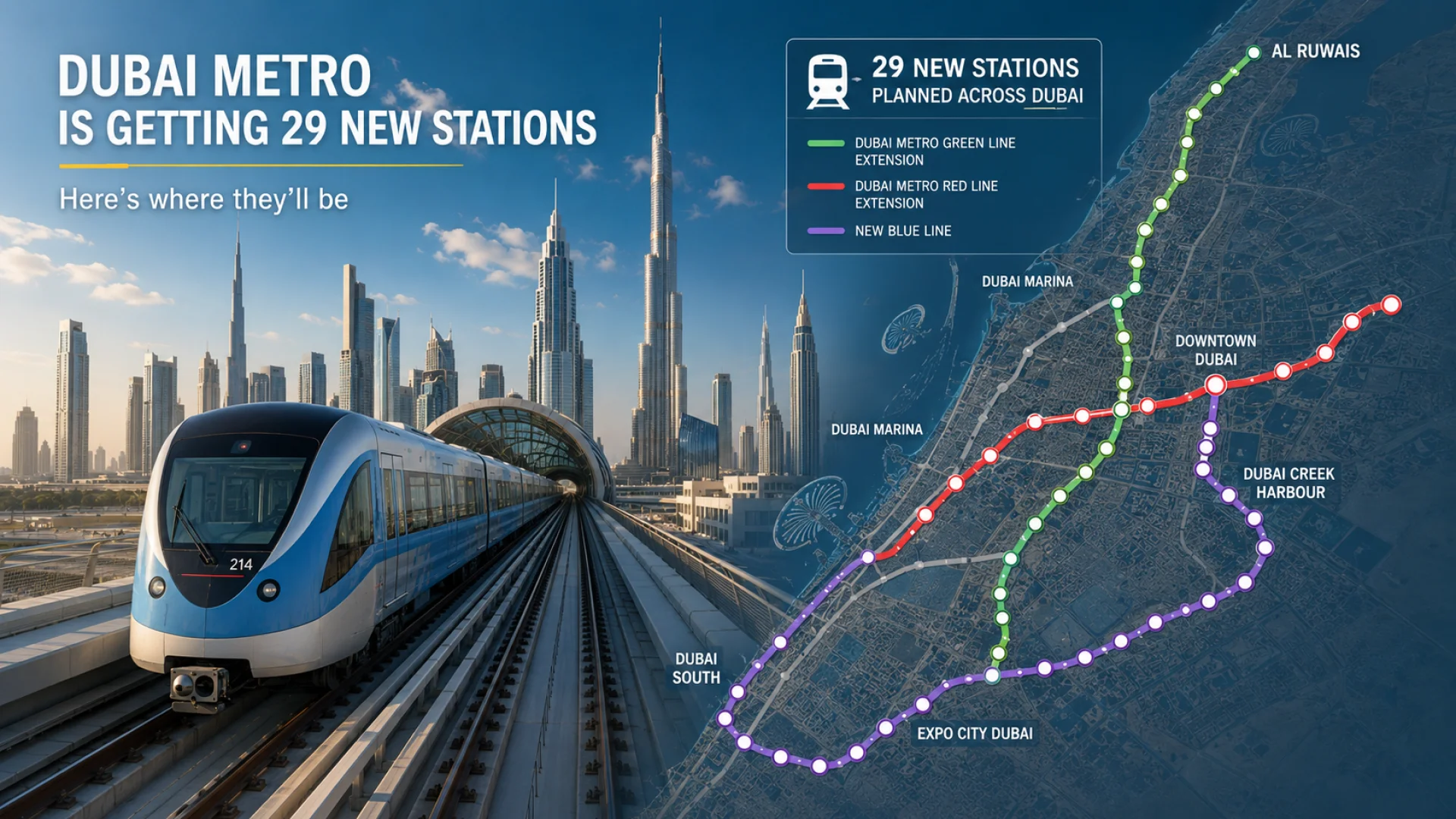

On a Dubai platform, the city feels like it’s been tuned to the future: cool air, glass walls, a soft hum — then the train arrives as if it’s gliding on intention. That everyday moment is set to appear in more neighbourhoods as Dubai moves forward with new metro stations and major network upgrades, with the long-awaited Blue Line at the heart of the plan. The goal is simple and ambitious: faster commutes, smoother interchanges and a rail backbone that keeps pace with the city’s next wave of growth.
The doors chime. A thin line of cold air slips out — a tiny miracle in a city that can feel like a hairdryer on full blast. You step onto the platform and watch your reflection multiply in the glass: commuters with coffee cups, a family herding excited kids, someone in a crisp shirt checking the time like it’s a heartbeat.
Then the train arrives.
Not with the screech of old steel, but with a quiet, confident glide — like Dubai has negotiated a private deal with friction. In that moment, the city doesn’t just look modern. It behaves modern. And Dubai, being Dubai, isn’t content to keep that feeling confined to the same familiar stops. The metro is expanding again — with new stations, upgraded connections, and the headline act: the Dubai Metro Blue Line.
The plan is about extending the reach of the metro into more parts of the city and improving how riders move between lines and key hubs. New stations are expected to support fast-growing districts, bring more residents within reach of rail, and relieve pressure on roads by making public transport the obvious choice — not the brave one.
In Dubai, a station isn’t just a pin on a map. It’s a gravitational pull. Put a stop somewhere and the area starts to act differently: sidewalks get busier, cafés open earlier, residential towers suddenly advertise “minutes to metro” in letters as bold as the skyline.
Ask anyone who tracks Dubai’s infrastructure story and the same phrase keeps surfacing: Blue Line. Designed as a new route to complement the existing network, it’s expected to improve cross-city connectivity, add capacity, and create smoother interchange options. In a city where time is currency, that translates into something deeply personal: less of your life spent inching forward in traffic.
You can hear the impact in everyday conversations — the casual kind, the ones people don’t realise are urban planning in miniature.
“If the new line connects the way they say, I won’t need two changes,” a man says into his phone, pacing near the platform edge.
“Good,” someone replies. “Then you can finally stop leaving before sunrise.”
Small sentences. Big implications.
Dubai’s growth isn’t a slow swell — it’s a steady, deliberate expansion. New communities rise. Business zones multiply. Entire districts are designed to be lived in, not just visited. The challenge is obvious: if everyone drives everywhere, the city’s speed starts to collapse under its own weight.
The metro is Dubai’s answer to that. Not as a nice-to-have, but as an organising system — a way to stitch together where people live, where they work and where they spend their evenings. Rail makes the city feel smaller, even as it keeps getting bigger.
Infrastructure stories are usually told in numbers: kilometres, budgets, completion dates. But the lived version is simpler. A new station means your commute stops being a daily gamble. It means you can plan dinner without building your whole day around the drive. It means a job across town becomes realistic — not just aspirational.
And then there’s the ripple effect. The moment a station arrives, the surrounding area starts to transform into a small ecosystem: convenience stores that know your routine, gyms that fill up after work, pharmacies, cafés, quick-service restaurants. The metro doesn’t just move people; it creates footfall — and footfall creates place.
Dubai is famous for its visible ambition — towers, islands, highways that look like they were drawn with a ruler. But some of its most powerful change happens quietly, at platform level. New rail links rewrite the mental map of the city. “Far” becomes “one ride away.” “Hard to reach” becomes “right on the line.”
That matters more than it sounds. Because cities aren’t just built out of concrete. They’re built out of routines. The places you can get to easily become the places you go. Over time, that shapes everything from where families choose to live to which neighbourhoods attract new businesses.
In the late afternoon, when the sun turns the station glass into sheets of amber, the metro feels like Dubai’s most honest portrait. People from everywhere, moving in the same direction for a while. A teenager laughs at something on a screen. A nurse adjusts her bag strap. A tourist points at the skyline, trying to catch it without glare.
The train arrives. The doors open. Life flows in.
And soon — with new stations and the Blue Line pushing the network outward — that flow will reach deeper into the city’s newer edges, turning them into connected places instead of distant coordinates.
For property investors, metro expansion in Dubai is rarely just “good news” — it’s a measurable driver of demand, liquidity and pricing. When a station moves from concept to construction to operation, the surrounding market often experiences a step-change: rentals lease faster, resale pools widen, and “minutes to metro” becomes a premium feature rather than a brochure line.
1) The metro premium: why it happens
Dubai’s housing market is strongly shaped by commute time. A reliable rail connection reduces the friction of distance, which increases the practical tenant/buyer catchment area for a building. That tends to support:
2) Which segments may benefit most
3) Timing strategy: before vs after opening
Markets typically price transit improvements in phases. Early stages (announcement/planning) can offer mispricing opportunities but come with uncertainty. During construction, attention rises — but so do short-term nuisances (noise, detours). Post-opening, performance becomes visible in leasing velocity and rent levels. Investors often aim to secure quality assets before the full operational premium is reflected, while stress-testing timelines and delivery risk.
4) What to check before buying near a future station
Bottom line
The Blue Line and new stations aren’t only about getting people from A to B. They change what “A” and “B” are worth. For investors, mapping likely station areas and interchange nodes against upcoming residential and commercial supply is one of the most practical ways to identify tomorrow’s high-demand pockets — before the market consensus arrives.