
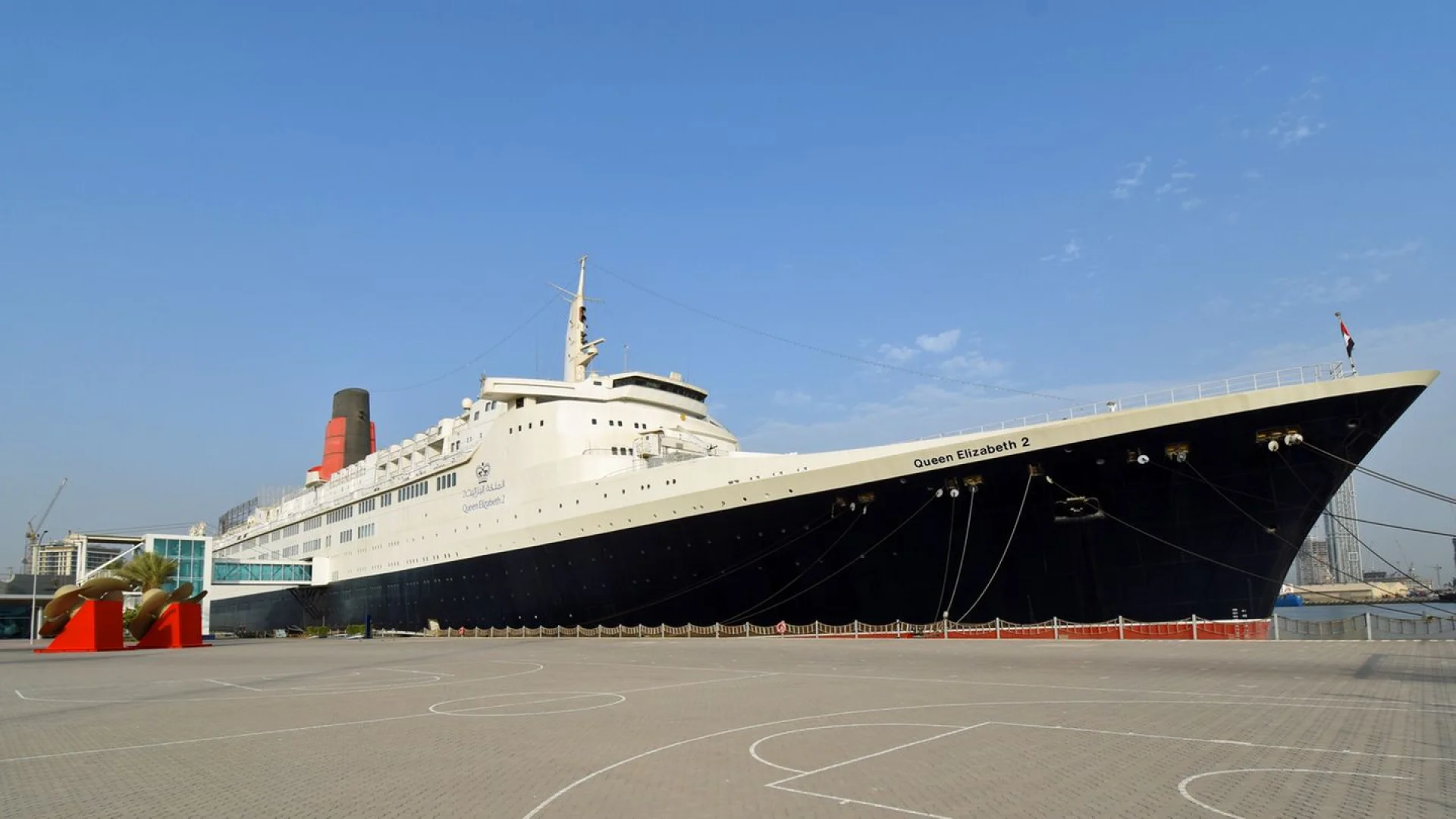
In Dubai’s evening heat, the Queen Elizabeth 2 no longer cuts through waves—she holds her ground like a waterfront building with a heartbeat. Once a transatlantic icon of British glamour, the former ocean liner has been reborn as a permanently moored hotel, blending preserved details with contemporary guest expectations. Corridors feel like time tunnels; cabins become rooms; lounges keep their old-world hush. The QE2’s second life is more than nostalgia—it’s a masterclass in turning legacy into a destination.
The city is loud—until it isn’t. There’s a minute at dusk when Dubai’s edges soften, when glass towers stop glittering quite so aggressively and the air tastes faintly of salt. That’s when you see her properly. The Queen Elizabeth 2. Not a postcard silhouette, not a logo, but a vast, grounded presence of steel and memory.
She doesn’t move anymore. And that is the first surprise. A ship, built for crossings and horizons, now behaves like architecture. Fixed. Addressable. Photographed from the promenade like a landmark you’d meet at: “See you by the QE2.”
“I thought she’d feel… smaller,” a guest murmurs beside me, as if speaking too loudly might wake something sleeping inside the hull. The QE2 answers in her own language—clean lines, a confident bow, railings that still look prepared for wind. Her new role is not to depart. Her new role is to receive.
Boarding is a change of sound. Outside: engines, laughter, the clipped rhythm of a city that doesn’t like to pause. Inside: carpet. Soft steps. A faint scent of polish and wood, the way old places smell when they’ve been cared for rather than replaced.
Cabins have become hotel rooms. The logic is different now—check-in, room keys, housekeeping schedules—but the proportions still whisper of ocean travel: compact, clever, designed for a world that once rocked gently beneath your feet. You notice doorways that feel slightly narrower than modern hotels. You notice corners made for utility, not Instagram.
And yet the romance is stubborn. It clings to the ship like a well-tailored jacket. The QE2 was never just transportation. She was an event, a floating stage where people dressed for dinner and measured distance in days, not hours.
Walking her corridors feels like moving through layers. Some spaces are curated like a museum—details highlighted, history framed, the past offered neatly to the present. Other spaces are unmistakably modern, shaped by the demands of today’s hospitality: comfort standards, operations, the need to make a famous name work as a sustainable product.
This tension is exactly what makes the QE2 compelling. She is not a relic behind ropes. She is a place. And places need reasons—reasons for families, couples, business travelers, the curious, the sentimental. Dubai understands this math: turn a story into an anchor, then let the anchor pull in footfall, attention, spending.
In a city that loves the new, the QE2 offers something rarer: the old that’s truly old. Not “vintage-inspired.” Not “heritage-themed.” But built-in authenticity—steel and craftsmanship shaped decades ago, carrying a name that still lands with weight.
A child runs a palm along the wall as if history has texture. The father leans toward a plaque, reading dates under his breath. The mother says, quietly: “Imagine crossing the ocean in this.”
That’s the secret power of a ship-turned-hotel: it invites you to time-travel without asking you to try too hard. Modern hotels can be flawless and forgettable. The QE2 has edges. She has a past. Her spaces were designed for motion—seasickness and celebration, storms and champagne—so even in stillness, the ship feels alive.
It’s easy to picture the old scenes: tuxedos, captains, flashes from cameras. But the ship also speaks of engineering and logistics, of an era when ocean liners were not nostalgia but necessity. Air travel changed that. The QE2 survived it. And now she survives again, by becoming something else.
When a ship stops sailing, the world flips. “Location” used to mean itinerary. Now it means neighborhood. View corridor. Access roads. The quality of the waterfront around you. The surrounding ecosystem of restaurants, attractions, conference venues.
Dubai’s waterfront is already a theater—promenades, marinas, hotels, curated leisure. The QE2 steps into that stage with a paradoxical advantage: she is a landmark that wasn’t fabricated for this decade. Her luxury is not in novelty, but in provenance.
Of course, provenance alone doesn’t run a property. Turning a liner into a hotel involves continuous investment: safety standards, mechanical systems, corrosion control, energy demands, staffing. A ship that stands still ages in its own way. The challenge is to preserve patina without letting it become wear.
Later, in a lounge, I catch a conversation at the next table. “I always wanted to see the QE2,” a man says, mid-fifties, the sentence sounding like a box finally ticked. His companion smiles. “It’s like stepping into a film.”
That’s the modern travel economy in one line. People don’t just book rooms. They book moods. They book stories they can walk through. The QE2 is a ready-made narrative: corridor as chapter, cabin as scene, dining room as a memory you haven’t had yet.
And unlike themed hotels, she can’t be easily copied. You can imitate brass and carpet. You can’t imitate having been there. The ship’s authenticity—however curated—remains her most valuable asset.
The QE2 distills a trend reshaping hospitality and urban real estate: experience-driven adaptive reuse. A once-mobile asset is effectively converted into a fixed-income property—closer to a landmark hotel or mixed-use anchor than to a conventional lodging product. For investors, it’s a case study in how narrative, uniqueness, and waterfront positioning can translate into pricing power—if operational execution keeps pace.
1) Micro-location matters more than ever: In a project where the asset itself is the draw, access and visibility still determine performance. Waterfront footfall, proximity to complementary leisure uses, and transport connectivity influence occupancy and event demand. This mirrors broader waterfront real estate dynamics: scarce shoreline, premium views, and strong place-making often support resilient values.
2) Hybrid revenue model: Assets like the QE2 can monetize beyond room nights—food & beverage, meetings and events, guided experiences, branded retail. That diversification can reduce seasonality but increases operational complexity. Investors should scrutinize operator capability, contract structure (lease vs. management), and who carries CapEx responsibilities.
3) CapEx intensity and lifecycle planning: Iconic conversions typically require higher ongoing maintenance budgets than standard hotels. Marine-grade materials, corrosion mitigation, safety compliance, and specialized systems can create recurring capital needs. Underwriting should include robust reserves and conservative assumptions for periodic refurbishment.
4) Branding as a value lever: The QE2 demonstrates how brand equity can become real estate equity. In markets saturated with new, similar hotel inventory, a globally recognized heritage asset can protect ADR and support stable demand. For developers, the lesson is transferable: identify properties with embedded stories—historic infrastructure, industrial heritage, cultural icons—where reuse is feasible.
5) Spillover into surrounding real estate: Signature attractions often lift adjacent values by generating consistent visitation and media attention. That can open opportunities in the immediate catchment—serviced apartments, F&B leases, retail frontage, and complementary leisure concepts. In master-planned waterfront districts, one anchor asset can materially influence absorption and tenant mix.
Bottom line: The QE2 is proof that, increasingly, investors aren’t just buying square meters—they’re buying story per square meter. When location quality, operational excellence, and disciplined CapEx planning align, iconic adaptive reuse can compete not by being newest, but by being unforgettable.