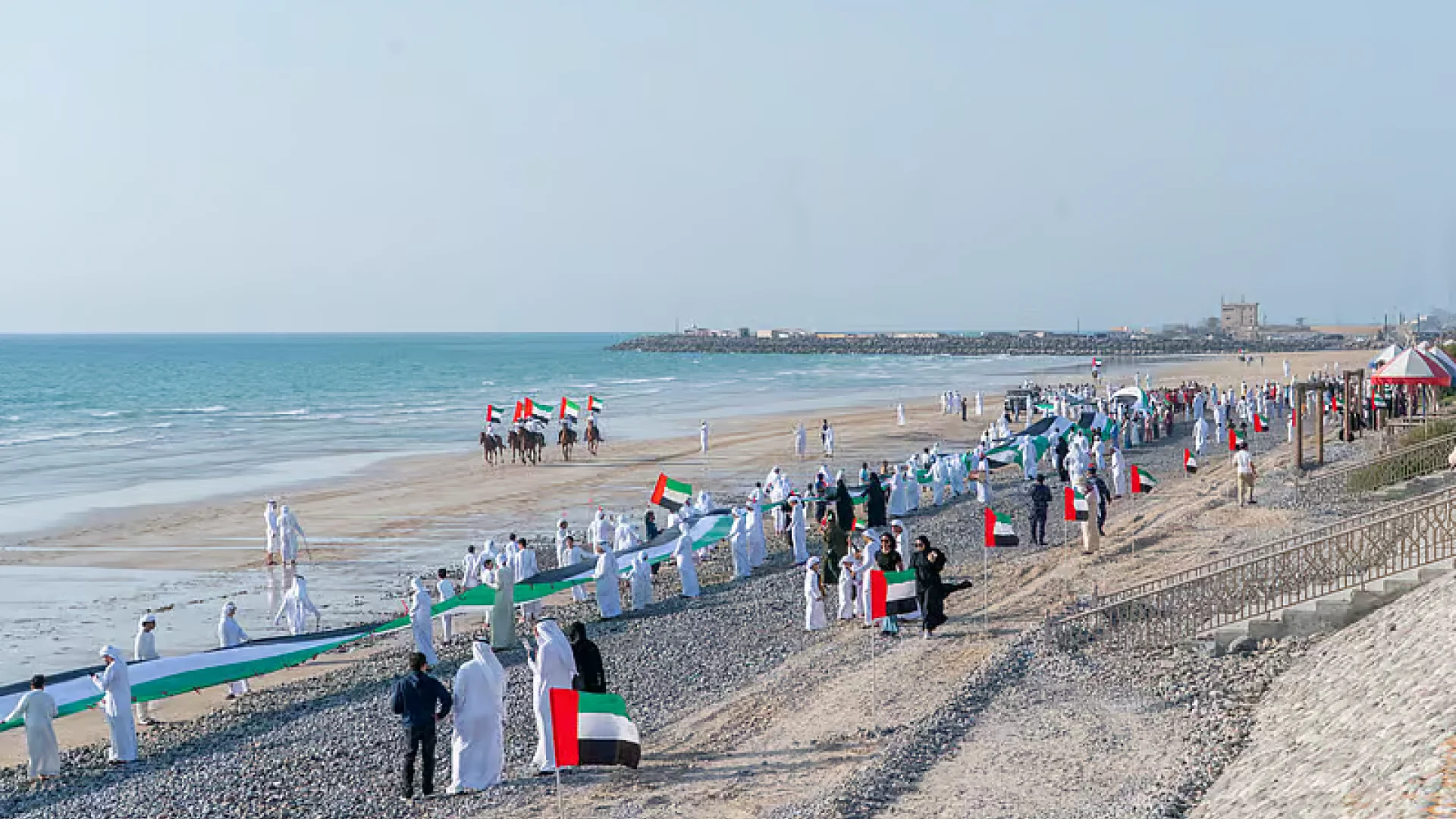
On the shoreline of Shaam Beach in Ras Al Khaimah, the UAE’s colours are expected to stretch into something almost unreal: a flag measuring 1,200 metres in length. The plan turns a quiet strip of coast into a stage for national pride, a record-scale visual and a ready-made aerial image built for the modern attention economy. Beyond symbolism, the spectacle feeds directly into RAK’s wider push to sharpen its tourism identity and amplify its investment narrative along the northern coast.
The beach is still waking up when the first hint arrives—not in an announcement, but in the sound of fabric catching the wind. The sea is a muted silver, the sand cool underfoot. A father points out to his daughter where the water turns from pale green to deep blue. Somewhere behind them, someone laughs: “No way that’s what I think it is.”
At Shaam Beach, Ras Al Khaimah is preparing a scene designed to stop people mid-step: the unfurling of a 1,200-metre-long UAE flag. Not a flag on a pole. Not a flag on a building. A flag that becomes a landscape—spilling across the shore like a ribbon of colour, so long the eye has to work to understand it.
It’s the kind of idea that makes you squint first, then reach for your phone. Because scale has a new language now. It’s not just measured in metres; it’s measured in drone shots, in panoramic reels, in that one overhead image that says: This happened here.
Shaam Beach isn’t the loudest address in the UAE’s coastal conversation. It doesn’t arrive with neon confidence or a skyline postcard. It’s calmer than that—family picnics, weekend strolls, children collecting shells, fishermen who know the rhythm of the tide better than the rhythm of traffic.
And that calm is exactly why it works.
A 1,200-metre flag needs breathing space. It needs a clean horizon line, a stretch of sand that behaves like an open canvas. It needs the sea as a backdrop, not a distraction. On this coast, the elements cooperate: wind to animate the fabric, light to sharpen the colours, emptiness to make the size feel even bigger.
In the UAE, the flag is never just decoration. It’s identity, unity, a shared story told in four colours. To lay out a flag at this scale is to turn pride into a physical experience: something you can walk beside, photograph from above, remember as a day when the nation’s symbol felt larger than the frame.
Imagine the micro-scenes that will play out along the edge of the cloth. A teenager pacing it off with friends—“We’ll never reach the end.” A grandmother adjusting her scarf as the wind lifts the corner. A small boy tugging at his father’s sleeve: “Is this the biggest one?” And the father, smiling: “It’s big enough to make everyone look.”
That’s the real power of record-scale gestures. They don’t just announce themselves; they gather people into the same moment.
Big visuals are a currency. Travelers don’t only book places; they book stories. And stories today travel at the speed of shares.
For Ras Al Khaimah, the 1,200-metre flag fits neatly into a broader strategy: building a recognisable identity that blends nature, coastline and experience. RAK has been steadily stepping into the spotlight as a destination for outdoor adventure, resort stays and quieter luxury—an alternative rhythm to the region’s more saturated urban hubs.
A headline-grabbing beach spectacle doesn’t replace that substance. It amplifies it. It gives the media a hook, visitors a reason, and the destination a moment that can be re-used—across campaigns, year-end highlight reels, and the mental maps of people choosing where to go next.
There’s an unspoken second storyline here: competence.
You don’t handle 1,200 metres of fabric on a windy shore without planning. You need coordination, safety measures, crowd management, timing, and a respect for the coastline itself. If the execution is smooth, the message extends beyond patriotism: it says the emirate can deliver complex public events—an attribute that matters in tourism, yes, but also in business, infrastructure and investment confidence.
Modern destinations are judged on how they manage attention without damaging what made them attractive in the first place. The best events arrive like a wave: a surge of energy and visitors, then a clean return to normal.
Later, when the sun climbs and the sea turns brighter, the colours will look different—sharper, warmer, more alive. That’s what the Gulf light does: it makes everything feel cinematic. And the flag, spread across the shoreline, will likely do what it was designed to do: make people stop, then smile, then step closer.
There’s a particular hush that arrives when something is both simple and enormous. A flag is familiar. But at 1,200 metres, familiarity flips into awe. You don’t just see it—you feel the scale in your legs as you walk, in your voice as you say, “It keeps going.”
For Ras Al Khaimah, that feeling is the point. A moment that lodges itself in memory. A picture that travels. A coastline that, for a day, becomes part of a national narrative written in fabric and wind.
For real estate investors, landmark-scale public spectacles are not just “nice headlines.” They are demand signals—soft indicators of how aggressively a destination is shaping its brand, and how effectively it can convert attention into visitation, spending and longer-term residential interest.
1) Tourism visibility → occupancy uplift: High-impact events can drive short-term spikes in hotel and short-stay occupancy, especially around weekends and domestic travel peaks. Over time, repeated visibility strengthens destination awareness, which supports steadier booking pipelines for hospitality assets, serviced apartments and regulated holiday homes in coastal micro-markets.
2) Place-branding that helps sell projects: Developers and brokers know the friction point: unfamiliar locations require more explanation. A globally shareable image tied to Shaam Beach makes the northern coastline easier to market. It compresses the “Where is that?” phase and accelerates the “We should go see it” curiosity—useful for off-plan launches, resort-branded residences and lifestyle-led communities.
3) Execution capability as comfort: Events at this scale require coordination across permitting, public safety, transport management and on-site operations. Successful delivery signals governance capacity, which matters to institutional and private investors assessing project risk, timelines and the practicality of operating assets in-market.
4) Don’t confuse buzz with fundamentals: While branding can lift demand, sustainable price growth still depends on fundamentals: pipeline discipline, employment drivers, connectivity, tourism seasonality, and the regulatory environment for rentals and ownership structures. Investors should treat the flag event as a positive momentum indicator—not a substitute for underwriting based on conservative rent, ADR and occupancy assumptions.
5) What to watch in RAK: The biggest beneficiaries tend to be assets that sit close to experience corridors—beachfront plots, mixed-use waterfront promenades, F&B-led retail strips, and residences with strong short-stay appeal. If RAK continues stacking “moments” like this alongside infrastructure and hospitality expansion, coastal zones can see improved liquidity and stronger resale narratives.
Investor takeaway: The 1,200-metre flag is a symbol, but symbols move markets when they move people. For investors tracking Ras Al Khaimah, it’s another data point that the emirate is actively manufacturing visibility—an ingredient that, when paired with solid fundamentals, can translate into demand for coastal hospitality and lifestyle real estate.