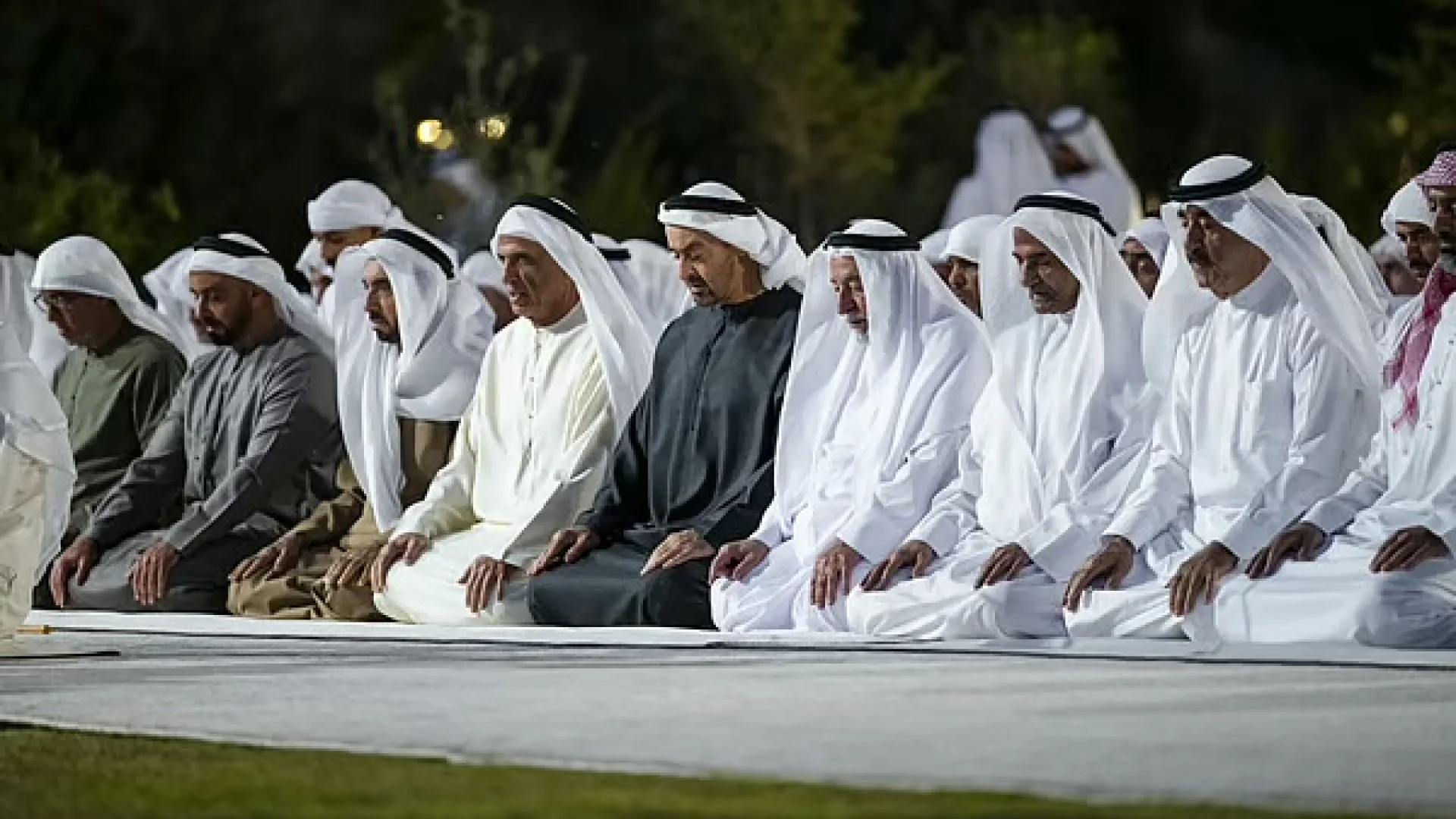
As daylight thinned into amber, UAE President Sheikh Mohamed bin Zayed Al Nahyan welcomed the rulers of the Emirates and senior officials for a Ramadan iftar. Beyond the dates and coffee, the gathering carried a clear message: the federation’s leadership is aligned, present, and steady. In a month defined by reflection and community, the image of leaders breaking fast together becomes a national signal—quiet, cultural, and strategically powerful.
The city always changes a little just before maghrib.
The air softens. Traffic sounds fade into a distant hush. People glance at their phones, then at the horizon, as if the sky itself is keeping time. Inside, the lighting turns warm—gold on glass, bronze on stone. Someone adjusts a tray. Someone whispers, “Almost.”
And then, in that intimate pause between hunger and relief, a scene with national gravity unfolds: UAE President Sheikh Mohamed bin Zayed Al Nahyan hosting the rulers of the Emirates and senior figures for a Ramadan iftar.
It is, in the simplest sense, a meal. In the Emirati sense, it is also a message—delivered without a podium, without urgency, without noise. A message that travels precisely because it is calm: unity, continuity, and a federation that knows how to sit together.
In Ramadan, the UAE moves on a shared rhythm. Kitchens across the country start to hum in late afternoon. Cafes get quieter. Workdays end a little earlier. Families gather. The first sip of water becomes a small ceremony repeated millions of times.
That’s why an iftar at the highest level doesn’t feel like a distant state function. It feels connected—plugged into the same national heartbeat. When the President and the rulers of the Emirates break fast together, the country reads the moment with an instinctive fluency: this is togetherness made visible.
There’s a particular power in leadership that doesn’t need to announce itself. No booming statements. No dramatic choreography. Just presence. Handshakes that linger a second longer than protocol requires. A quiet exchange—“Ramadan kareem.” “Allah ykaremk.” A brief smile that says, we’re here.
The UAE is a federation by design and by daily practice—seven Emirates, each with its own identity and priorities, moving forward under a shared national framework. That framework isn’t maintained only through policies and institutions. It is maintained through relationships, through trust, through repeated moments where alignment is renewed in public view.
At an iftar like this, the details carry the story. Who is present. How the room holds itself. How tradition and modern statehood sit comfortably side by side—like two guests who have known each other for decades.
The setting matters, too. Ramadan is not just a time of fasting; it is a season of generosity, restraint, and community. It offers a moral vocabulary that people recognize instantly. When leaders choose this month—and this ritual—as the frame for togetherness, the signal lands with extra weight.
It’s tempting, especially in international headlines, to treat political gatherings as transactional: what was announced, what was signed, what was decided. But some meetings are built to do something subtler. They don’t produce a document. They produce reassurance.
Reassurance is not an abstract concept in a fast-moving country. It becomes concrete in daily life: long-term projects that keep moving, infrastructure that arrives on schedule, plans that don’t evaporate overnight. In places growing as quickly as the UAE, people don’t only look for ambition. They look for steadiness to match it.
So the image of the President hosting the Emirates’ rulers for iftar works on multiple layers at once. To citizens and residents, it reads as cohesion. To regional observers, it reads as stability. To international partners, it reads as continuity.
There is a form of diplomacy in hospitality—especially in the Gulf, where welcoming someone is both culture and communication. An iftar table is not merely about food; it is about respect. It is about listening. It is about acknowledging a shared moral season.
Even the sequence tells a story. Dates first. Water first. The simple before the elaborate. It’s a ritual of humility that levels the room, no matter the titles. For a few minutes, everyone is simply waiting for the same call to prayer, sharing the same human need.
That shared moment—brief, ordinary, profound—is exactly why Ramadan gatherings carry political meaning without turning political in tone.
In a region where narratives can turn quickly and markets are sensitive to confidence, the UAE’s leadership often communicates through consistency as much as through announcements. An iftar bringing together the federation’s top leaders reinforces a fundamental premise: coordination is intact; the center holds.
And that premise has a ripple effect. It shapes how businesses plan expansions, how families decide to stay, how international talent evaluates the future, and how investors price long-term risk. Not because a single dinner changes policy—but because it strengthens the underlying picture of governance.
For real estate investors, the headline is not “a dinner.” The headline is governance confidence. In markets like the UAE—where foreign capital participation is significant, where mega-project timelines are long, and where demand is tied to international mobility—political cohesion is an input into valuations, not an afterthought.
1) Stability supports pricing and liquidity: A consistent, aligned leadership narrative helps compress perceived country risk. That can translate into stronger liquidity for prime assets, tighter yield expectations for core product, and improved refinancing conditions—particularly for income-producing residential, office, and hospitality assets in established submarkets.
2) Continuity reduces execution risk: Developers and institutional buyers price execution risk heavily: approvals, infrastructure delivery, zoning clarity, and inter-emirate coordination. Public demonstrations of federal unity suggest smoother coordination—important for mixed-use districts, transit-adjacent communities, and large-scale regeneration where multiple agencies and stakeholders must move in step.
3) Soft-power and place brand effects: Ramadan is a high-visibility period for culture, values, and national identity. When leadership is seen engaging through tradition and community, it strengthens the country’s place brand—supporting residential demand from end-users and long-stay residents, as well as hospitality performance tied to events, visitation, and corporate travel.
4) Segment implications:
Investor takeaway: Events like this iftar don’t move the market overnight, but they help protect the narrative that underpins long-duration investment. For investors running core/core-plus strategies—or developers relying on stable demand and predictable delivery—the value lies in the signal: leadership alignment, continuity, and a federation presenting itself as one steady platform for growth.