
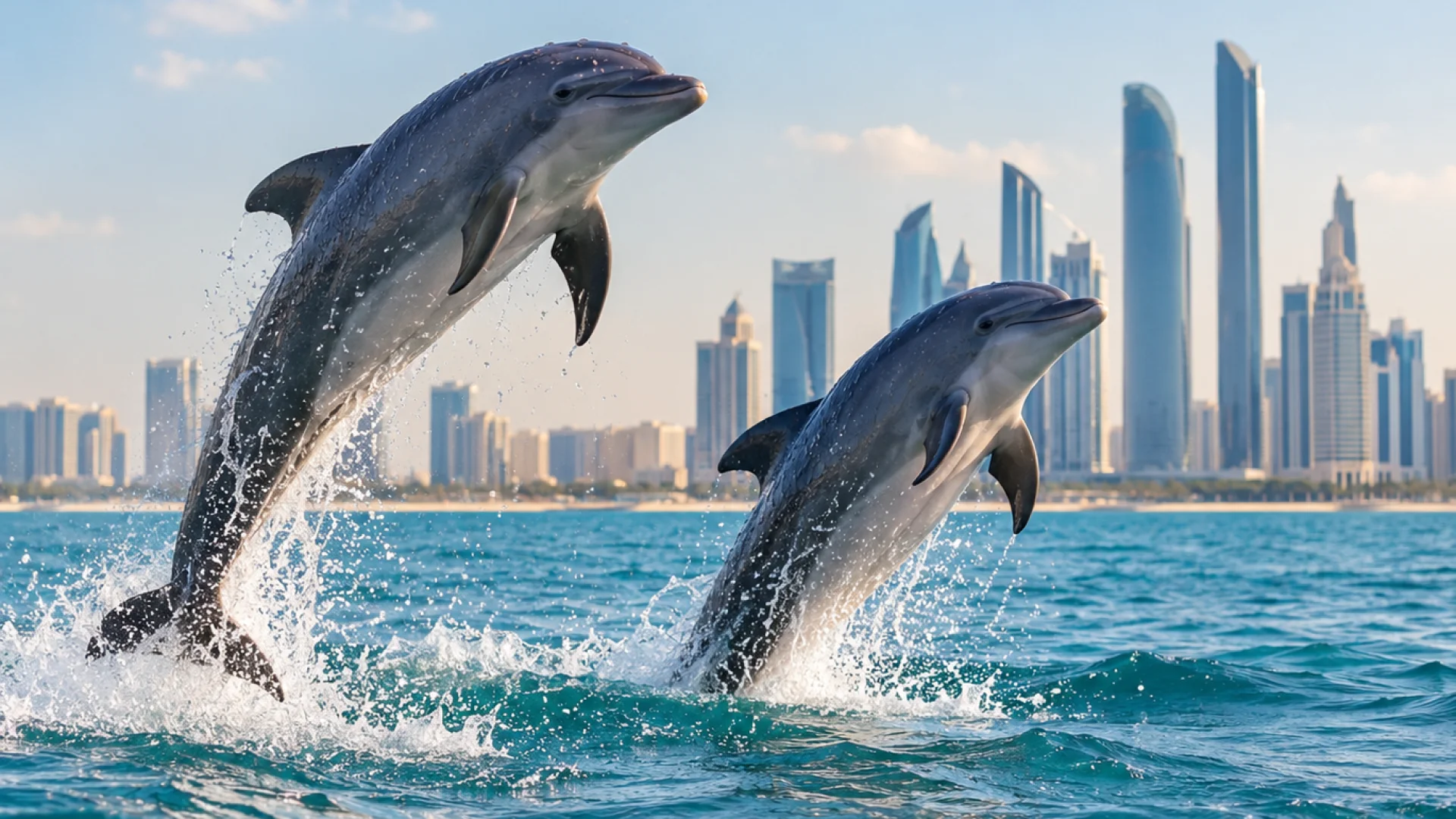

A fleeting movement in the Arabian Gulf has drawn attention to one of Abu Dhabi’s least visible coastal residents. Indian Ocean humpback dolphins were observed in local waters, offering a rare glimpse of a species that lives close to shore but is notoriously difficult to monitor. The sighting highlights the ecological importance of Abu Dhabi’s islands, mangroves and shallow marine habitats at a time when coastal development and conservation must advance together.
The sea looks empty until it moves. A dark fin cuts through the pale water, slips beneath the surface and appears again several metres away. No dramatic leap. No splash worthy of a postcard. Just a quiet, unmistakable rhythm: dolphins travelling through the waters of Abu Dhabi.
The animals are Indian Ocean humpback dolphins, one of the more elusive cetaceans found along the region’s coast. Known scientifically as Sousa plumbea, they favour shallow coastal waters, bays, estuaries and island channels. Their backs rise in a distinctive hump, while their long, slender beaks give them a profile that differs from the more familiar bottlenose dolphin.
“There they are,” someone might say from a boat. Then the water closes over the animals and the moment is gone. That brief encounter is precisely why the sighting matters. Humpback dolphins are coastal, but they are not easy to find. Tides shift quickly, visibility is often limited, and busy waterways can make observation difficult.
Indian Ocean humpback dolphins are not performers looking for an audience. They tend to move discreetly, often in small groups, through the shallow waters where land and sea constantly reshape one another. Depending on age, light and condition, their colouring may appear grey, brownish or pale pink. Their bodies are built for a life close to shore, where channels, sandbanks and mangrove edges create both opportunity and risk.
Abu Dhabi’s coastline is a complex patchwork of islands, tidal flats, lagoons and mangrove forests. At low tide, broad areas become shallow or exposed. At high tide, water returns across the flats, carrying nutrients and concentrating fish. For dolphins, this constantly changing landscape can provide feeding opportunities. For scientists, it creates a challenging environment to survey.
The same waters are also used by people. Boats cross between islands. Construction and dredging can alter shorelines. Engines and underwater machinery introduce noise into a world where marine animals depend on sound to navigate, communicate and locate prey. The sighting therefore carries a message beyond its immediate beauty: the coastal zone is not empty space.
A single observation cannot reveal the size of a population or prove how frequently the animals use a particular area. It can, however, become an important piece of evidence. In the case of rare and elusive species, every reliable record helps build a clearer picture of distribution, movement and habitat use.
Where do the dolphins feed? Do they return to the same channels? Are they travelling alone or as a group? Are young animals present? Long-term monitoring can help answer these questions. It can also identify locations where boat speed, construction activity or other disturbances may need to be managed more carefully.
For anyone standing on the shore, the implications are immediate. A flat horizon becomes a living map. Beneath the surface are feeding grounds, travel routes and possible nursery areas. A boat moving too quickly through a shallow inlet is no longer simply passing through open water; it is entering a habitat used by wildlife.
Abu Dhabi is often pictured through its skyline: towers, highways, cranes and bright waterfront architecture. Yet its identity is equally tied to the sea and to the islands scattered beyond the city. Mangroves, seagrass beds and tidal channels support fish, birds, turtles and invertebrates. They also protect shorelines, filter water and store carbon.
Mangrove roots create underwater shelter for young fish and small marine creatures. Their branches slow waves, while their muddy sediments hold nutrients. The value of these forests cannot be measured only by what appears above the surface. Much of their importance is hidden in the dense, intricate habitat below.
For humpback dolphins, mangrove-lined waterways form part of a wider coastal network. They may not remain inside one narrow habitat, but the health of the whole system affects the availability of prey and the safety of their movements. Protecting dolphins therefore means protecting the waters around them.
Calm behaviour matters. Repeated approaches can disturb animals even when the encounter looks harmless from a distance. There is no need to force the perfect photograph. A quiet engine, a patient observer and an unobstructed route give the dolphins control over the meeting.
That principle may sound modest, but it changes the character of wildlife tourism and everyday boating. The goal is not to make the animal perform. The goal is to leave the animal undisturbed.
The dolphins spotted off Abu Dhabi are more than a striking news image. They are evidence that the waters beside a rapidly developing city remain biologically active. Their presence connects modern urban life with an older, quieter world of tides, shoals and mangrove shadows.
The next appearance may last only seconds. A fin. A curved back. A silver trail. Then nothing but ripples. Yet such a moment can change the way the coast is seen. Abu Dhabi is not merely a city beside the sea. It is part of a marine system that stretches between islands, channels and open water.
That perspective is valuable. Conservation is not an abstract idea reserved for remote reserves. It begins in the routes boats take, the way shorelines are designed, the amount of noise released underwater and the care taken with waste. The rare dolphins make the invisible visible.
The sighting also has implications for waterfront development. Coastal property value is shaped not only by views, access and amenities, but by the quality of the natural environment. Clean water, healthy mangroves and protected island landscapes can strengthen the long-term appeal of residential communities, hotels and leisure destinations.
Investors and developers are increasingly expected to consider environmental impact, resilient shoreline design and the protection of sensitive habitats. Projects that preserve ecological corridors, manage marine traffic and integrate nature into public waterfronts may prove more durable over time. The dolphins offer a simple reminder: successful coastal development should not turn its back on the sea. It should understand what already lives there.