
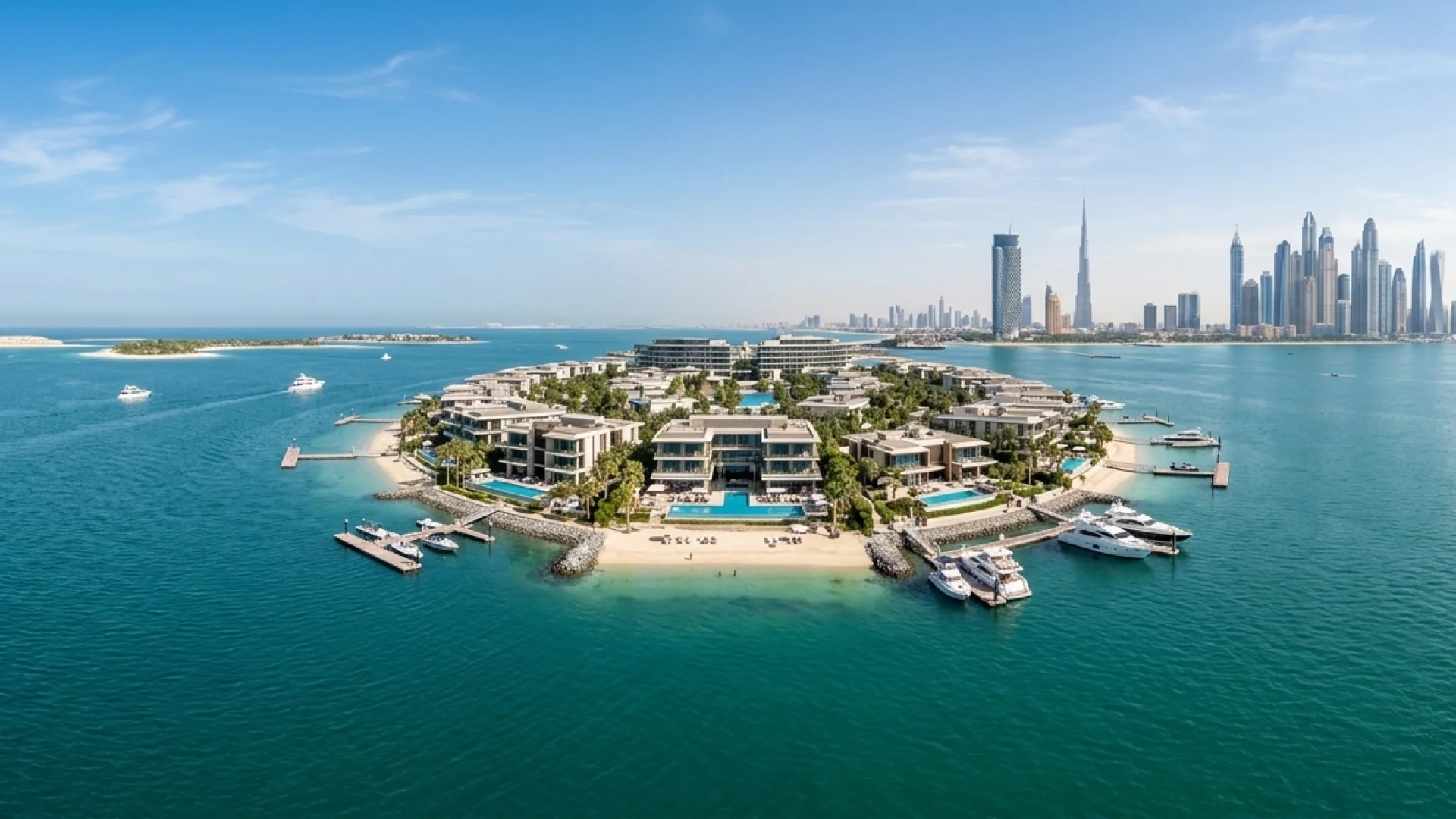

A few minutes offshore, Dubai’s volume drops—and a new kind of address steps forward: The Ritz-Carlton Residences on the World Islands. The project blends private villas and luxury apartments with the choreography of a resort: concierge, curated amenities, and a lifestyle built around sea views, beach access, and calm. It also signals renewed momentum for the World Islands as more than a headline from the past—positioning them as a credible, premium place to live, retreat, and invest. In a city where branded residences have become a barometer of confidence, the Ritz-Carlton name brings both polish and pricing power to an island setting that can’t be replicated on the mainland.
The boat engine fades, and suddenly you notice what’s missing.
No horns. No rush-hour impatience. No glass-and-steel echo of the city. Just water—soft, insistent—tapping the dock like it’s trying to get your attention. The air tastes faintly of salt and sunscreen. And ahead, sunlit and strangely serene, the World Islands feel less like a developer’s legend and more like a place where someone actually lives.
“So this is it,” a man beside me murmurs, half to himself. Not disbelief. More like relief.
The Ritz-Carlton Residences, Dubai, The World Islands is the kind of announcement that doesn’t shout; it lowers its voice. The pitch is not height or hustle. It’s distance—measured in boat minutes, not kilometers—and the promise that when you step inside, life runs on hotel logic: smooth, prepared, quietly indulgent.
Some luxury is obvious—marble, chandeliers, dramatic entrances. The luxury here is choreography. Doors that open before you reach them. A lobby that feels more like a pause than a passage. The gentle certainty that someone else can handle the small things, so you can reclaim your time.
The new Ritz-Carlton Residences are positioned around that idea: high-end apartments and private villas designed for island living, with the brand’s signature service culture stitched into daily routines. Think concierge support, housekeeping, and the kind of hospitality where requests are answered with “Of course,” not “We’ll see.”
On the islands, the sea is not a view—it’s a constant companion. Light scatters across the water and climbs the walls. Even in the middle of the day, it feels like the world is breathing slower.
For years, Dubai’s World Islands were a story people told. A bold map-shaped archipelago built from sand and ambition—famous, photographed, and often discussed in the past tense. The idea was always cinematic. The reality took longer.
What’s changing now is the tone. With serious branded residential product arriving, the islands begin to read less like a curiosity and more like a micro-district—an address with a defined lifestyle and a credible operating model.
Because this isn’t just about building homes. It’s about making a place work: arrivals and departures, service logistics, food and wellness, privacy and security, the daily ease that separates a fantasy from a functioning community.
You can spot a resort pretending to be residential from a mile away. It looks good, but it doesn’t feel lived in. The Ritz-Carlton playbook is different: it’s built around repeatable standards—the same invisible discipline that makes a hotel stay feel effortless.
Here, that discipline is translated into ownership. Residents are promised a world of curated comforts: beach-and-sea proximity, wellness-driven amenities, and spaces shaped for indoor-outdoor life—terraces, wide openings, long sightlines to the horizon. It’s less “square footage” and more “exhale.”
Dubai has become a laboratory for branded living. As global wealth gets more mobile, buyers want two things at once: a place that feels personal, and a system that feels reliable. Brands offer a shortcut to trust—especially for international owners who may not live in the city year-round.
Add an island address, and the offer sharpens. Island living is inherently scarce. You can’t “build another street next door” when the boundary is water. That scarcity can turn into long-term desirability—if access, operations, and quality are executed without compromise.
And then there’s the emotional hook. On the mainland, Dubai dazzles. Out here, it shimmers—at a distance. At night, the skyline lights up like a jeweled bracelet across the dark, close enough to feel part of your world, far enough to feel like it’s not demanding anything from you.
Imagine waking up and not negotiating with your schedule. Barefoot on cool stone, you cross the room while the sea throws moving patterns onto the ceiling. Somewhere nearby, cutlery clicks softly—breakfast being set, not announced.
“Coffee?” someone asks. The word lands gently, like a towel placed on a sun-warmed chair.
You swim a few quiet lengths. The water is warm, not bathtub-warm—more like silk. When you stop, there’s no traffic noise to rush you back into the day. Only the slow logic of an island: sun, shade, salt, and time.
That’s what these residences are selling, at their core. Not just luxury. Not just a brand. A different tempo.
Branded residences can command a premium—but the premium only holds if operations match the promise. On an island location, the checklist gets more specific. If you’re assessing The Ritz-Carlton Residences on the World Islands as a lifestyle purchase or an investment, focus on these fundamentals:
Bottom line: this is not simply another luxury address. It’s a rare pairing of a globally trusted hospitality name with an offshore setting that feels genuinely separate from the city—while still keeping Dubai’s skyline within reach.