
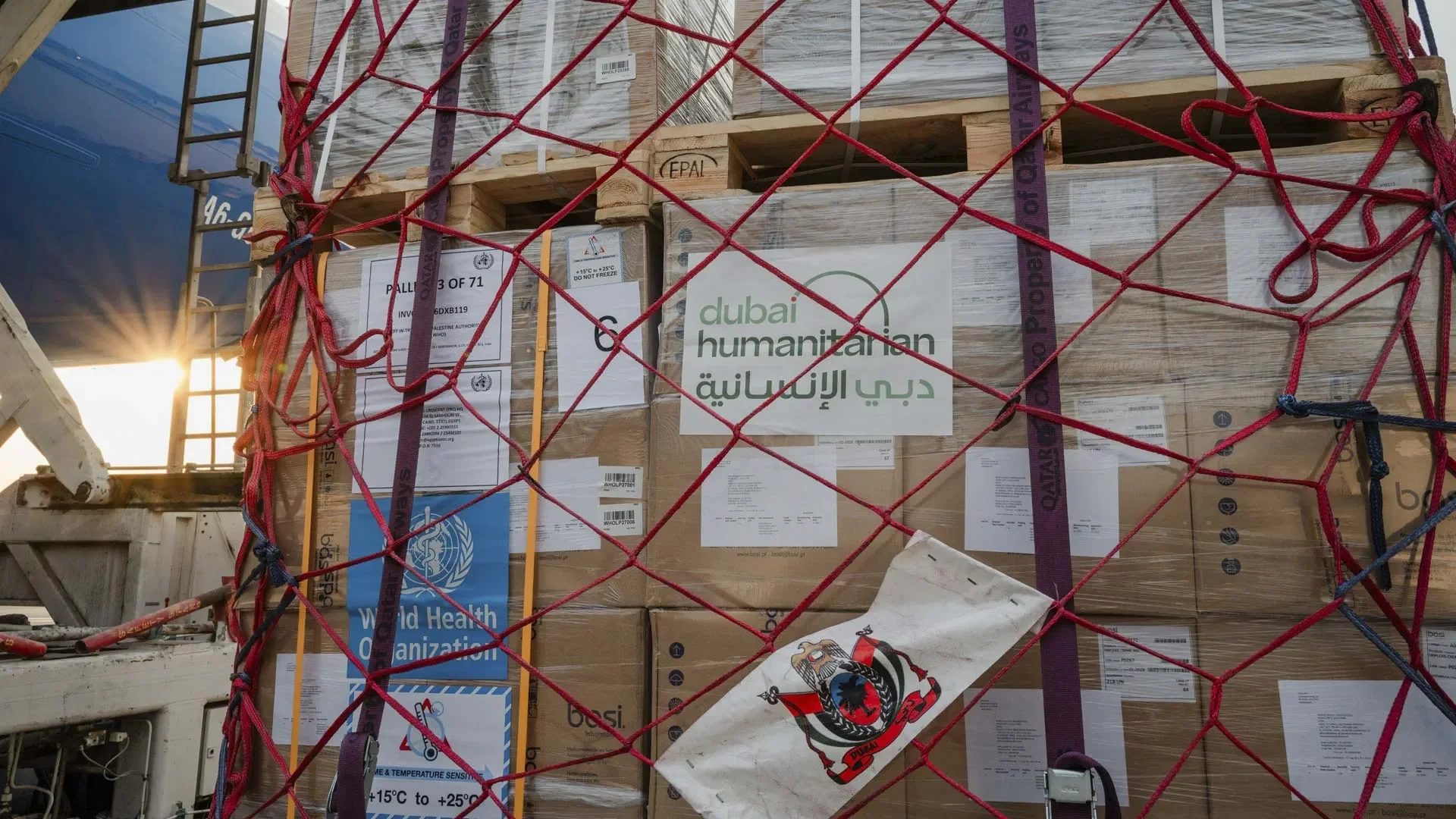

Dawn over Dubai. A C-130’s ramp clicks shut, and 11 tonnes of essential medicines rise into the pale heat, bound for Egypt’s Al Arish and onward to Gaza—opening a new air bridge led by Dubai Humanitarian (DXBH) under the directives of H.H. Sheikh Mohammed bin Rashid Al Maktoum. Three more flights follow, stacking speed with tents, more medicines, and fortified biscuits. Over the coming weeks, about 150 tonnes of WHO medical supplies—pulled from the WHO Global Logistics Centre hosted by DXBH—will flow through a continuous pipeline. In a sector squeezed by funding, each flight pushes reach up and costs down, supporting care for roughly 400,000 people.
The first light breaks like a match across the tarmac. The C-130 hums low, a metal chest ready to breathe. “Clear!” a loadmaster calls, palms open, as a forklift backs away in tidy beeps. Blue WHO crests shine from shrink-wrapped pallets. The ramp rises. Hydraulics hiss. Paper manifests flutter. Then the aircraft leans into the runway, gathers breath, and is gone—pointed at Al Arish, where ground crews will pass the baton and move the cargo onward to Gaza.
This is the opening scene of Dubai Humanitarian’s new air bridge. It starts small—11 metric tonnes of essential medicines—but scale is coded into the plan. Three more flights take off in close rhythm, carrying additional medicines, sturdy tents, and stacks of fortified nutritional biscuits. It’s the kind of cargo that looks ordinary until you watch it land in a field clinic or a crowded ward. Then cardboard becomes treatment and time.
Four flights are only the prelude. Over the next weeks, roughly 150 tonnes of WHO medical and health supplies will depart through a continuous logistics pipeline, drawn directly from pre-positioned stocks at the WHO Global Logistics Centre hosted by Dubai Humanitarian. That detail matters. Pre-positioning is the difference between “soon” and “now.” Between a shipment on paper and a stethoscope in a patient’s ear.
“This air bridge reaffirms Dubai’s enduring commitment to the people of Gaza,” emphasizes Mohammed Ibrahim Al Shaibani, Chairman of Dubai Humanitarian. It’s not an isolated runway either. DXBH’s partnerships have helped move relief to Afghanistan, Mozambique, Lebanon, and Uganda this year, and a three-truck overland convoy to Gaza added grit to the early response. Each line on the operations map represents weeks of calls, clearances, and quiet persistence.
Numbers sketch the scale; scenes show the point. A clinic tent breathes open like a sail in a crosswind. A nurse steadies a tray of saline bags, the plastic cool against her arm. A child studies a biscuit, then bites with the caution of someone who has learned to ration trust. The supplies turn into moments: a fever that breaks, a wound that cleans, a breath that settles. Logistics only looks cold from far away.
Robert Blanchard, Head of Emergency Operations at the WHO Hub for Global Health Emergencies Logistics, puts the impact in plain math: the series of charters delivers over $1.3 million in medicines and medical supplies—enough to treat roughly 400,000 people. And because the Government of Dubai and Dubai Humanitarian absorb critical logistics loads, WHO can scale reach while cutting expenses, redirecting resources into life-saving access in Gaza and beyond.
You can read speed on a clock, or hear it in the cadence of ground crews. “Clear left.” “Roll two.” Nets tighten. Metal rails sing. T-minus minutes to pushback, and a new set of coordinates take shape in the cockpit. The work is muscle memory by now, but never routine. You don’t get casual about a lifeline.
Back in the warehouse, the quiet heroics continue. A barcode pings. A coolant unit whispers. Someone sets a box down gently, like a sleeping child. It’s all choreography, and it adds up to one truth: help moves fastest when the stage is already built.
Here the WHO Global Logistics Centre in Dubai proves pivotal. It is a hub with muscle: customs corridors cut short, sea and air within a handshake, skilled teams that turn paperwork into passage. Dubai Humanitarian hosts the stocks that make sudden deployments practical. The new air bridge is less a surprise than the visible result of choices made years ago—location, redundancy, interoperability.
And then there’s the map beyond Gaza. The same playbook—pre-position, partner, push—has supported air bridges and relief shipments to Afghanistan, Mozambique, Lebanon, and Uganda this year. Different geographies, same physics: a runway, a window, a will.
Not every story leaves contrails. This one does. Each departure draws a thread across the sky, from a city built for connection to places that need it most. When resources shrink, efficiency turns ethical. Save four million dollars on logistics, and you fund the next clinic line or stock the next ward. It’s the arithmetic of empathy.
For real estate and logistics investors, this air bridge is also a market signal. Humanitarian speed depends on hard assets—sites, shells, slabs—that perform under pressure. The buildings behind the headlines are not generic sheds; they are choreographed machines for care.
Capital pathways are multiplying: logistics-focused REITs, JV developments in Dubai South, and sale-and-leaseback structures tailored to humanitarian operators. Demand for temperature-controlled, well-connected warehouses is rising structurally, not cyclically. The lesson from this air bridge is simple and investable: when a region can turn stock into sorties overnight, real estate isn’t just space. It’s a multiplier.