
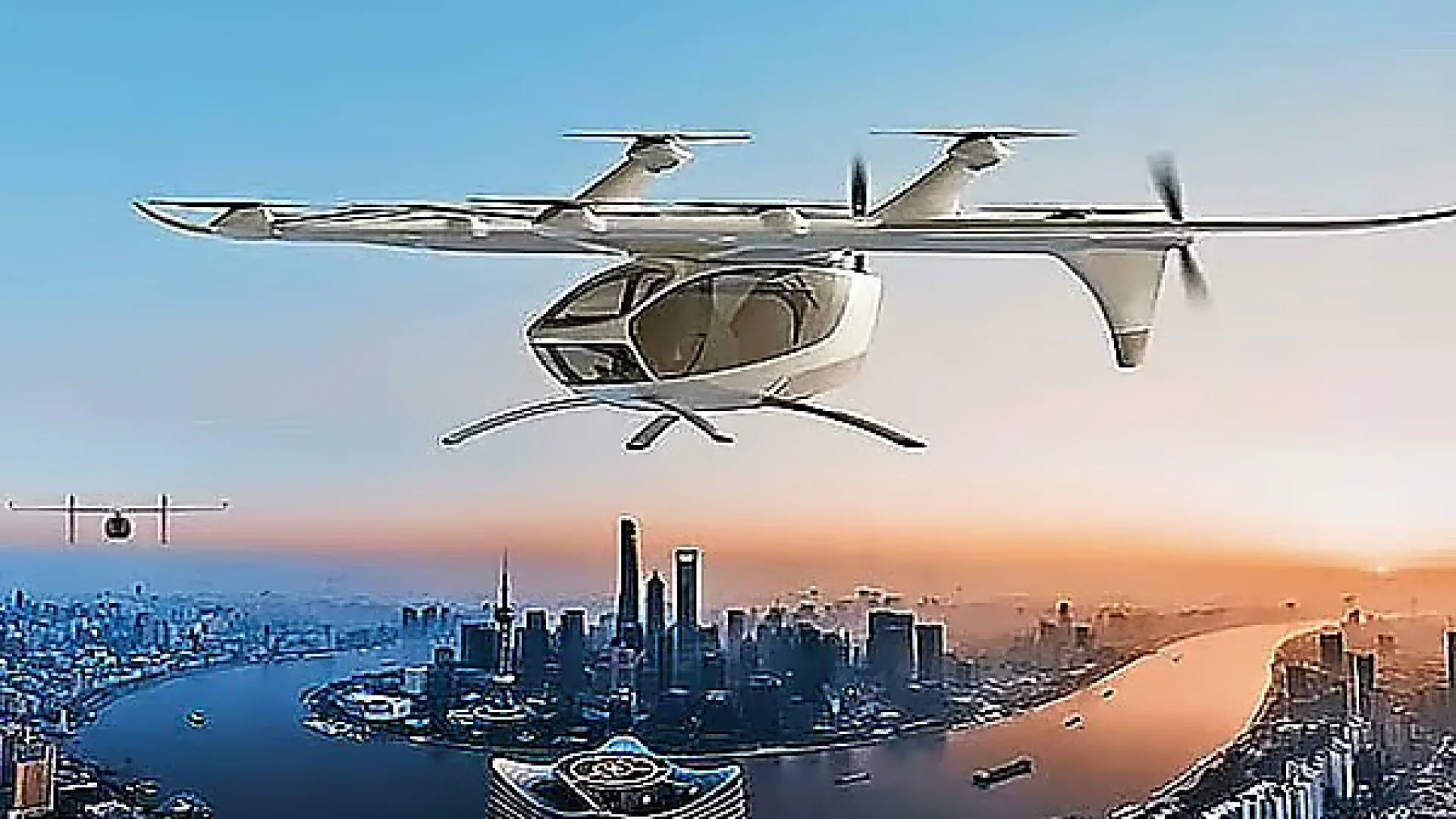

Look up over Sharjah and the future suddenly feels close: the emirate has approved a study dedicated to air taxi fares, pushing a new transport project toward real-world viability. The work is expected to examine pricing models, demand, operating costs, and how air taxis could connect with existing mobility networks. It’s a shift from spectacle to substance—because fare design will decide whether air taxis become an everyday time-saver or a niche luxury. For residents, businesses, and investors, it’s an early signal that Sharjah is mapping the economics of flight, not just the dream of it.
The street is doing what it always does at midday—holding its breath, then exhaling in slow motion. Cars nose forward. A bus sighs at the curb. Heat shimmers above the asphalt like a thin veil, turning distant buildings into watercolor. Somewhere nearby, a driver taps the steering wheel in a rhythm that says, not again.
And then there’s the sky. Empty. Quiet. An unused lane stretching from horizon to horizon.
“If it goes up there,” a man murmurs beside the road, shading his eyes with his palm, “it doesn’t have to wait down here.” The sentence hangs in the air for a second—half joke, half wish. In Sharjah, that wish just took a more concrete step.
Sharjah has approved a study focused on one deceptively simple question: what should an air taxi ride cost? Not the kind of question that makes glossy headlines. But it’s the question that decides whether futuristic mobility becomes a practical tool—or stays a showroom attraction.
The study is intended to explore fare-setting for air taxis as part of a broader transport project. In plain terms, it’s about building a pricing structure that can survive contact with real life: commuters who compare costs, businesses that need reliability, operators that must cover expenses, and a city that has to make new modes fit safely and smoothly into the network it already runs every day.
In transport, technology gets the applause. Pricing gets the adoption.
An air taxi can be fast, sleek, and silent enough to feel like science fiction. But if the fare sits too high, it becomes a special-occasion indulgence—an aerial limousine. If it’s pushed too low, the economics buckle under operating costs and infrastructure overhead. The sweet spot is where the service feels worth it: expensive compared to a car ride, perhaps, but rational when the alternative is an hour lost in traffic, a missed meeting, or a connection you can’t risk.
That’s why Sharjah’s decision to study fares matters now, at the planning stage. It suggests the emirate is thinking beyond the aircraft and into the system: the passenger journey, the business model, the timetable of demand. It’s the difference between building a gadget and building a service.
A fare isn’t just a number. It’s a compressed story about costs, constraints, and behavior.
Behind a single ticket price sit layers most riders will never see: maintenance cycles, pilot or operator staffing, battery charging or energy supply, insurance, safety compliance, ground handling, landing infrastructure, scheduling buffers, and the quiet but expensive reality of keeping aircraft ready to fly when people actually want to fly.
The study is also likely to test demand patterns: who would use air taxis, when, and for what kinds of trips. Morning peaks? Airport links? Business corridors? High-urgency medical or government use cases? Each scenario produces a different pricing logic and a different capacity plan.
Sharjah has a particular rhythm. Many destinations aren’t far on a map. Yet the minutes in between can stretch—especially at peak times—until a quick cross-town errand starts to feel like an expedition.
That’s where air taxis sell something more emotional than speed: certainty. The promise isn’t only that you’ll arrive faster, but that you’ll arrive when you said you would. In a business culture built around punctuality and momentum, predictability is a premium product.
But again, predictability has to be priced. Too expensive, and only a narrow slice of users can buy it. Sharjah’s fare study is effectively asking: how wide can that slice be?
When people hear “air taxi,” they imagine a flying version of a street cab. But fare design could look more like a hybrid of ride-hailing, premium rail, and airline logic—scaled down and simplified.
Depending on the study’s findings, structures could include:
Each model has a personality. Fixed routes feel orderly and commuter-friendly. Dynamic pricing can boost efficiency but risks making the service feel unpredictable or elitist. Integration with buses, taxis, or metro links (where applicable) could be the difference between an air taxi being a novelty and being a node in the everyday network.
Even the best aircraft can’t outrun a bad first mile.
For air taxis to work, you need places to take off and land—vertiports or designated pads—and you need those places to be where people actually want to be. Not hidden behind fences. Not marooned in industrial corners. Close to business districts, interchanges, major destinations. Accessible. Legible. Safe.
And once you arrive, you need to step back into the city without friction: a short walk to a pickup zone, a shaded path, a connection that doesn’t feel like an afterthought. Fare strategy links to this directly. If the ride is premium-priced, the on-the-ground experience must match. If the goal is broader adoption, then convenience and frequency become the brand.
Across the UAE, innovation often arrives with confident visuals. But the quiet decisions are the ones that last. Approving a fare study is a quiet decision with long shadows.
It says: we’re not only testing whether air taxis can fly—we’re testing whether they can operate, scale, and serve. We’re putting a pencil to the question of affordability, viability, and integration. We’re treating urban air mobility as infrastructure, not entertainment.
For residents, that’s promising. For operators and partners, it’s a sign that the project is moving into the hard, necessary phase: designing the market.
Imagine it: a small lounge-like platform, a clean line on the pavement, a staff member checking a booking with a quick nod.
“Two minutes,” they say.
Rotor sound rises—not the aggressive chop people expect, but a controlled hum. Doors close. A brief lift. The city tilts, then steadies. Below, the familiar snarl of traffic becomes a pattern, not a problem. You watch a queue at a signal and feel, almost guiltily, how light time can be when it isn’t trapped on the road.
That scene won’t be built by engineering alone. It will be built by pricing, operations, and trust—layer by layer, study by study.
For property investors, Sharjah’s approval of an air-taxi fare study is an early, market-facing indicator that urban air mobility is moving from concept toward commercialization. The moment fares are seriously modeled, two things happen in real estate: accessibility gets repriced, and nodes get nominated.
Investment takeaway: watch where Sharjah positions early air mobility nodes and what fare philosophy emerges (premium niche vs. integrated premium-mass). In either scenario, the fare study is a tell: Sharjah is not just imagining flight—it’s pricing it. And in real estate, priced accessibility is where valuation changes start.