
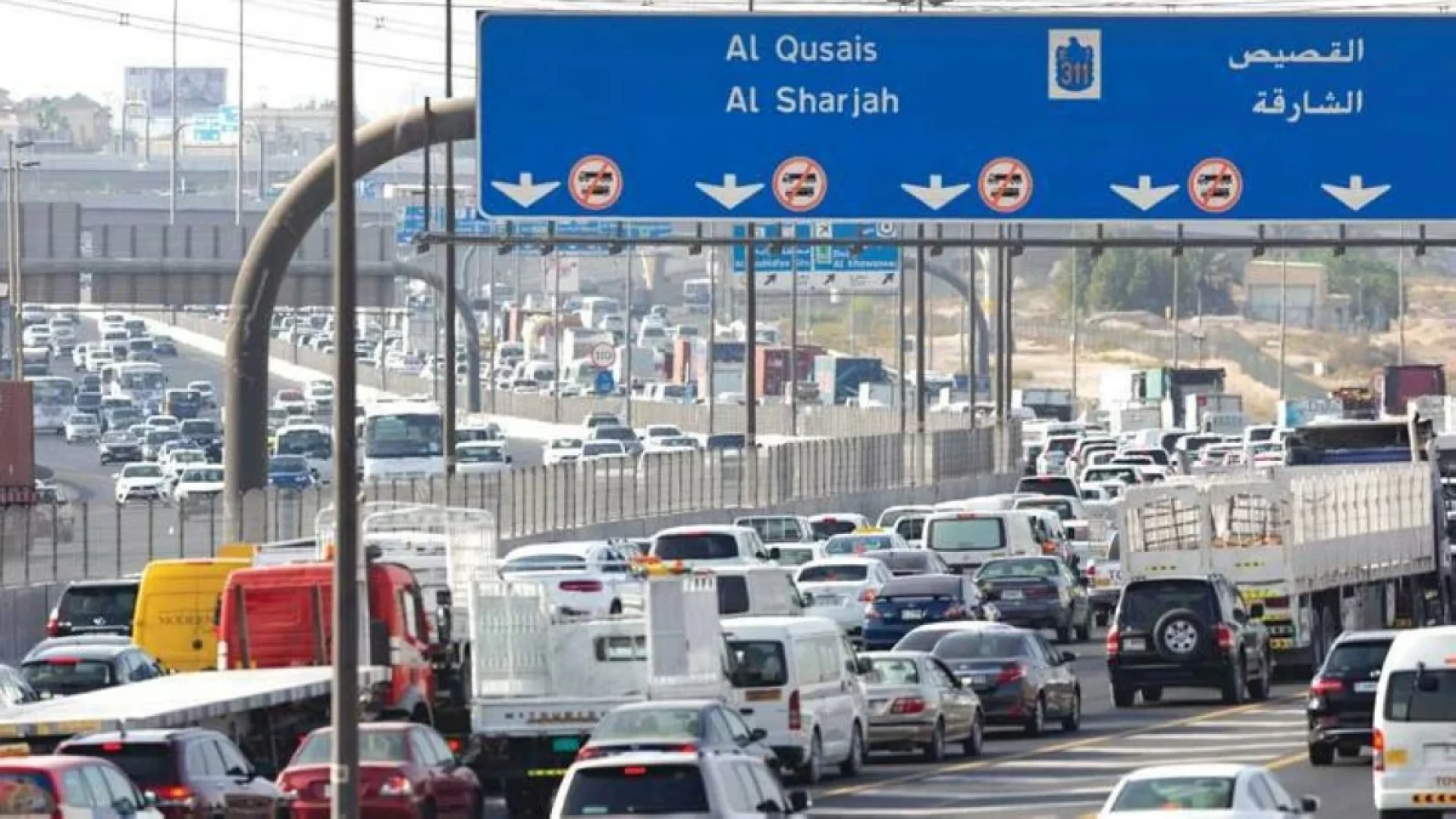

Dubai has a single ribbon of asphalt that the whole metropolis seems to breathe through: Sheikh Zayed Road. According to the Roads and Transport Authority (RTA), about 32% of Dubai’s traffic is handled by this one highway—an outsized share that turns every interchange, ramp and merge into a citywide pressure point. Nowhere is that dependence more visible than on the Sharjah–Dubai commuting corridor, where peak hours can feel like a daily ritual of brake lights and small negotiations for space. The figure doesn’t just describe congestion; it reveals how mobility, productivity and real estate value cluster along one dominant spine.
The day starts as a reflection.
For a few minutes, Sheikh Zayed Road mirrors the skyline—glass, chrome, and pale morning sun sliding across eight lanes like a spotlight. The towers look freshly rinsed. The road looks impossibly calm. Then the calm breaks, not with a bang but with a soft, steady accumulation: a headlight in the distance, a second one, a line, a sheet. The city’s pulse arrives on wheels.
At the next merge, a driver leans forward as if posture alone could create space. “If we pass this interchange,” he mutters—half to himself, half to the car—“we’re fine.” It’s the kind of sentence you hear in places where traffic isn’t a nuisance; it’s a daily forecast.
Dubai’s Roads and Transport Authority (RTA) has put a number on that feeling: 32%. That’s the share of Dubai’s traffic the RTA says is handled by Sheikh Zayed Road (SZR). One highway. Nearly a third of the moving city. Read it once and it sounds like a statistic. Sit inside it, watching the red glow of brake lights ripple forward, and it feels like an admission: this is the spine, and the city leans on it.
Sheikh Zayed Road is not simply a route from A to B. It is Dubai’s stage set—hotels shaped like sculptures, towers that catch the sun like blades, the Metro gliding above the lanes with the cool confidence of a different reality. But it’s also the city’s circulatory system. Every on-ramp is an artery. Every interchange is a valve. When it works, the city feels fast. When it tightens, everything downstream feels it: commutes, deliveries, meetings, school runs, service calls.
The RTA’s 32% figure matters because it highlights concentration. Dubai is built around corridors—places where housing, work, retail and leisure are linked by high-capacity roads. And SZR is the most powerful corridor of them all, pulling trips toward it the way gravity pulls water downhill. You can live far away, work somewhere else, and still find yourself drawn onto Sheikh Zayed Road because it’s the quickest, most direct, most familiar option.
If you want to see dependence in high definition, watch the Sharjah–Dubai commute in peak hours. The number plates tell a story. So do the vehicles: vans carrying crews, compact cars with coffee cups wedged into holders, delivery trucks with schedules that don’t care about traffic, ride-hailing cars floating between lanes as if they’re reading the road’s mood.
There’s a choreography to it. A blinker flashes. A gap opens—half a car length, a small mercy. A quick nod. A tiny drama is resolved without a single word. Then another merge, another negotiation. In these moments, the road feels less like infrastructure and more like a crowded room where everyone is politely trying to reach the door first.
When the flow suddenly loosens—when the lanes breathe again—the relief is almost physical. Shoulders drop. Phones stay face-down for a minute. You hear engines rather than horns. It lasts, maybe, for a few hundred meters. Then the next knot forms and the red lights return, wave after wave.
Put bluntly: if a third of traffic relies on one highway, small disruptions grow teeth. A minor crash. A stalled vehicle. A lane closure. A sudden surge from an on-ramp. The system can flip from “moving” to “crawling” faster than a driver can switch playlists.
That’s why transport authorities obsess over places most people barely notice: ramp geometry, weaving lengths, lane discipline, sign clarity, the way feeder roads deliver cars into the mainline. On SZR, the highway itself is only part of the equation. The real drama often happens at the edges—where traffic joins, exits, or tries to cross from one side to the other in a narrow window.
Dubai often speaks the language of scale—tallest, largest, fastest. But in traffic, the unit of measurement becomes smaller and more personal: minutes. Ten minutes is the difference between breakfast with your child and a rushed goodbye. Fifteen minutes is the difference between arriving calm and arriving already tired. When Sheikh Zayed Road carries 32% of the city’s traffic, it also carries an enormous amount of time.
You can see how people adapt. Some leave before sunrise to “beat it.” Some negotiate flexible hours. Some build whole routines around known pinch points—this interchange is always slow, that exit clears quickly, that stretch opens up after a certain time. In the glove compartments of Dubai, there are invisible maps made of experience rather than GPS.
Above, the Metro slides by again, steady and unbothered. It’s a reminder that the city is not locked into one mode. And yet the highway remains dominant—because it connects so much, so directly, to the places people need to be.
The RTA’s statement isn’t just a headline; it’s a planning clue. When an authority publicly anchors attention on a single corridor’s share of traffic, it typically means two things: first, the corridor is essential to economic rhythm; second, improvements there (and in its supporting network) have outsized returns.
Those improvements don’t have to mean endless widening. Often, the most meaningful gains come from smoothing the friction points: better-managed merges, upgraded interchanges, rebalanced access, improved guidance, and stronger alternatives that distribute demand. Because in a system carrying 32% of trips, even small percentage improvements translate into massive real-world effects—shorter travel times, fewer delays, more reliable journeys.
By midday, the road looks almost innocent again. Heat shimmers above the lanes. The skyline resumes its role as backdrop rather than obstacle. And then, on your phone, a message arrives from a colleague: “Try to leave early tonight.” The city’s pulse never really stops; it just changes tempo.
For real estate investors, the RTA’s 32% figure is a bright signal about where value concentrates—and where operational risk can hide. A highway that carries nearly a third of Dubai’s traffic is a direct proxy for accessibility, catchment size, and commuter behavior. It can lift rents and occupancy for well-positioned assets, while also creating vulnerability for locations that depend on a single, congested approach.
1) Accessibility premiums along SZR
Assets near high-performing interchanges or within easy reach of Metro stations along the SZR corridor typically benefit from stronger tenant demand. In Dubai, “close” is increasingly defined by reliable minutes, not straight-line distance. Buildings that cut 10–20 minutes off a peak commute can command a meaningful premium in both residential and office segments, especially for mid-market tenants whose schedules are less flexible.
2) Sharjah–Dubai commute shapes housing choice
The heavy commuter wave between Sharjah and Dubai underlines a cross-emirate housing calculus: households often trade unit size and price against travel time. Investors can position for this in two ways: (a) commuter-friendly residential stock with strong corridor access and amenities that support early/late routines; (b) smaller, closer-in units in Dubai that “buy back time” and reduce dependence on peak-hour driving. The demand for time-saving locations tends to rise as congestion becomes more predictable—and more costly.
3) Micro-location due diligence: ramps, not just maps
When a single highway is this dominant, tiny network changes—an adjusted ramp, a reconfigured merge, a revised access road—can materially change a property’s effective accessibility. Investors should underwrite not only the neighborhood brand, but the actual path: nearest interchange, average peak travel times, alternative routes, and the presence of last-mile bottlenecks that can erase the advantage of a “prime” address.
4) Metro adjacency as a resilience feature
As congestion pressure grows, mode shift becomes more attractive. Developments that truly integrate public transport—walkable Metro access, safe pedestrian routes, functional drop-off zones—can show greater leasing resilience and stronger exit liquidity. This also aligns with ESG narratives and corporate location strategies that increasingly consider employee commute quality.
5) Logistics and retail: reliability equals revenue
For industrial, last-mile logistics, and retail/hospitality assets, time reliability is a cash-flow variable. Delivery windows, service SLAs, customer arrival patterns—these all react to congestion on SZR. If the corridor is prioritized for operational improvements, properties tied into that network can benefit. If bottlenecks worsen, investors may need to price in higher operating friction or focus on assets with multiple access options.
Investor takeaway
Treat the 32% statistic as a map legend: Sheikh Zayed Road is a value spine. Underwrite assets with a mobility lens—peak-minute catchments, Metro proximity, interchange quality, and network redundancy. In a city measured in minutes, the best real estate isn’t just well-designed; it is well-connected in a way that stays reliable when the road gets crowded.