
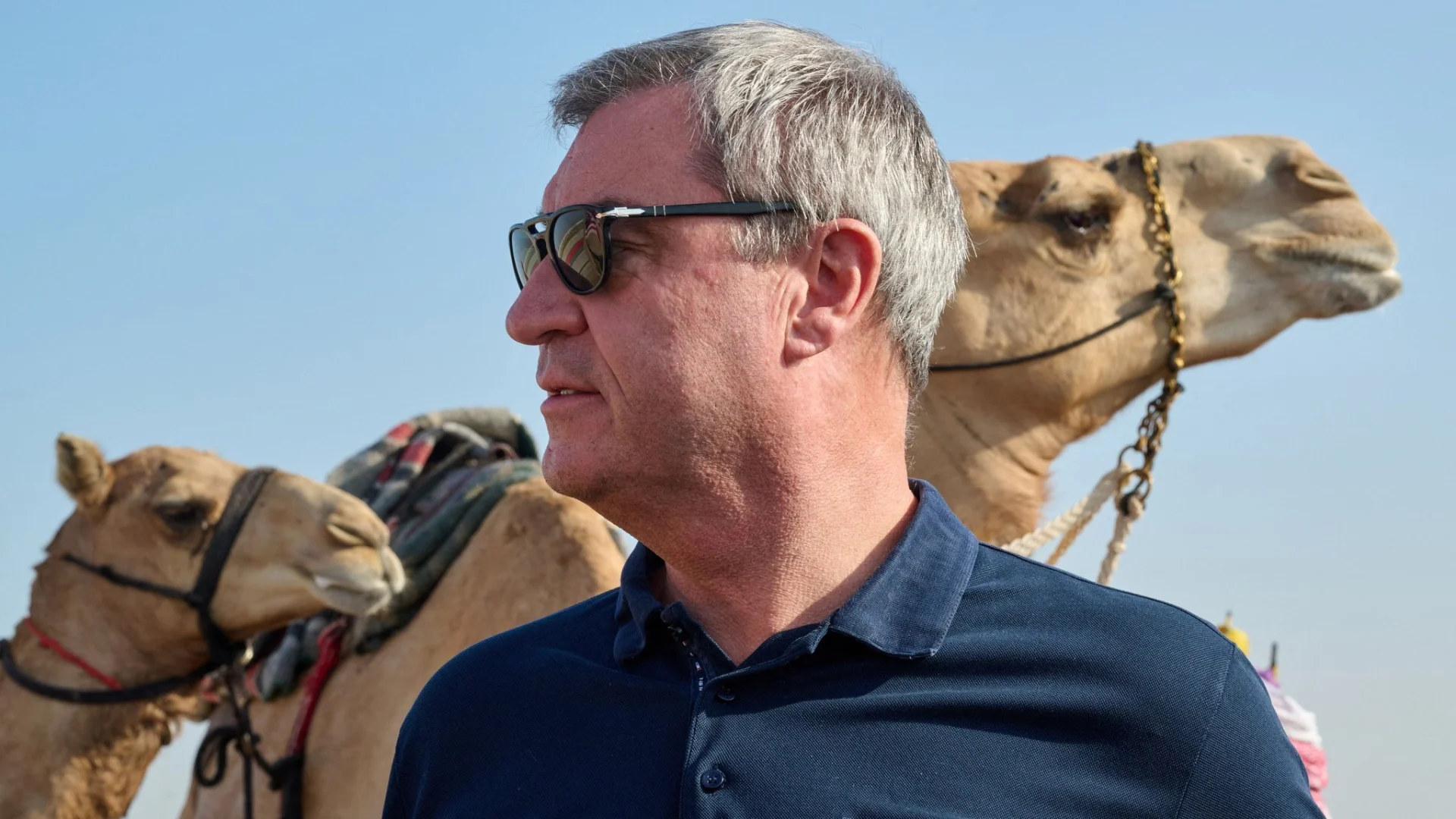
At dusk, Abu Dhabi’s towers glow above the water while Doha’s futuristic skyline rises from the desert. Against this striking backdrop, Bavarian Minister-President Dr Markus Söder is travelling to the United Arab Emirates and Qatar with representatives from politics and business. The trip focuses on energy security, digital technologies, artificial intelligence, research, trade, investment and stronger international partnerships.
The heat still clings to the pavement. Beyond the road, glass towers catch the last light of the day. Cars move quietly along the waterfront, and somewhere behind the skyline a new construction project is already taking shape. Bavaria seems far away. Yet this is precisely where the future of its international economic relationships is being discussed.
Minister-President Dr Markus Söder is visiting the United Arab Emirates and Qatar, accompanied by a delegation from business and politics. The journey is designed to strengthen existing ties and open new doors for Bavarian companies. It is a political visit, but it is also a meeting of economic cultures: Bavaria’s industrial expertise and research strength on one side; the Gulf’s investment power, development speed and ambitious transformation programmes on the other.
The central question is simple but enormous: how can regions grow and modernise in a world shaped by energy uncertainty, digital disruption and geopolitical change?
Energy is one of the trip’s clearest connecting themes. The UAE and Qatar are major players in global energy markets, while both are also investing heavily in new technologies, renewable power, hydrogen, efficient infrastructure and lower-emission systems.
That transformation matters to Bavaria. The state is home to internationally active companies in mechanical engineering, automotive technology, environmental systems, energy solutions and industrial automation. The Gulf states, meanwhile, are building on a vast scale and looking for technologies that can be deployed quickly and reliably.
In a meeting room, the conversation may begin with a chart. A Bavarian engineer points to an efficiency curve. A Gulf partner asks how the system performs at city scale. The discussion turns to cost, resilience and implementation. Behind the formal language lies a practical ambition: turning expertise into projects.
The UAE has positioned itself as a hub for digital government, artificial intelligence, smart-city systems and advanced research. Qatar, too, is investing in education, science and technological modernisation. Both countries want to move beyond traditional economic models and build knowledge-based industries.
For Bavarian companies, this creates opportunities in software, healthcare, mobility, robotics, industrial data and automation. The region’s large development programmes can provide a testing ground for new solutions. Bavaria, in turn, offers a network of universities, research institutes, hidden champions and established industrial groups.
International business is rarely created by a signature alone. It begins with a laboratory visit, a conversation after a presentation or a follow-up call weeks later. A political delegation can make those first encounters easier. It can create confidence, connect decision-makers and give companies a stronger platform abroad.
In the United Arab Emirates, the talks focus on political and economic cooperation. Abu Dhabi represents the region’s long-term strategic approach. Its investments reach far beyond landmark architecture, extending into education, research, energy, infrastructure and global holdings.
The relationship is significant for Bavaria. Emirati partners are important in trade and investment, while Bavarian firms already operate in the region and continue to see potential in new markets. Water technology, healthcare, logistics, renewable energy, construction systems and high-quality industrial equipment are natural areas of contact.
The city itself becomes part of the argument. A waterfront road, a canopy of towers, a construction site surrounded by finished buildings: Abu Dhabi is a living example of how quickly ideas can become infrastructure. For visitors from Europe, that pace can be startling. It is also one reason why the region is such a compelling partner for technology companies.
The journey then continues to Qatar. Doha combines traditional souqs with a highly modern skyline, international institutions and large-scale development zones. Qatar has established itself as an important energy, investment, sporting and diplomatic centre.
Here, too, the agenda reaches beyond business figures. Energy, research, education, economic ties and the international situation are closely connected. Bavaria is seeking reliable partners at a time when supply chains, energy costs and geopolitical developments affect companies directly.
Sometimes the most important moment is not the official statement. It comes afterwards, when delegates remain standing in the room. One person asks a follow-up question. Another writes down a name. A formal meeting becomes a possible next step. That is how international cooperation is built: through continuity, curiosity and trust.
The visit pursues several objectives:
The results of such a journey rarely appear the following morning. They emerge in the weeks and months afterwards: a company follows up with a partner, a research project finds a new sponsor, or an engineering firm enters a market it had previously considered too distant.
The visit is therefore also a message to Bavaria’s own economy. International networks remain essential. Energy transition, artificial intelligence, climate adaptation and technological change do not stop at national borders. Anyone looking for practical solutions must be willing to learn from places where new models are being built at speed.
The journey also carries significance for property and investment. Abu Dhabi, Dubai and Doha are developing large urban districts, business centres, logistics hubs, education campuses and mixed-use communities. Such projects require planning, construction, energy systems, smart infrastructure, water management and long-term asset strategies.
Bavarian firms can contribute specialist expertise in sustainable building, engineering, digital planning, building services, materials and facility management. Investors may find the Gulf attractive because of its strong development programmes, substantial capital and ability to execute major projects. Every opportunity, however, depends on careful analysis of location, regulation, partners, financing and lasting demand.
The most interesting link between Bavaria and the Gulf is not property in isolation. A successful district needs transport, energy, water, data, schools, healthcare and public space. Real estate becomes part of a wider urban system. This is where Gulf-scale development and Bavarian technical precision can meet.
As evening settles over the skyline, the distance between the regions feels slightly smaller. Bavaria’s journey is an attempt to turn geography into connection – through conversations, commercial relationships and ideas that may eventually become buildings, energy systems, research partnerships and new investment.