
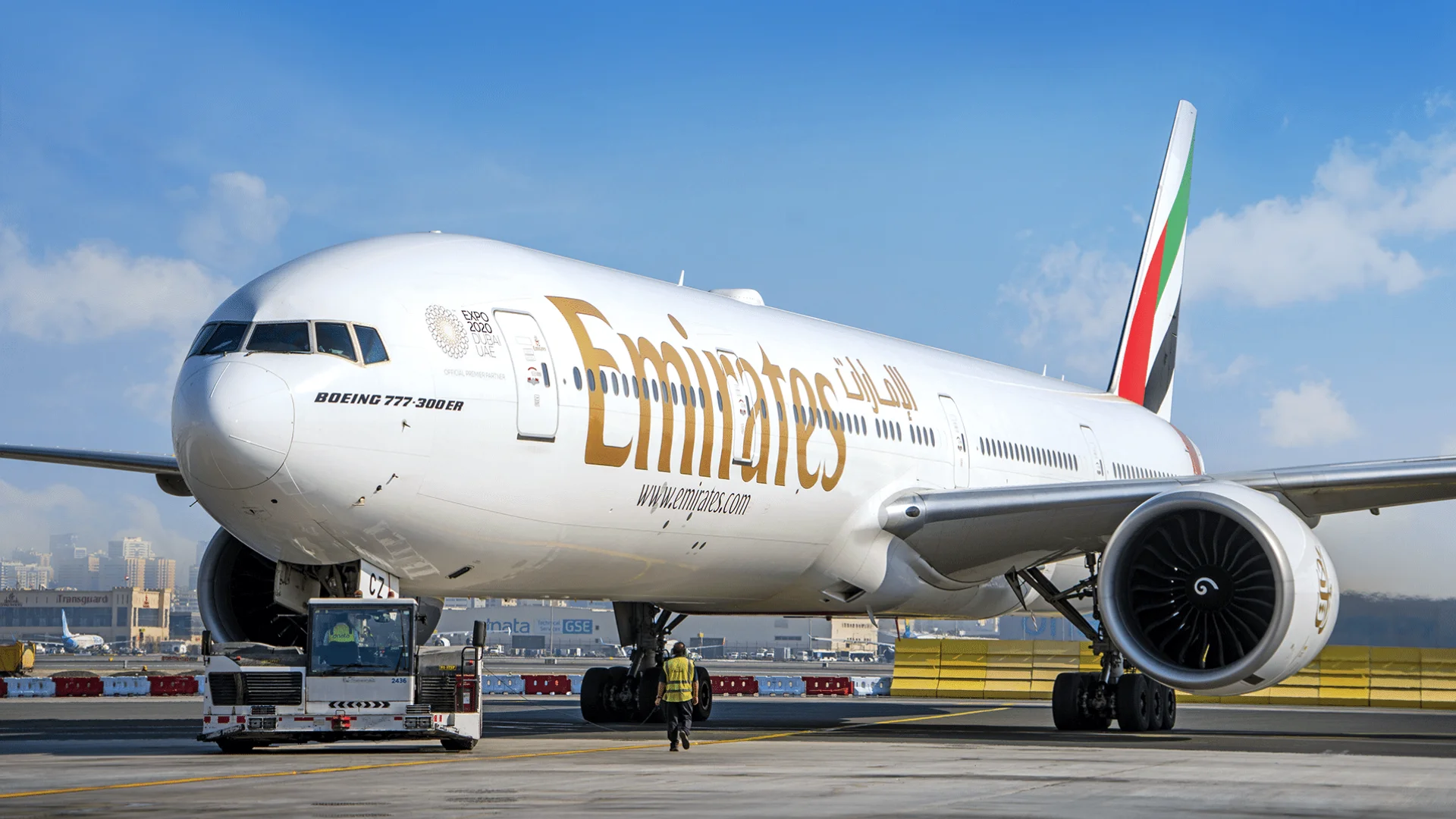
In Stuttgart, the Gulf no longer feels like a distant horizon—it’s edging into everyday business reality, one boarding pass at a time. As companies in Baden-Württemberg deepen ties with the Gulf region, a potential Emirates direct route from Stuttgart to Dubai is emerging as a powerful signal: faster travel, tighter project cycles, and a more visible corridor to one of the world’s most investment-driven markets. Dubai’s role as a global hub would make the connection more than a convenience—it would be a competitiveness tool. And once connectivity shifts, so do locations, hotel nights, office demand, and investor attention.
The departures board blinks like a restless eye. Wheels hum over stone. Somewhere behind the glass, an aircraft noses into place with the slow confidence of a machine that knows it belongs.
“If it’s direct, I can do this in a day,” a man in a blazer says, half to himself, half into his phone. He pauses, listening, then adds: “Dubai. From Stuttgart. That changes things.”
At Stuttgart Airport, the conversation isn’t just about gate numbers and carry-on rules. It’s about momentum—about the Gulf region stepping closer to Baden-Württemberg’s industrial heart. And it’s about the idea now gaining traction: Emirates flights, potentially direct, linking Stuttgart with Dubai, the Gulf’s high-speed gateway.
For years, the Gulf sounded like a far-off chapter in a global strategy deck—important, yes, but distant. Today it feels immediate. Companies from Baden-Württemberg are meeting clients there, servicing equipment there, negotiating partnerships there. The region’s investment wave—across infrastructure, health, mobility, energy, and technology—creates a kind of pull that export-driven economies can’t ignore.
And Baden-Württemberg has what the Gulf keeps ordering: machinery, precision components, industrial systems, automotive expertise, medical technology, and the practical engineering that turns ambitious plans into working reality.
One export manager describes the market with a single word: “Fast.” Fast decisions. Fast timelines. Fast scaling. In that environment, travel time is not a nuisance—it’s a cost, a risk, a limiter.
A direct connection is the opposite of friction. It compresses distance, but also compresses uncertainty: fewer missed connections, fewer overnight layovers, fewer travel days swallowed by transfers. That matters most to the Mittelstand—the mid-sized companies that form the backbone of Baden-Württemberg—because they often travel with lean teams. When a technician needs to be on site, or a project lead needs to be in a room now, there isn’t a spare day to lose.
“The Gulf is where projects move from ‘idea’ to ‘built’ very quickly,” says a manager from the med-tech sector who travels to the region regularly. “You feel it the minute you arrive. The pace. The expectation.”
Dubai, in particular, functions as a door that opens into multiple rooms: the UAE, yes, but also Saudi Arabia, Qatar, Oman, Bahrain—and onward links to South Asia and East Africa. A Stuttgart–Dubai flight isn’t merely a city-pair. It’s a corridor into a broader geography of deals, tenders, and partnerships.
Air routes are like bold type on a map. They announce where traffic flows—where people, budgets, and plans are moving. When a global carrier like Emirates serves a route, it signals real demand: executives, engineers, consultants, suppliers, and delegations regularly making the trip.
For Stuttgart and the region, that can translate into a subtle but meaningful re-positioning: not just a strong industrial cluster in Europe, but a place directly connected to one of the world’s most globally networked hubs.
Watch the terminal for a minute and you can almost see the economy in motion. Two engineers lean over a laptop, arguing about maintenance intervals. A sales director sends a slide deck with a last-second “please review.” A couple in sneakers and hoodies drifts past, holiday-bound—but the business travelers move differently. They walk with a schedule in their shoulders.
“Four hours saved each trip,” one of them says, tapping his phone. Four hours doesn’t sound like a strategy. But in a negotiation cycle, it can be the difference between “next week” and “tomorrow.”
A direct route would not turn Stuttgart into a mega-hub, and it doesn’t need to. Its impact would show up in patterns: more short business trips, more predictable travel routines, and potentially more project-based stays. Those patterns ripple into the local economy—often first into hospitality and services, then into real estate.
In practical terms, stronger Gulf connectivity could support:
The most interesting part is how quickly perception can change. Once a market feels “easy to reach,” companies visit more often. They send junior teams. They scout. They commit. Distance isn’t just measured in kilometers; it’s measured in effort.
Dubai is famous for spectacle—glass towers, perfectly lit malls, architectural bravado. But behind the photos is something more consequential: capital deployment at scale. The Gulf’s push to diversify economies, build new industries, and modernize infrastructure is generating procurement opportunities with real volume.
For Baden-Württemberg firms, the challenge is rarely whether there is demand. The challenge is how to meet that demand at the speed the region prefers—through reliable delivery, service capacity, and presence on the ground.
“You don’t get invited because your brochure is pretty,” a machinery executive says. “You get invited if you can deliver—and if you can be back next week.”
That last clause is where flight schedules turn into strategy. A direct Stuttgart–Dubai route changes what “next week” feels like. It makes repeat visits routine rather than heroic.
There’s also a softer effect: confidence. Regions with strong direct links tend to behave like nodes, not endpoints. Stuttgart already has the ingredients—industry, research, trade fair gravity. Add a visible air corridor to Dubai, and the story becomes easier to tell internationally: this is a place that builds things—and can meet you quickly.
A young project manager who flew to the Emirates for the first time recently puts it simply: “It felt like opening a window. Different air. Different pace.”
If the route materializes, the window becomes a door. And doors invite movement in both directions—business, talent, investment, and, inevitably, the property decisions that follow.
A potential Emirates direct link between Stuttgart and Dubai is a classic example of how transport connectivity can translate into real estate demand—especially in sectors tied to business travel, project cycles, and international corporate presence.
1) Hotels and serviced living: Direct flights typically increase short-stay corporate travel. That supports well-positioned hotels near the airport/trade fair and in the inner city. Even more structurally, it can boost serviced apartments and extended-stay products for rotating project teams (engineering, commissioning, training, audits), where stays run from a few nights to several weeks.
2) Office and flex space: Intensifying Gulf business often creates small, agile footprints—representative offices, temporary project rooms, and swing space for visiting teams. Investors should watch flex-office absorption in Stuttgart’s central submarkets and near Messe/airport locations, where “plug-and-play” space matches the travel-driven rhythm.
3) Light industrial and time-critical logistics: If the route indirectly supports air cargo capacity or strengthens time-sensitive supply chains, demand may rise for modern light industrial units and well-connected logistics sites along key corridors (A8/B27). The relevant signal here is not only cargo volumes, but the number of service-driven trips and the density of cross-border projects.
4) Residential spillovers via relocation: More international project work can lift demand for furnished rentals, micro-living, and compact two-bedroom units in well-connected neighborhoods. The impact is usually concentrated—felt most in submarkets popular with corporate tenants rather than across the entire housing market.
5) Capital perception and location branding: Global connectivity acts as a soft infrastructure advantage. For institutional investors, direct access to a major hub like Dubai can strengthen a city’s profile in cross-border business networks—supporting long-term tenant demand in hospitality and offices and reinforcing the investment narrative around Stuttgart as an internationally reachable industrial center.
What to monitor: frequency and timing of flights (business-friendly schedules matter), seasonality, corporate travel policies, trade fair calendars, and announcements of Gulf-linked partnerships or regional HQ functions. In real estate, those early indicators often appear before the demand curve shows up in leasing statistics.