
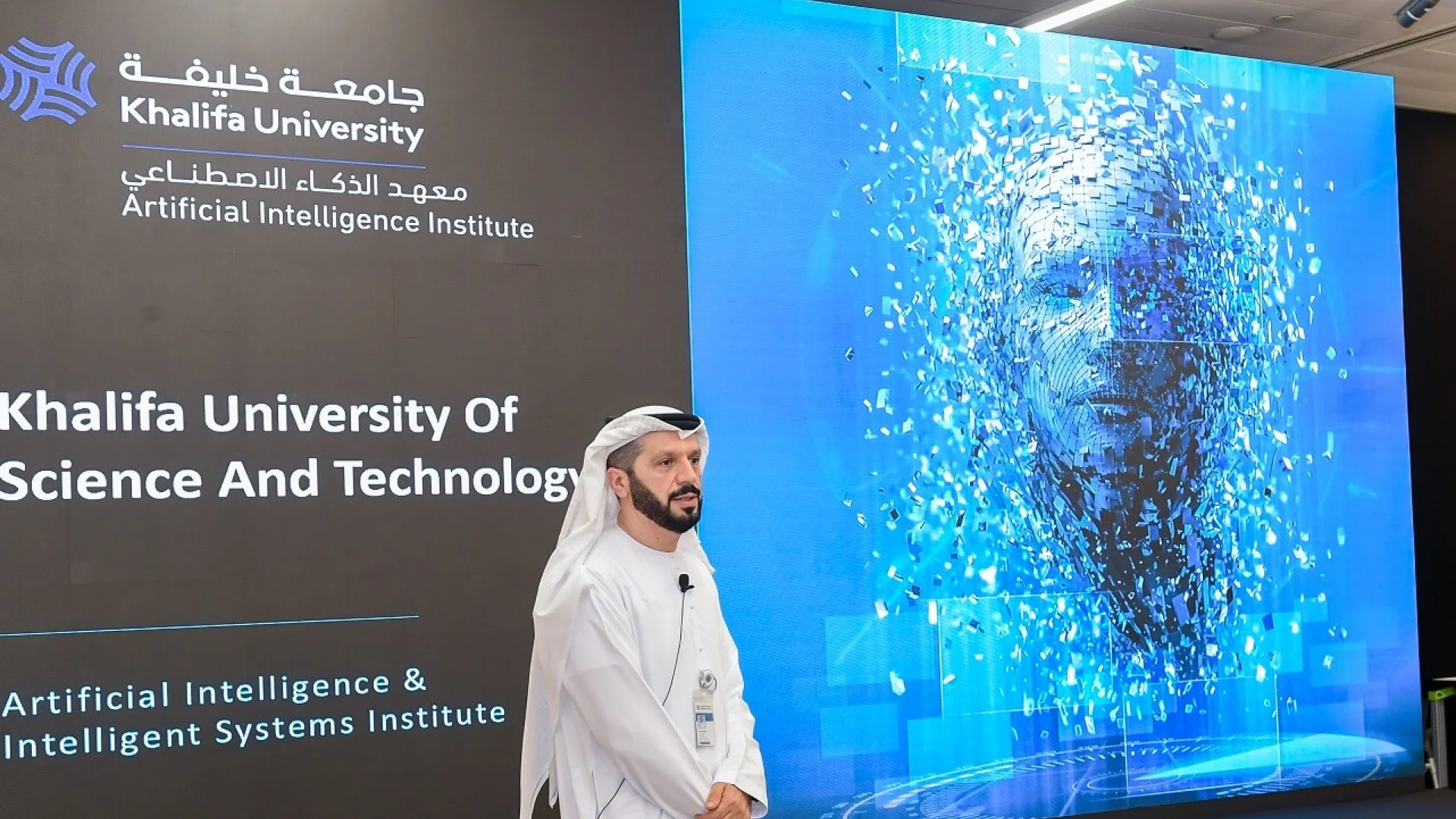

In the UAE, the race for artificial intelligence isn’t starting in boardrooms—it’s starting in lecture halls. The country is scaling up AI faculties by attracting international professors, expanding research capacity, and redesigning programmes around real-world use cases, from machine learning and data science to responsible AI. Universities and education authorities are pushing faster, more strategic hiring and deeper industry partnerships so graduates can move from theory to deployment. The goal is a steady, homegrown pipeline of AI talent that can power government digitisation, fast-growing tech companies, and a maturing start-up scene.
The projector hums. A line of sunlight cuts across the desks like a spotlight. On the whiteboard, someone has written a single word in thick marker: TRUST. The room is quiet in that charged way—quiet because everyone is thinking, not because no one has anything to say.
“If we get this wrong,” a lecturer murmurs, half to the class and half to himself, “the model won’t just fail in the lab. It’ll fail in the real world.”
This is what the UAE’s AI ambition looks like up close. Not a glossy keynote. Not a futuristic promo video. A classroom where the future is being argued over, tested, rebuilt—line by line of code, assumption by assumption.
According to reporting on how the UAE is building the next generation of AI faculty, the country is moving quickly to expand its academic backbone: recruiting international professors, strengthening research, and modernising curricula so graduates can step straight into the needs of industry and government. The headline may be “AI,” but the real story is capacity—how you create enough teachers, mentors, supervisors, and lab leaders to train the workforce a national AI agenda demands.
In many places, AI education hits a wall. Student demand rises fast. Corporate demand rises faster. But faculty numbers—qualified people who can teach, run labs, publish research, supervise postgraduate work—grow slowly. The UAE is trying to widen that narrow point.
Universities are seeking more AI-specialised academics across machine learning, data science, robotics, natural language processing, and the increasingly non-negotiable field of responsible AI. The push is not only about adding courses; it’s about building full departments and research clusters that can stand shoulder-to-shoulder with international peers.
Walk through a campus corridor and you can feel the urgency in small details: posters for new labs, packed timetables, a noticeboard crowded with seminar invitations. In an office, CVs are stacked like playing cards. Someone is always on a call—time zones crossing, interviews scheduled, reference letters chased.
To build “next-generation AI faculty,” you need people who can do more than deliver lectures. You need builders: academics who can set up labs, design programmes, bring in funding, and mentor a pipeline of master’s and PhD students. And because AI talent is global, recruitment has to be global too.
A newly hired assistant professor describes the move like relocating into a living experiment. “It’s like arriving at a lab while the walls are still being painted,” he says over coffee. “But that’s exactly why I came. You can shape things.”
That word—shape—keeps coming up in conversations around fast-growing education systems. The UAE’s pitch isn’t only about facilities or lifestyle; it’s about momentum and the opportunity to create something new, quickly, with visible impact.
There’s a difference between learning AI and learning to operate AI in the wild. The UAE’s approach emphasises practical, applied learning: real datasets, project-based modules, industry-linked assignments, and training that anticipates deployment issues—performance drift, data governance, security, and ethics.
In a lab session, students huddle around a laptop as a model misclassifies a cluster of images. One student exhales sharply. “It’s confident,” she says, pointing at the probability scores. “Confident and wrong.”
The lecturer doesn’t rescue them. He lets the discomfort sit for a second. “Good,” he says. “Now we’re learning.”
That is the mood of modern AI education: less polished certainty, more disciplined iteration. The reporting highlights a push to integrate responsible AI principles into learning—fairness, transparency, explainability—so graduates don’t treat ethics as a slide at the end of a presentation, but as a design constraint from the start.
The UAE is also tightening the loop between academia and industry. Partnerships matter here because they shorten the distance between what’s taught and what’s needed: companies bring problems; universities bring methods; students bring energy and time; the outcome is talent that’s job-ready—and research that’s not trapped behind campus gates.
In a shared workspace, a visiting industry mentor gestures at a dashboard filled with alerts. “This is what we live with,” he says. “Not clean data. Not perfect labels. Reality.”
A professor replies, dryly: “Perfect. That’s what we’ll train on.”
It’s a small exchange, but it captures the larger strategy: move learning closer to production environments, so graduates understand not only how to build models, but how systems behave when they’re connected to people, processes, and high-stakes decisions.
Because AI is becoming infrastructure. It’s sliding into everything: transport planning, energy optimisation, financial services, fraud detection, customer experience, medical diagnostics, public service delivery. If a country imports all of that capability without developing its own expertise, it risks long-term dependency—technical and economic.
Building AI faculty is therefore not a “nice-to-have” education initiative. It’s a competitive strategy: grow research capacity, produce skilled graduates, attract global minds, and keep more value creation inside the country.
And there’s another layer: trust. As AI systems spread, questions multiply—about privacy, bias, accountability, and safety. Universities are one of the few places designed to handle such questions slowly and rigorously, even when the market wants answers yesterday.
For students, the expansion of AI faculties translates into more options and clearer pathways: broader course offerings, deeper specialisations, stronger supervision for postgraduate research, and more exposure to real projects through internships and partnerships. The ambition is to create graduates who can move from fundamentals (maths, statistics, programming) to advanced capability (MLOps, model risk, governance, deployment) without losing sight of the human consequences of automation.
In the classroom where “TRUST” is still written on the board, the discussion drifts from technical metrics to something messier: who gets impacted when an algorithm makes a decision. A student raises a hand. “So,” he asks, “how do we prove it’s fair?”
The lecturer pauses. “We don’t prove,” he says softly. “We measure, we test, we document—and we keep watching.”
Outside, the day is bright and busy. Inside, the future is being built in small, careful steps.
For real estate investors, the UAE’s push to build next-generation AI faculty is a classic early signal of durable, high-value demand. Universities act as anchor institutions: when research capacity grows, it pulls in startups, corporate R&D teams, accelerators, professional services—and a workforce that tends to rent and buy in higher-quality segments. In other words, talent policy becomes property demand.
1) Residential demand near education and innovation nodes: Expanding faculty headcount (professors, researchers, PhD candidates) increases inbound relocation. These groups typically prioritise connectivity, amenities, and quality—supporting rental resilience in well-serviced districts close to campuses, research parks, and major employment corridors.
2) Mixed-use outperforms in “knowledge districts”: AI ecosystems thrive on density and interaction. Investors and developers should watch for districts that combine housing, flexible offices, labs, retail, and hospitality. These environments capture daily footfall from students and staff and attract events, meetups, and short-term visitors tied to conferences and partnerships.
3) Office demand shifts to premium, flexible space: AI and tech teams often need less square footage than traditional corporates, but they demand better infrastructure—secure networks, adaptable floorplates, proximity to talent, and collaboration-ready design. This supports Grade-A assets and well-positioned secondary buildings that can be repositioned toward innovation tenants.
4) Student housing and serviced living: International cohorts and fast-growing programmes can lift demand for managed accommodation: purpose-built student housing, micro-living, and serviced apartments near campuses. Investors should focus on operational quality, tenant experience, and transport links—because these tenants are highly mobile and compare globally.
5) A long-term moat for city positioning: Strong AI faculties help a city compete for corporate site selection and R&D mandates. That can translate into more stable absorption across cycles—especially in submarkets tied to education, healthcare, logistics, and government digitisation initiatives.
Investor takeaway: Track where the UAE’s AI education capacity is physically concentrating—campuses, research hubs, innovation districts—and treat those nodes like infrastructure. Over time, they can underpin stronger occupancy, steadier rent growth, and higher liquidity for residential, mixed-use, and premium office assets nearby.