
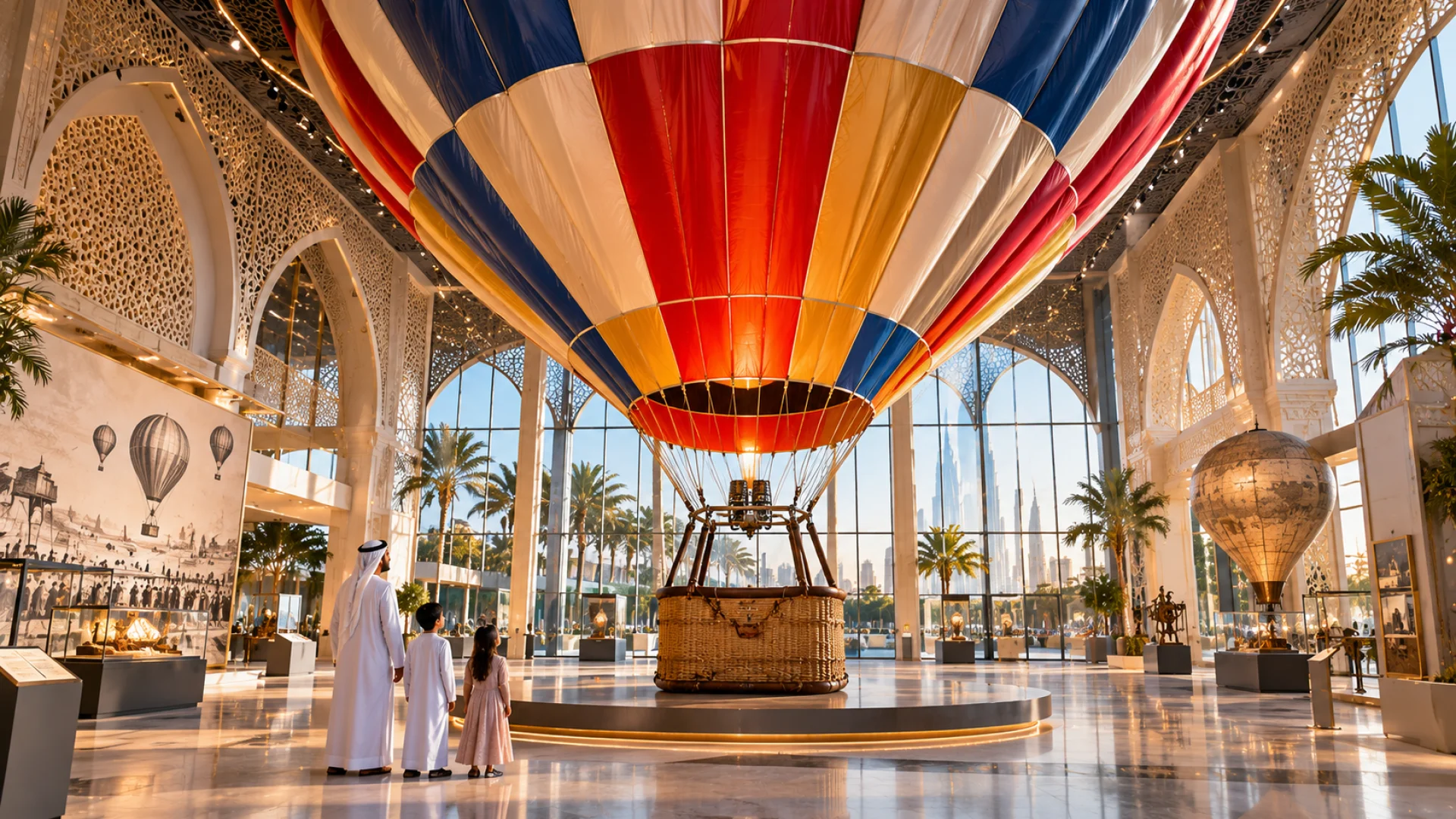

A burner roars, a vast envelope rises, and the desert floor begins to drift away: the UAE is set to create the Middle East’s first hot-air balloon museum. The project is designed to bring together aviation history, hands-on technology and the distinctive magic of silent flight. Visitors are expected to encounter historic balloons, interactive displays and the story of ballooning in the region.
First comes the flame. A brief roar cuts through the morning air. The fabric above the basket trembles, then begins to fill. Slowly, almost impossibly, a balloon grows from a heap of colourful cloth into a floating globe. This is the moment the UAE’s planned hot-air balloon museum wants visitors to feel for themselves: the instant when the ground gives way to the sky.
The project will be the first museum of its kind in the Middle East. Its subject is simple to describe but difficult to resist. How does a vehicle fly without wings? Why can a basket drift above the desert with no engine pushing it forward? And what does it feel like to see an entire landscape become quiet and small below?
The answers begin with hot air. A burner heats the air inside the envelope, making it lighter than the cooler air around it. Lift follows. The principle is elementary. The experience is anything but. Every flight depends on preparation, changing winds, careful judgment and the skill of a pilot who can control altitude but not simply point the balloon in any direction.
The planned attraction is expected to go beyond a conventional display of aircraft. Hot-air balloons are too large, too tactile and too dramatic to be reduced to labels on a wall. A full-sized basket can show visitors how close passengers stand to one another in the air. Sections of envelope fabric can reveal the stitching, seams and strength behind the bright colours. Burners can make the mechanics of lift visible rather than abstract.
Imagine walking into a gallery and seeing an envelope stretched across the space like a suspended sail. Nearby, a display explains the preparations before launch. The fabric lies on the ground. Ropes are checked. The burner fires. Helpers move quickly. The balloon rises, first awkwardly, then with surprising grace.
Interactive exhibits could allow visitors to experiment with the forces that shape a flight. Change the temperature and the balloon rises. Alter the wind direction and the possible route changes. Move higher or lower and the air behaves differently. For children, it becomes a game. For adults, it becomes a reminder that flight does not always require speed.
The UAE is a compelling setting for such a museum. At sunrise, the desert seems made for ballooning. Dunes catch the first light in long bands of gold. A road disappears behind a ridge. A vehicle becomes a dark speck. From a basket, the landscape does not rush past. It unfolds.
Ballooning in the region has become associated with that quiet, elevated view. It combines adventure with restraint. There is no engine noise drowning out the wind. No cabin window separates the passenger from the morning air. The basket moves at the pace of the atmosphere.
The museum can bring that experience indoors while preserving its sense of place. It can explain how the region’s climate, open spaces and tourism ambitions have helped make balloon flights a memorable part of the UAE visitor economy. It can also show that ballooning is not merely a leisure activity. It is a meeting point between science, craftsmanship, weather and human curiosity.
A strong museum story begins before modern tourism. The history of ballooning is a story of daring experiments, ingenious materials and people willing to trust an unfamiliar machine. Early pioneers discovered that heated air could lift a vessel. Later generations refined the fabric, burner systems, baskets and safety procedures.
Visitors will be able to follow that progression through objects, photographs, film and reconstructed equipment. The emphasis is likely to be on movement: what changed, who improved it and why each development mattered. A burner is not just a piece of hardware. It is the sound that begins a flight. A rope is not just a rope. It is part of the system keeping a passenger safe.
The regional chapter gives the story its local character. Balloon flights over the UAE’s desert landscapes have created their own visual language: colourful envelopes against pale sand, small baskets above endless dunes, and sunrise journeys that turn geography into theatre. The museum can preserve that memory while introducing new audiences to the science behind it.
The attraction is also designed to be accessible. A child may arrive because the balloons look enormous and colourful. A parent may be drawn to the aviation history. A student may leave thinking about air density, meteorology or engineering. That is the strength of a hands-on museum: the same object can open several doors.
Short demonstrations could show why a balloon climbs and descends. Digital screens could recreate a flight over the dunes. A viewing area might allow visitors to watch real launches, depending on the final location and design. The best moments would be small and physical: the hiss of a burner, the pull of a rope, the shadow of an envelope moving across the floor.
There is emotion in the technology, too. A balloon is not an anonymous machine. It is assembled by people, inflated by people and guided by people. Before every launch there is a pause when everyone looks up. The envelope is full, the basket is ready, and the decision to leave the ground suddenly feels personal.
The UAE has developed a reputation for ambitious attractions, but the balloon museum offers a different kind of spectacle. It does not need to compete through height or speed. Its power lies in atmosphere. The museum can create a place where visitors slow down, look upward and understand an element of aviation that remains wonderfully exposed to nature.
It may also become a gateway to wider experiences. A visit could be paired with desert excursions, balloon flights, family workshops or seasonal events. Schools could use the museum to connect physics lessons with real machines. Aviation enthusiasts could study historic equipment. Photographers could come for the colours and leave with a deeper appreciation of the craft.
Ultimately, the museum’s promise is contained in the image of a balloon preparing to launch. The equipment is practical. The procedure is precise. Yet the result still feels like a small act of magic. A flame rises, the envelope fills, and the horizon opens.
When the first visitors walk through the doors, they will not simply be entering a museum about flight. They will be entering a story about the human desire to rise, to see familiar places differently and to trust the invisible force of air. Outside, the desert will remain where it has always been. From above, however, it will look entirely new.
A major cultural and tourism attraction can influence the property market around it well beyond ticket sales. A hot-air balloon museum could increase footfall, strengthen the area’s identity and encourage visitors to stay longer. That creates opportunities for hotels, serviced residences, restaurants, retail units and experience-based businesses.
For investors, the key issue will be integration. The museum is most valuable as part of a broader destination strategy rather than as an isolated building. Convenient access, public spaces, family facilities and links to desert resorts or balloon operators can turn a single attraction into a complete visitor circuit.
The long-term effect will depend on programming, accessibility and year-round activity. Exhibitions, school visits, festivals and live launches can keep the destination active beyond the initial opening. If those elements come together, the museum could help transform a desert tourism node into a more complete cultural and investment environment. The balloon rises into the sky; the surrounding district may rise with it.