
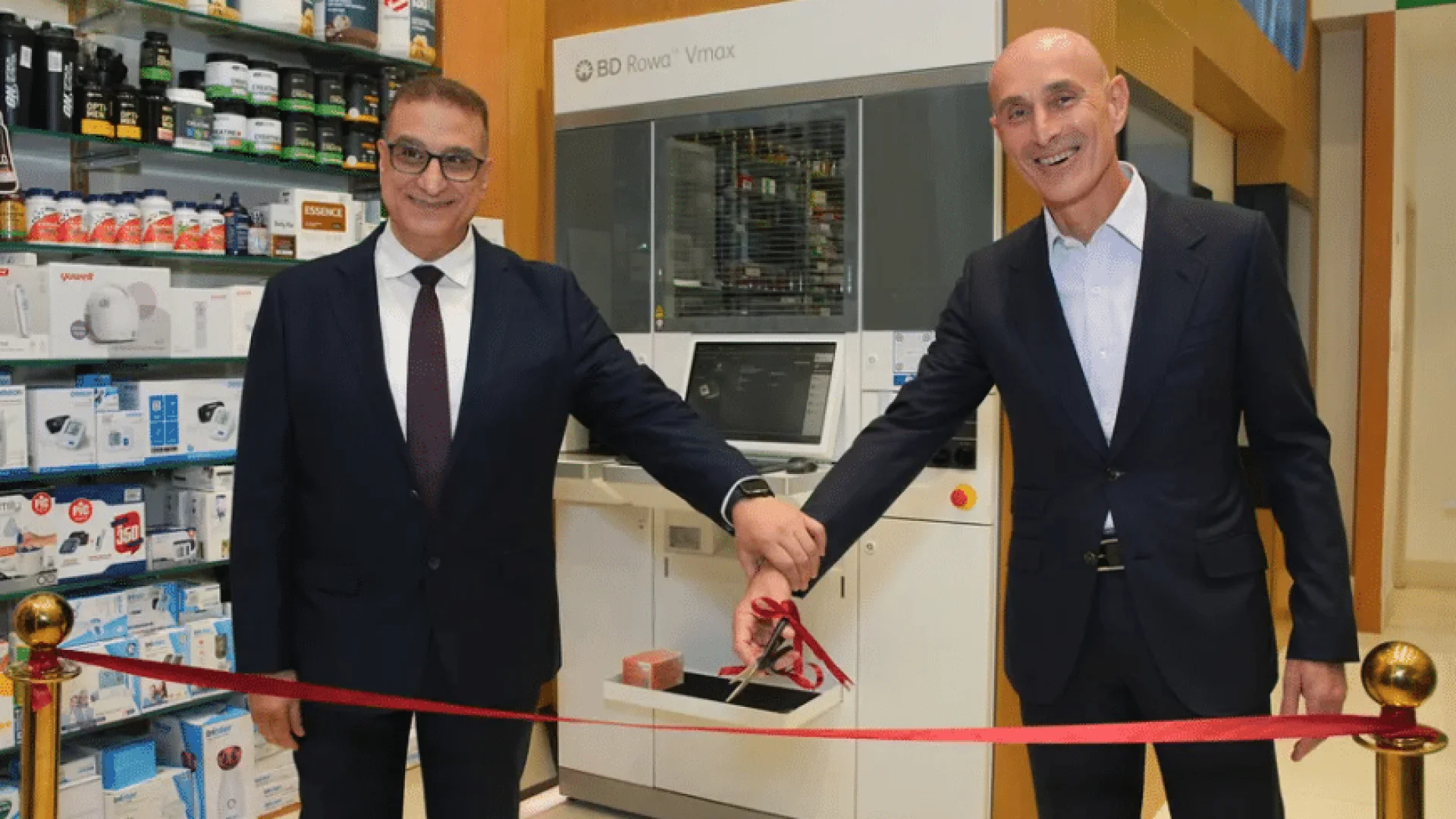

Behind a glass panel, a robotic arm moves through a carefully organised field of medicine packs, selects the required product and sends it to the collection point. The UAE’s first robot-automated retail pharmacy is designed to streamline storage, improve stock control and reduce time spent on repetitive tasks. Pharmacists remain central to the experience: the machine handles the movement of products, while people remain responsible for advice, safety and care.
The first thing you notice is the sound. Not a bell, not a printer, not the familiar rattle of drawers behind a pharmacy counter. It is a soft mechanical hum. Behind glass, a robotic arm glides sideways, pauses and reaches for a medicine pack with remarkable precision. A moment later, the product appears at the collection point.
This is the UAE’s first robot-automated retail pharmacy – a compact glimpse of how everyday healthcare may change. The system automates important parts of the pharmacy journey, including the storage, identification and retrieval of medicines. What once required a member of staff to search through shelves and drawers can now begin with a digital instruction.
For customers, the promise is straightforward: less waiting, more accurate stock handling and a smoother experience. For pharmacists, the change may be even more significant. By handing routine logistics to an automated system, staff can devote more attention to the conversations that matter – explaining a prescription, answering a worried question or checking that a patient understands how to take a medicine.
A conventional pharmacy is a carefully managed maze. Products are arranged by category, brand or dosage. Staff members learn the layout and build speed through repetition. But the larger the range, the more demanding the operation becomes. Similar-looking boxes sit close together. Products need replenishing. Expiry dates have to be monitored. During busy periods, every search adds another few seconds to the queue.
The automated pharmacy approaches the problem differently. Its digital system keeps track of where products are stored and directs the robotic mechanism to the requested item. The movement is simple to watch but sophisticated underneath. The machine must identify the right product, retrieve it safely and deliver it to the correct point in the process.
“Where is this medicine?” is one of the most ordinary questions in a pharmacy. Here, the question becomes a digital task. The system searches. The robotic arm reaches. The pack arrives. A trained professional remains available to verify the order and speak with the customer.
The UAE has invested heavily in digital public services and smart-city infrastructure. Automated transport, digital government platforms and cashless services have become familiar features of urban life. The pharmacy project extends that ambition into a more sensitive field: medication and personal health.
Its value is not limited to the spectacle of a machine moving behind glass. The system can help pharmacies organise stock more efficiently, monitor availability and manage replenishment with greater precision. It can also make the path from order to collection more predictable. Customers may not see every digital step, but they feel the result when the waiting line moves more quickly.
That last point is crucial. Medicines are not ordinary retail products. A robotic system can locate and move a package, but it cannot replace professional judgement. A prescription may raise questions about dosage, interactions, allergies or the patient’s wider circumstances. The machine can perform a precise logistical task. The pharmacist remains responsible for the human and clinical conversation around it.
Picture a customer arriving with a digital prescription. Their details are confirmed. Somewhere behind the glass, the pharmacy system receives the request. The robotic arm begins its short journey through the storage area. The customer watches, perhaps with curiosity, perhaps with the impatience of someone who has already had a long day.
Then the medicine arrives. But the interaction is not over. A pharmacist explains how and when to take it. The customer asks one more question. The conversation takes place because the professional has not been pulled away to search through a cabinet.
This division of labour is the most compelling part of the technology. Automation handles repetition and movement. People handle context, reassurance and judgement. Done well, it does not make the pharmacy colder. It makes room for better human attention.
The UAE’s urban environment makes efficient healthcare logistics especially relevant. Dubai, Abu Dhabi and other fast-growing centres combine dense development, international populations and high expectations for convenience. Residents are accustomed to services that are quick, connected and available beyond traditional office rhythms.
A smart pharmacy fits naturally into this setting. It can serve a busy retail centre, a medical district, an airport-linked development or a mixed-use neighbourhood. Its transparent design also turns infrastructure into part of the customer experience. The machine is not hidden in a back room. Its movement becomes a visible sign that the service is working.
Behind the visual appeal lies a practical advantage: better information. When inventory is digitally tracked, staff can see what is available and what needs replenishing. Orders can be prepared more systematically. Products can be arranged with greater spatial efficiency. In a pharmacy, where safety and traceability matter as much as convenience, that added visibility is valuable.
Launching an automated pharmacy is not simply a matter of installing a robot. Staff must learn how to supervise the system and respond when an exception occurs. Existing workflows must be adapted. Customers need to understand where technology ends and professional responsibility begins.
Trust will be built through small moments. The correct medicine appears. A pharmacist confirms the details. A question receives a clear answer. The process is fast, but not rushed. Reliability becomes visible not in a demonstration, but in thousands of ordinary transactions.
That is also why the human presence remains so important. Healthcare is full of uncertainty. A patient may be embarrassed, anxious or unsure. A machine can be accurate without being reassuring. A pharmacist can notice hesitation, adjust an explanation and recognise when a customer needs more than a quick handover.
The new system could become part of a wider digital chain. Electronic prescriptions, mobile ordering, automated inventory and collection services may eventually connect into one seamless process. A customer could place a request before leaving home. The pharmacy could confirm availability, prepare the product and alert staff to any information requiring personal attention.
Supply management may benefit too. Real-time inventory data can support more accurate ordering and reduce the risk of both shortages and unnecessary overstocking. For a country with a mobile population and rapidly expanding urban districts, that efficiency can have a meaningful impact.
The central question is not whether a robot can pick up a medicine pack. It can. The more important question is whether automation gives healthcare professionals more time to do what machines cannot: listen carefully, explain clearly and respond to the individual standing in front of them.
At the UAE’s new automated pharmacy, the answer begins with that quiet mechanical hum. The arm moves, stops and delivers the pack. The action takes seconds. The idea behind it is much larger: healthcare can become more digital without becoming less personal.
For the property sector, automated pharmacies offer more than a futuristic visual. They can become valuable service anchors in shopping centres, mixed-use districts, office developments and residential communities. A pharmacy that combines convenience with advanced technology may increase the everyday usefulness of a location and strengthen its appeal to residents, workers and visitors.
The strongest opportunities may lie close to clinics, hospitals, medical offices and high-density housing. When healthcare services are concentrated within an easily accessible district, the result is a broader health ecosystem rather than a single retail unit. Developers can use that ecosystem to differentiate projects, while investors may view advanced healthcare services as part of a location’s long-term resilience.
Automation may also influence how space is designed. If storage becomes more compact and efficient, more floor area can be dedicated to consultation rooms, diagnostic services or customer-facing care. In land-constrained urban environments, that is an important consideration. The pharmacy of the future may occupy a smaller footprint while offering a broader service experience.
For landlords, the technology can support a shift from retail space as a place of transaction to retail space as a place of essential service. A smart pharmacy brings regular visits, reinforces the identity of a neighbourhood and fits naturally into the UAE’s wider movement toward connected, technology-enabled urban living.