
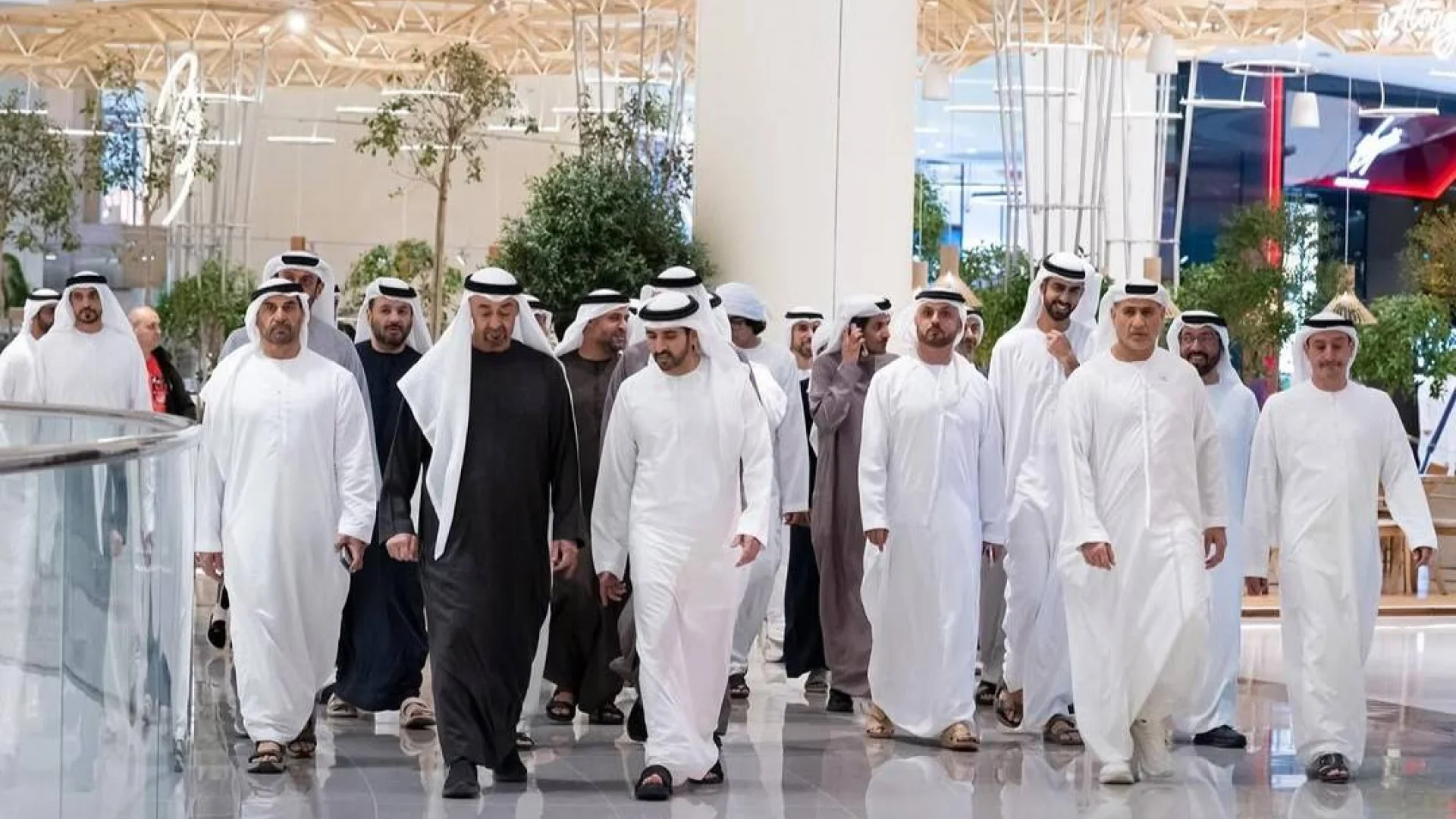

In the UAE, reassurance often arrives not as a speech but as a scene: leaders stepping into public view, greeting people, moving through everyday settings with unforced normality. Recent appearances by senior figures quickly travelled across phones and group chats, calming residents who were feeling the ripple effects of a tense regional news cycle. The message was simple and unmistakable—life is steady, security is intact, leadership is present. For a country built on global connectivity, that kind of visible confidence can be as powerful as any official statement.
The city is doing what it always does: glowing, humming, moving.
A delivery rider weaves through traffic. A family pauses at a pedestrian crossing, the smallest child tugging at a sleeve. Inside a café, the spoon hits the glass—clink—and a conversation stalls for half a second as someone raises a phone. “Look,” he says, angling the screen toward the table. A short clip. A familiar face in public. A handshake. A smile. People exhale like they didn’t realize they’d been holding their breath.
That’s the thing about reassurance in the United Arab Emirates: it can arrive quietly. Not with a podium. Not with a long address. But with presence—leaders seen, not just heard about. In a moment when regional headlines can spill into local nerves, those public appearances have landed like a steady hand on the shoulder.
As the story circulated, residents described the same reaction in different ways: “It’s fine.” “We’re safe.” “Everything is normal.” The images and videos of UAE leaders appearing in public—meeting people, attending engagements, moving through public spaces—were received as more than protocol. They became a signal. A visual confirmation that the country’s calm is not performative; it’s maintained.
In a region where news can turn sharp quickly, perception matters. Not because people are irrational, but because uncertainty spreads faster than clarity. A single ambiguous post can ignite group chats. A misread headline can turn into a dozen forwarded voice notes. And before anyone checks sources, the mood has already shifted.
Against that backdrop, an untroubled public appearance can feel like a reset button.
Security is partly infrastructure—planning, readiness, coordination. But it’s also psychology. People look for cues that match what they want to believe: that schools will open as usual, flights will run, roads will stay busy, work meetings will stay on the calendar. When leaders appear in public, they offer a cue that’s instantly understood. It’s not an abstract assurance. It’s a scene you can recognize: daylight, routine, normal faces, a composed pace.
One resident describes it like this: “When you see them out, you feel the situation is under control.” Another puts it more simply: “If they’re moving around normally, we can move around normally too.”
That’s how public confidence often works in global cities. It’s contagious, and it’s built from small observations. The tone of the taxi driver. The line at the supermarket. The fact that the mall is full of ordinary errands and weekend plans rather than whispered speculation.
In tense moments, misinformation doesn’t always arrive as lies. Sometimes it arrives as fragments—half-true, out of context, emotionally charged. It thrives on gaps: gaps in understanding, gaps between an event “somewhere” and daily life “here.”
Visible leadership presence helps close those gaps. It doesn’t answer every question, but it makes the biggest one—Are we okay?—feel less urgent. It changes the temperature of conversations. The endless “Did you hear…?” turns into “It seems calm.” The frantic refreshing of news feeds becomes a quick check, then back to dinner.
What’s striking is how quickly a shared image can travel through a population as diverse as the UAE’s. A clip posted in one language is re-captioned in another. A photo becomes a status update, then a comment thread, then a lunchtime topic in an office where people come from five continents. The reassurance spreads in the same channels as the anxiety—only this time the content is steadier.
The UAE’s daily life is built on predictability: transport that runs, services that show up, plans that hold. That’s not accidental; it’s part of the country’s modern identity and international appeal. Residents—especially expatriates—often choose the UAE because it offers a rare combination: ambition without constant friction, speed without chaos, global scale with local order.
But that also means the UAE is sensitive to outside noise. As a travel hub and business centre, it absorbs the world’s mood. When the region’s news cycle tightens, the UAE feels the ripple—not necessarily in events on the ground, but in emotions. People begin to calculate risk in their heads, even if nothing has changed outside their window.
In that context, leaders stepping into public view is not a minor detail. It’s a stabilizer. It tells residents and the wider world: the system is functioning, and it’s visible.
Most people don’t want drama; they want a reliable Tuesday. They want the school run to feel routine. They want to book a flight without second-guessing. They want to plan a weekend without scanning the horizon for hypothetical trouble.
The reactions around the UAE suggest that public appearances deliver a few practical psychological benefits:
It’s not that a single appearance “solves” anxiety. But it nudges the collective mood back toward baseline.
There is a particular kind of confidence in not over-explaining. In letting normal life be the headline. The UAE has often leaned on that approach: show operational readiness by continuing to operate; show cohesion by staying visible; show stability by keeping the everyday machine running.
And on nights like this—when the cafés are full, when the roads glitter, when people scroll past a video and feel their shoulders drop—that strategy works in the most human way possible. Not as policy. As atmosphere.
For property markets, “perceived safety” is a leading indicator—sometimes faster than official statistics. In globally traded real estate destinations like Dubai and Abu Dhabi, shifts in sentiment can immediately affect search traffic, viewing activity, reservation rates for off-plan units, and the speed at which tenants commit to renewals.
1) Tenant confidence and rental stability: When residents feel reassured, they are less likely to make sudden relocation decisions or negotiate aggressively out of fear. That supports occupancy and reduces short-term vacancy risk, particularly in expat-heavy submarkets and family-oriented communities where stability is a key decision driver.
2) Buyer decision cycles: In uncertain news periods, many international buyers pause—not because fundamentals change overnight, but because they want confirmation that daily operations, travel connectivity, and public order remain intact. Visible leadership presence can shorten these “wait-and-see” phases by reinforcing continuity and reducing the perceived risk premium.
3) Pricing power and risk premiums: Real estate pricing is partly a function of confidence. When a market is seen as resilient—able to maintain normality despite regional volatility—investors often require less additional yield to compensate for perceived risk. That can help protect pricing, especially for prime assets and well-located projects with strong developer reputations.
4) Off-plan and development pipeline implications: Pre-construction sales depend heavily on trust: escrow frameworks, delivery timelines, and future demand. In jittery periods, top-tier developers and projects with transparent construction progress tend to capture a larger share of demand, while marginal locations can see slower absorption. Investors may find relative safety in established master communities, prime waterfront districts, and assets with proven rental liquidity.
5) Investor playbook right now: Instead of reacting to headlines alone, track real-time market signals: listing days-on-market, rental renewal rates, transaction volumes, airline capacity, hotel occupancy, and corporate hiring announcements. Public stability cues suggest these indicators may stay firmer than sentiment-driven narratives imply—supporting a strategy focused on quality, liquidity, and location.
In short: public reassurance is not just political theatre—it’s a confidence mechanism. And in real estate, confidence is often the first domino that determines whether a market accelerates, pauses, or keeps walking forward at the same calm pace.