
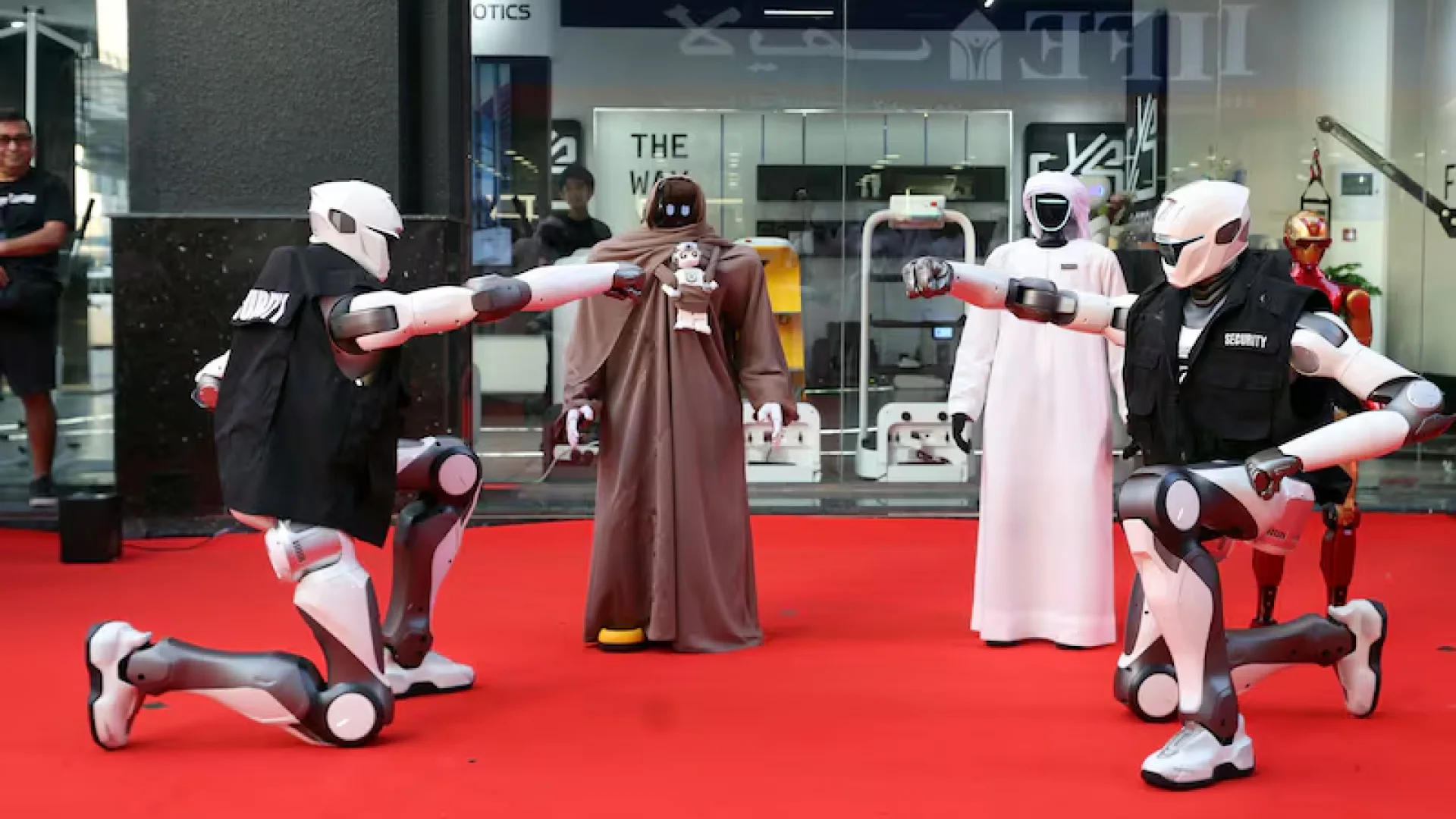

A hand rises, a head turns and a room full of visitors suddenly falls quiet. The UAE’s first humanoid robotics showroom brings artificial intelligence out of the laboratory and into a public, physical space. Its opening adds momentum to Dubai’s ambition to deploy about 200,000 robots by 2030, with potential consequences for hospitality, logistics, public services and the design of future buildings.
The robot lifts one hand. Its head tilts towards the visitor. For a second, the showroom goes quiet. Then someone laughs and asks the obvious question: “Can it understand me?”
That small exchange captures the strange power of the UAE’s first humanoid robotics showroom. The machines are not hidden in a research facility or shown only on a conference screen. They stand in front of the public. They move, respond and demonstrate how artificial intelligence is acquiring a body.
The setting feels less like a science-fiction film than a new kind of retail space. There are polished floors, curious visitors and machines designed to operate in environments built for humans. A robot may gesture, walk, answer questions or demonstrate a task. The experience is immediate. You do not simply hear about the technology. You watch it cross the room.
Humanoid robots are compelling because their shape is familiar. Two arms. Two legs. A body proportioned for human spaces. Unlike a traditional factory robot, fixed behind a safety barrier, a humanoid machine is designed to move through offices, hotels, warehouses and public areas.
That promise is practical as much as visual. If a machine can use existing doors, lifts, corridors and work surfaces, businesses may not need to redesign every building from scratch. In theory, one robot could welcome a guest, carry an item, guide a visitor or perform repetitive tasks. The showroom allows companies and the public to imagine those scenes in detail.
There is still a considerable distance between a polished demonstration and dependable daily operations. A useful robot must navigate unexpected obstacles, distinguish people from objects, operate safely and recover from mistakes. It needs more than impressive movement. It needs maintenance, software updates, trained operators and clear rules.
Yet public demonstrations matter. They change the conversation. A machine that once seemed like a distant prototype becomes something businesses can evaluate. The question shifts from “Will robots ever arrive?” to “Where could they work first?”
Dubai is not looking at humanoid robotics as a novelty involving a handful of machines. The emirate is pursuing a target of around 200,000 robots by 2030. That figure turns robotics into an urban policy and an economic proposition.
For a visitor, the first encounter might be simple: a robot points towards an entrance or answers a routine question. For a company, the calculation is much larger. Can automation raise productivity? Can it help address staffing pressure? Can it provide consistent service around the clock?
The showroom puts those questions on display. It also exposes the limitations. A robot that performs beautifully in a controlled environment must prove itself amid crowds, heat, noise, changing light and unpredictable human behaviour. Dubai’s ambitions will depend not only on the machines themselves, but on the infrastructure around them.
Dubai already presents itself as a city of connected systems. Digital government services, automated transport and highly engineered buildings are part of its urban identity. Humanoid robots could add a physical layer to that digital network.
They are not just algorithms working invisibly in the cloud. They occupy space. They need power, charging points, storage, maintenance and safe routes. They also need access permissions. A robot in a residential tower cannot simply enter every floor. A machine in a hotel must know which areas are public, which are private and when a human employee should take over.
That creates a new design brief for property owners and developers. Buildings may need charging stations, service rooms, wider circulation zones and stronger connectivity. New districts could plan these features from the start. Older properties may face a more complicated retrofit.
“Where does the robot wait?” may become as ordinary a question as “Where is the lift?” In a shopping centre, an efficient route may matter. In a logistics building, floor loading and turning space may matter. In a luxury hotel, the challenge is different: technology must support the guest experience without making it feel impersonal.
The most important test may not be mechanical. It may be emotional. People need to know when a robot is reliable, what it can see, what information it stores and when a human is available. A machine that looks friendly is not automatically trusted.
That is why the showroom is also a place of social adaptation. Some visitors approach immediately. Others watch from a distance. A child may wave. An older visitor may ask what happens if the machine stops. These reactions are not side notes. They are part of the technology’s future.
Robots will enter spaces where people live, work, shop and recover. Their success will depend on safety and dignity as much as speed. In healthcare, assistance cannot replace empathy. In hospitality, efficiency must not erase welcome. In residential buildings, convenience must not compromise privacy.
For real estate, humanoid robotics introduces a new layer of asset value. Buildings with reliable connectivity, flexible layouts and efficient service infrastructure may become better prepared for automation. Logistics properties could be redesigned around robotic movement. Hotels may develop new service models. Office and residential developments may need dedicated charging, maintenance and access-control systems.
Investors should look beyond the headline number of robots. The more useful questions concern operating costs, uptime, user acceptance, cybersecurity and the adaptability of the building. A property that can accommodate new systems without major structural work may retain greater flexibility.
The showroom is therefore more than a display of futuristic machines. It is a signal to developers, operators and investors. Robotics is moving from the exceptional to the imaginable. In Dubai, the next generation of buildings may not only connect people to data. They may also be designed for machines that walk among them.