
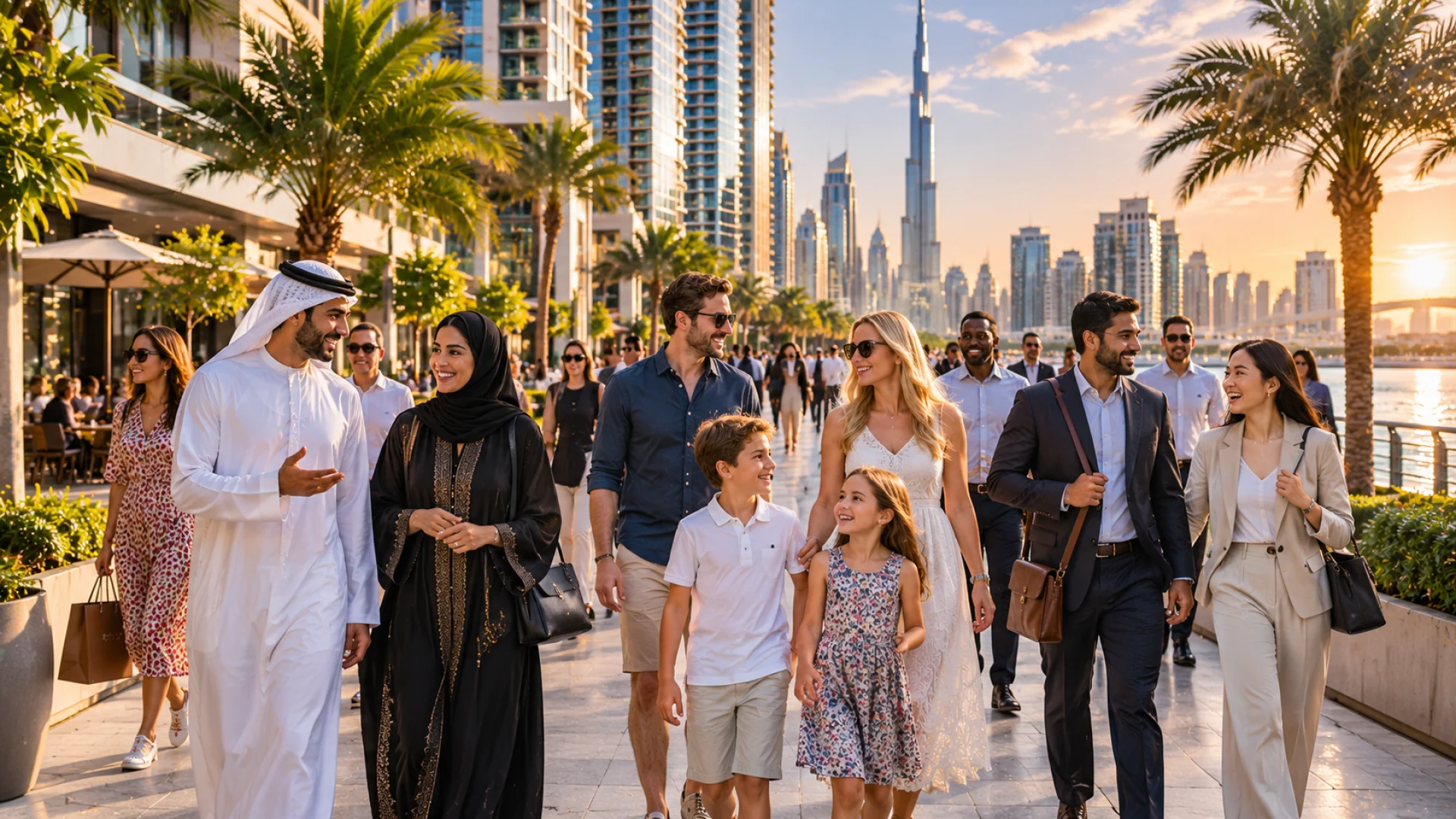

The United Arab Emirates has crossed a striking demographic threshold: its population has grown by nearly 30 percent in just five years to more than 12 million people. The increase reflects the country’s continuing pull for workers, families, entrepreneurs and highly skilled professionals. It also creates a new urban challenge, with housing, transport, schools and infrastructure all required to keep pace with the expansion.
Before the heat settles over Dubai, the city is already moving. Cars pour onto Sheikh Zayed Road. Elevators rise through towers of glass. At construction sites, the first lights flicker on. The morning rush is the visible edge of a remarkable statistic: the population of the United Arab Emirates has grown by almost 30 percent in five years and now stands above 12 million.
That number is not abstract for anyone walking through the country’s cities. It is the new family arriving in a residential tower. It is the engineer starting work in a technology park, the nurse joining a hospital, the entrepreneur opening a restaurant, and the child entering an international school. In a café, several languages overlap before the first coffee is finished.
The figures reported by Emirates 24|7 underline the extraordinary speed of the UAE’s expansion. Crossing the 12-million mark places the country in a new demographic chapter. The growth is closely connected to the strength of its economy, the arrival of international companies and the appeal of a country that combines modern infrastructure with a highly globalised business environment.
The answer begins with opportunity. The UAE continues to develop major sectors including trade, logistics, tourism, finance, technology, energy and construction. Each new project creates direct jobs, but also supports a wider network of suppliers, service companies and small businesses. A new office can mean new homes, new shops and new journeys across the city.
Residence reforms have strengthened that attraction. Long-term visa programmes for investors, entrepreneurs, exceptional talents and skilled professionals give more people the possibility of building a sustained future in the country. The distinction matters. A short assignment may bring one employee; a more secure long-term horizon can bring an entire household.
Many residents arrive alone and later bring partners, children or parents. That shift changes demand. The country needs not only office space, but also schools, clinics, parks, supermarkets, sports facilities and neighbourhoods designed for everyday life. Population growth becomes real when a school bus turns into a new street at seven in the morning.
Across the Emirates, the impact is visible in different ways. Dubai continues to expand beyond established districts, adding residential communities, business hubs and mixed-use developments. Abu Dhabi is upgrading existing urban areas while developing new coastal and island destinations. Sharjah, Ajman and Ras Al Khaimah are also absorbing demand for homes, offices and services.
Growth brings opportunity, but it also tests the urban system. More residents mean more trips, more energy and water consumption, more demand for medical care and more pressure on roads and parking. They also create larger markets for restaurants, retail, entertainment and professional services.
The central planning challenge is simple to describe and difficult to execute: expand quickly without sacrificing liveability. The UAE is experienced in delivering major infrastructure. Yet a population increase of almost one-third requires more than landmark buildings. It requires practical neighbourhoods where residents can reach work, school, shops and recreation without spending their lives in traffic.
Population growth also says something about confidence. People do not move only because a job exists. They stay when they see safety, reliable services and a credible future. The UAE’s proposition is built around that combination: efficient airports, digital government, international education, modern roads and policies designed to attract business and talent.
The result is one of the world’s most international urban environments. In a single apartment building, residents may come from every corner of the globe. At a weekend market, Arabic conversation sits beside English, Malayalam, Mandarin and French. This diversity is an economic advantage, but it also demands thoughtful places for communities to connect.
The next question is therefore not simply how many people live in the UAE. It is how well the country can accommodate them. Will new districts include schools, shade, green spaces and public transport from the beginning? Will housing remain available to workers and families across a broad range of incomes? Will infrastructure arrive before congestion becomes the defining experience?
The answer will shape the next decade. A larger population supports a deeper labour market, stronger consumer demand and greater international influence. It can help businesses scale and make cities more vibrant. At the same time, it raises the cost of poor planning. A tower without nearby services is not a neighbourhood; it is simply a tall building.
The UAE’s demographic leap is therefore both a success story and a test. More than 12 million residents represent the strength of the country’s economic model. They also represent millions of daily needs that must be met with precision: a home, a commute, a classroom, a clinic and a place to breathe.
For property markets, the population increase is a powerful long-term demand driver. Every new employee, family and business location requires space. Residential rentals, family housing, serviced apartments, student accommodation, logistics facilities and modern offices all stand to benefit from a broader base of users.
The most resilient opportunities may be found beyond headline-grabbing towers. Well-planned communities with schools, shops, parks and transport links are increasingly important as households seek convenience rather than a postal address alone. Affordable and mid-market housing also deserves attention because population growth includes workers and families with very different budgets.
Population growth does not guarantee a return. Investors still need to examine location, construction quality, service charges, vacancy risk, regulation and the depth of genuine local demand. But the structural direction is clear. A country with more than 12 million residents will require continuing investment in homes, offices, hotels, logistics and infrastructure. For UAE real estate, the demographic story is not a short headline. It is a long-term market force.