
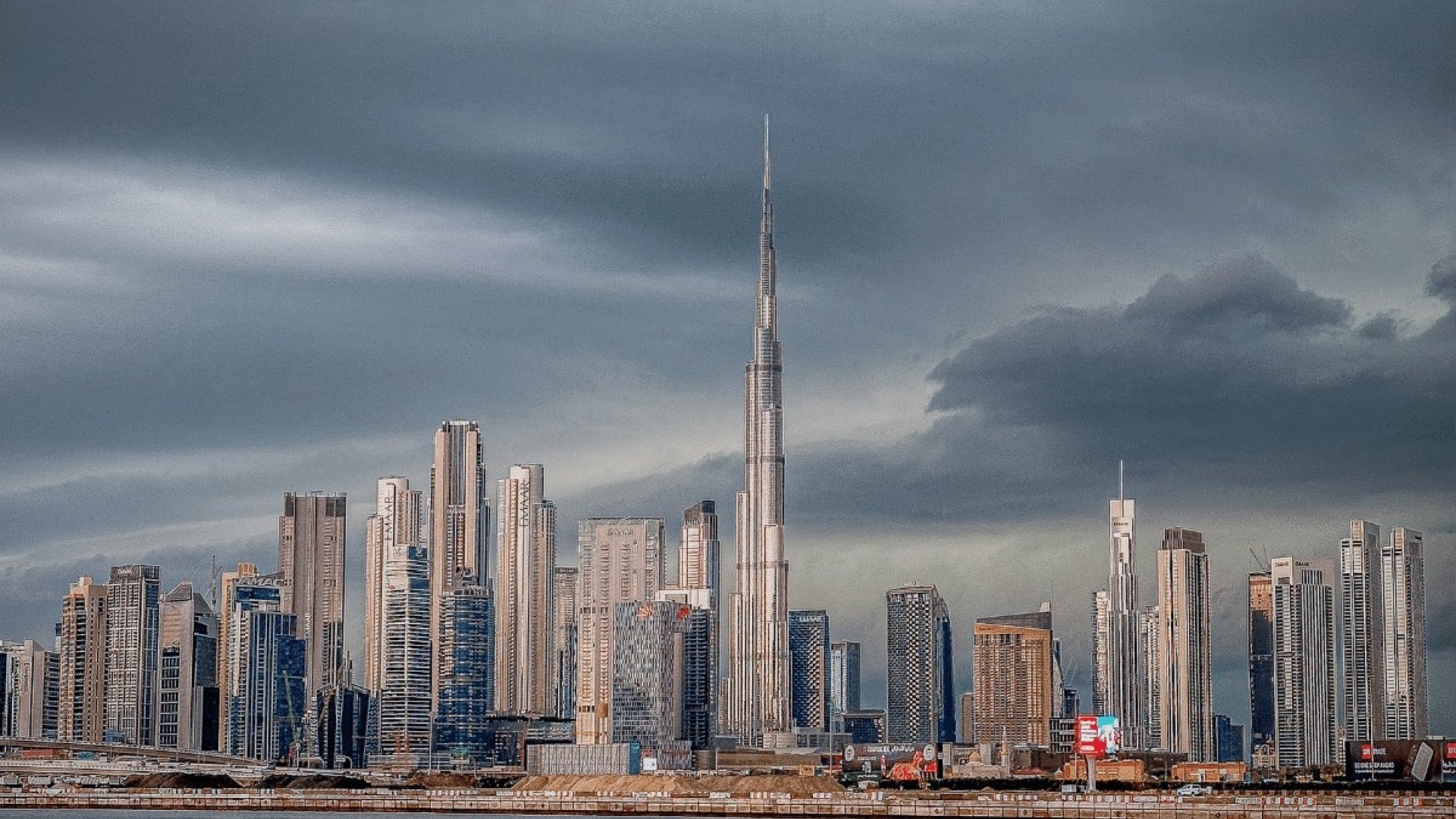

The UAE woke up to a rare kind of noise: rain that didn’t just sprinkle, but drummed—followed by thunder that lingered between towers and over open desert. Powerful showers and storm cells swept across multiple emirates, cutting visibility, slowing traffic and forcing airports into delay-and-cancel mode. Roads turned slick, water pooled in low-lying stretches, and drivers were urged to avoid flooded spots and take extra care. From flight boards flashing new times to congested highways moving in cautious waves, the country briefly shifted into storm tempo.
It starts as a rumor on the windshield.
One drop. Then another. Then—suddenly—the sound turns physical, a rapid drumbeat on hot asphalt that makes even a busy street feel hushed. A driver squints through the blur, nudges the wiper speed up, and says to no one in particular, “This is proper rain.” Above the skyline, clouds pile up in thick, steel-colored layers. Somewhere behind them, thunder clears its throat.
Heavy rain and thunderstorms swept across the UAE, disrupting the rhythm of a country built on precision schedules and fast movement. Storm cells brought bursts of intense rainfall, gusty winds and sharply reduced visibility in parts of several emirates—conditions that ripple outward quickly, from highways to airports to daily plans that suddenly need rewriting.
Inside the terminal, the first sign isn’t the rain. It’s the screens.
Rows of flights that normally tick along with quiet confidence begin to flicker: Delayed. Then another line: Cancelled. A gate agent leans closer to a passenger, voice lowered as if speaking softer might steady the situation: “Please check your airline updates. We’re waiting on the next clearance.”
Thunderstorms near flight paths and over key operational areas can force slower turnaround times and stricter safety buffers. Ground handling becomes more cautious. Schedules compress, then snap. Some services are delayed; some are cancelled. For travelers, it means the familiar airport choreography—check-in, security, boarding—turns into a waiting game punctuated by notifications and rebookings.
Out on the roads, the storm changes the city’s posture. Cars leave bigger gaps. Brake lights glow longer. What looks cinematic—streetlights doubled in puddle reflections—can be treacherous in practice. Water collects in dips and underpasses, the kind of places you barely notice on a dry day. Now they look like shallow lakes, swallowing lane markings and turning a routine commute into a slow, careful negotiation.
“Don’t go through that,” a passenger says, pointing at a waterlogged stretch ahead. The driver hesitates, signals, and eases into a different lane. Around them, traffic tightens and loosens in waves, each wave sparked by the same thought: How deep is it?
Authorities urged motorists to take extra precautions, avoid flooded areas where possible, and drive with heightened awareness as visibility and traction dropped. In heavy rain, stopping distances grow, spray hides hazards, and one sudden swerve can become a chain reaction. The advice isn’t dramatic—it’s practical.
There’s a particular kind of awe that arrives with rain in the Emirates. It’s not just weather; it’s an event. In residential neighborhoods, people drift toward windows. Someone sends a short video to a family group chat: lightning tearing open the clouds, thunder following like a slow applause. For a moment, the city looks freshly rinsed, as if the storm is polishing the edges of buildings and roads.
But even as the scene turns beautiful, the work behind the scenes becomes relentless. Road teams monitor trouble spots. Airport operations track storm movement minute by minute. Safety staff manage crowds and updates. A thunderstorm isn’t only a spectacle—it’s a logistics test, happening in real time.
And then, as quickly as it arrived, the rain sometimes eases. The wipers slow. The clouds thin at the edges. People step back outside, testing the air like it’s new. The city begins to accelerate again—carefully at first—returning to its usual pace with a fresh respect for how fast the sky can change the ground.
Episodes of heavy rain put a spotlight on resilience—an increasingly important factor for homeowners, landlords and investors in the UAE. Beyond views and amenities, weather performance matters: drainage capacity, building envelope integrity, and how efficiently a community responds when water starts to pool.
In the long run, the best-performing properties aren’t only the most photogenic on sunny days—they’re the ones that stay calm when the weather doesn’t.