
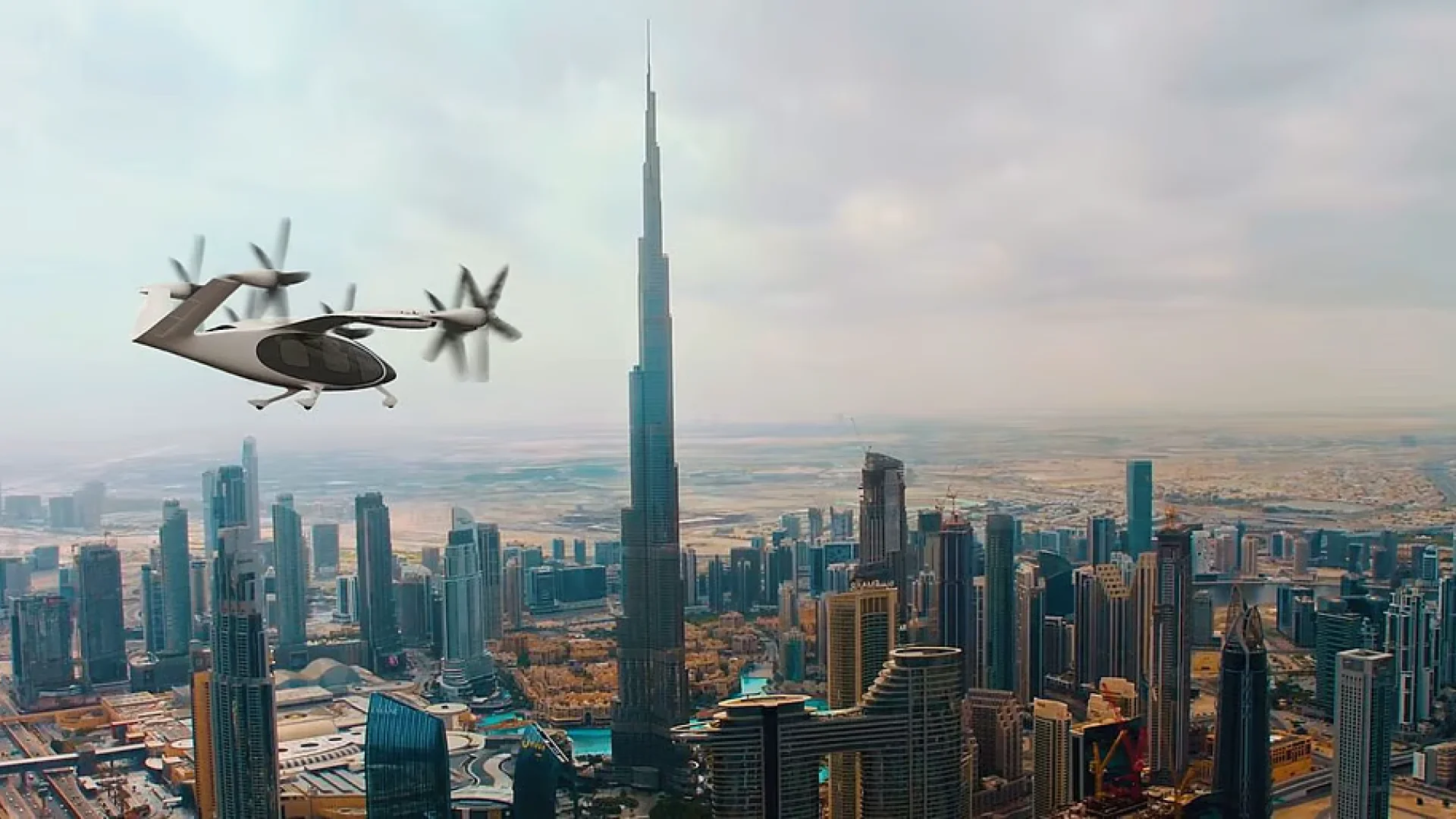

Down on Sheikh Zayed Road, time melts in traffic; up above, Dubai looks like a circuit board begging for a faster connection. Uber has now previewed its planned Dubai air-taxi service, built around Joby Aviation’s electric eVTOL aircraft and a network of Vertiports designed for quick, city-to-city hops. The promise is simple: book it like an Uber, lift off vertically, and slide over the gridlock in minutes. If Dubai turns this from demo to daily routine, it won’t just change commutes—it could redraw the city’s most valuable “nearby.”
The heat hits first. Even through sunglasses, Dubai’s midday glare feels physical—like the city is pressing a warm palm against your face. At street level, traffic moves in glossy, stubborn ribbons. Engines idle. Horns speak in short syllables. A driver leans out of a window, shrugs, and laughs: “This is normal.”
Then a different sound arrives—softer than you expect, a contained hum that doesn’t bully the air the way a helicopter does. People tilt their heads in unison, like a flock reacting to a shadow. Someone points upward. “There.”
Above the towers, a sleek aircraft shape cuts through the bright sky, hovering for a moment as if it’s testing the idea of stillness. This is the scene Uber wants you to remember: not the pitch deck, not the press release—the feeling that the city has suddenly gained another floor.
Uber has previewed its vision for an air-taxi service in Dubai, outlining what “air travel as a button” could look like when it’s built for short urban trips rather than airports and long-haul routes. The effort pairs Uber’s platform—routing, booking, and the habit of summoning transport on demand—with Joby Aviation, one of the best-known developers of electric eVTOL aircraft (electric vertical takeoff and landing).
The psychological trick is deliberate: make the extraordinary feel ordinary. Not “You’re flying today!” but “Your ride is here.” The preview leans into familiar language—service, booking, integration—because the goal is to turn a futuristic machine into an everyday choice. Tap. Confirm. Go.
“So it’s just Uber… but up?” a man murmurs, already holding his phone the way people do when they’re waiting for a car icon to inch closer on a map.
Dubai doesn’t adopt technology quietly. It stages it. The city likes prototypes that can be seen from a distance—projects that make the skyline feel like a headline. That’s why this preview lands with extra weight here: Dubai has both the appetite and the administrative agility to act as a proving ground for new mobility ideas.
And there’s a practical reason too. Dubai’s hot spots can be far apart in the way only a rapidly grown metropolis can be—glamorous districts separated by long stretches of highway, interchanges, and time. On a map, it’s simple. In a car, it’s not. If you can skim above the congestion, even for a short hop, the city compresses.
Joby’s aircraft is often described as “helicopter-like,” but standing beneath it—watching it move—you feel the difference in intent. It’s not built to thunder across the sky with brute force. It’s built to fit into an urban rhythm: electric propulsion, a design aimed at reducing noise, and an operational concept that depends on repeatability.
Uber’s role is less about the aircraft itself and more about the system around it: demand aggregation, user experience, and the messy reality of getting people from their front doors to the place where the aircraft actually departs. The preview makes clear that the air-taxi dream isn’t a single machine; it’s a chain of small, timed decisions that must click together.
In the air-taxi future, the most important real-world objects may not be the aircraft at all—but the places they touch. Uber’s preview emphasizes Vertiports: purpose-built hubs for vertical takeoff and landing, designed to manage passenger flow, boarding, and the practicalities of running a high-frequency service.
Think of a Vertiport as part terminal, part elevator lobby. It has to feel safe, fast, and boring—in the best way. The moment it feels complicated, the time savings evaporate. The moment it feels exclusive or fussy, the market shrinks.
Look closely and you can see the real challenge: creating a new kind of punctuality. Not airline punctuality—built around early arrivals and long buffers—but city punctuality, where people expect to leave five minutes late and still arrive on time.
As people discuss the concept, they don’t talk first about altitude or range. They talk about minutes. “If I can get there in twelve…” says a woman, trailing off, mentally rearranging her day. Dubai is a city where schedules can be tight and distances deceptive. Saving half an hour isn’t a convenience; it’s a new meeting, a longer dinner, a calmer morning.
That’s the quiet power of air mobility. It doesn’t need to be cheap to be valuable. It needs to be predictable. It needs to do one thing very well: turn dead time into living time.
Uber’s Dubai preview signals intent, but it also hints at how many pieces must align before anyone is routinely “calling a flight.” Infrastructure has to be built. Regulatory frameworks have to mature. Airspace coordination has to be safe and scalable. Maintenance, charging, staffing, and emergency procedures must be designed for repetition, not spectacle.
Dubai’s advantage is that it can move fast when it wants to. Its risk is that a public service must earn trust the slow way: through reliability. The first week will be exciting. The hundredth week will be the real test.
Late in the afternoon, when the light turns honey-colored and the glass towers look almost soft, you notice how much Dubai is defined by perspective. From the ground, it’s a sequence of exits. From above, it’s a pattern.
If air taxis become part of the pattern—if Vertiports become as normal as metro stations—the city’s sense of “near” and “far” will shift. And when that shifts, everything built on proximity shifts with it: where people live, where companies cluster, how hospitality sells convenience, how investors price access.
It starts with a hum you didn’t expect. It ends, potentially, with a new layer of city.
For real estate investors, Uber’s air-taxi preview in Dubai is best read as an accessibility story. Property markets have always capitalized travel-time reductions—metro extensions, new highway ramps, improved airport links. eVTOL services could introduce a similar dynamic, but in a more node-based way: value concentrates around Vertiports and the fastest door-to-door pathways feeding them.
1) Vertiport adjacency premium
If Vertiports are placed near business districts, major hotels, or high-end residential clusters, nearby assets may benefit from a “time liquidity” premium—particularly Grade-A offices, luxury apartments, serviced residences, and hospitality. Investors should watch not only the Vertiport location but also curb design, drop-off capacity, and pedestrian connectivity, because the ground interface will determine whether the time savings feel real.
2) Mixed-use and mobility-hub opportunities
Vertiports favor environments that can handle flow: parking structures, podium decks, transit interchanges, and master-planned mixed-use sites. Owners and developers with appropriately configured rooftops or parcels could find new revenue options via long leases, partnerships, or integrated mobility amenities that lift rents and footfall.
3) Hospitality and event-driven demand
Dubai’s MICE economy (meetings, incentives, conferences, exhibitions) is intensely time-sensitive. If premium guests can cut cross-city travel times materially, hotels near Vertiports could command higher rates and capture last-minute corporate stays. Event venues may also become more competitive if they’re “air-close” to airports and key districts.
4) Micro-location uplift, not blanket uplift
Unlike a metro line that spreads uplift along an entire corridor, eVTOL benefits are likely to be concentrated in micro-markets. That makes due diligence more granular: investors should model who can realistically use the service (price point, purpose of travel), how often aircraft can operate, and whether feeder roads can support peak flows.
5) Risk factors to price in
Noise—even reduced noise—can become a planning constraint near residential areas. Regulatory changes, airspace limits, operating hours, and public acceptance will influence real throughput. Investors should treat Vertiport proximity as an upside option rather than a guaranteed repricing until routes, permits, and operations are firmly established.
Investor takeaway
If Dubai normalizes app-booked air mobility, it adds a new dimension to the city’s accessibility grid. Real estate tends to reward whatever reliably saves time. The early winners are likely to be assets positioned at—or feeding into—the first Vertiport network, where “minutes saved” can be translated into higher rents, stronger demand, and sharper location narratives.