
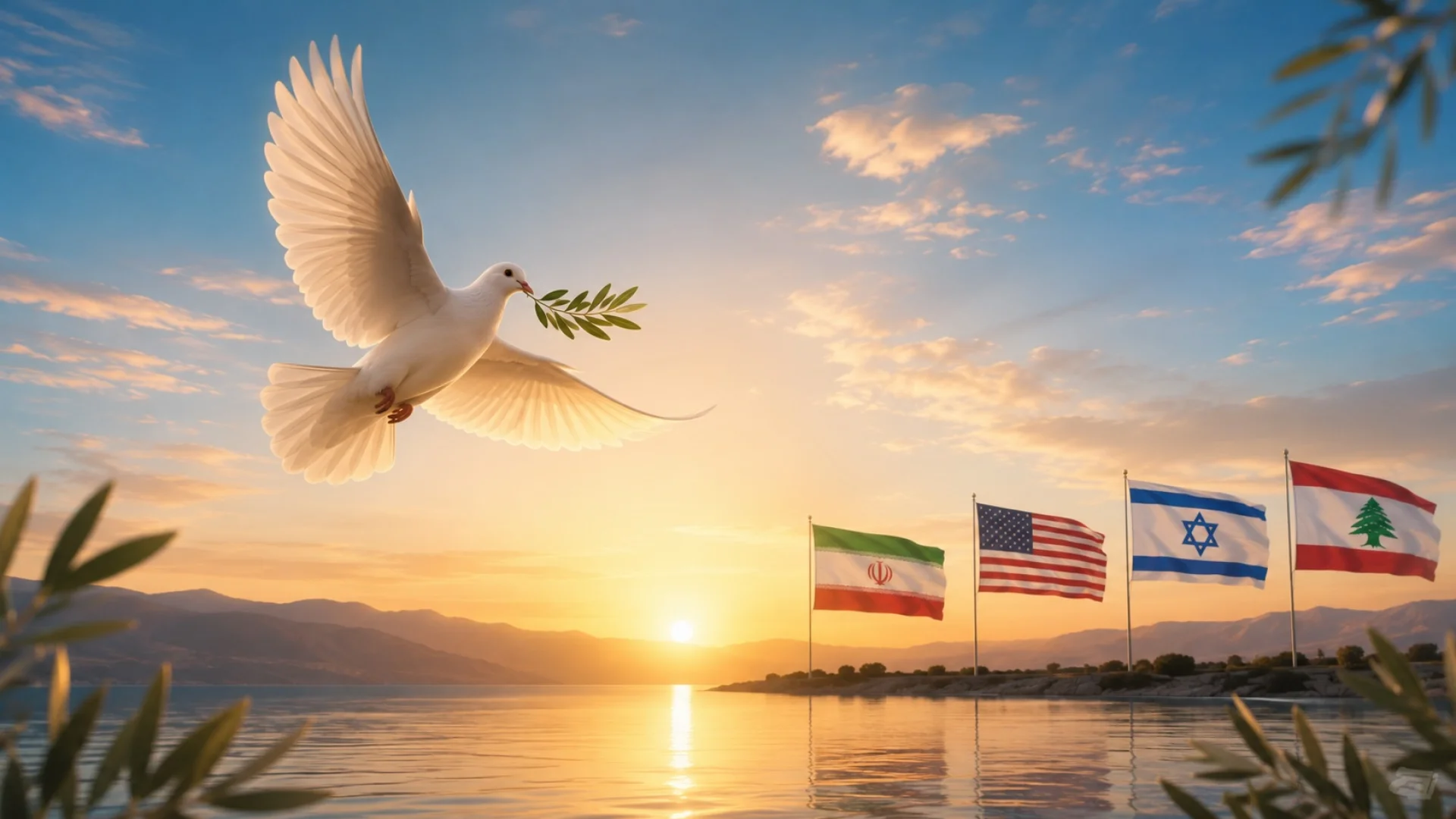

The United States and Iran have announced a preliminary peace agreement: a formal signing is expected in Switzerland on June 19, the Strait of Hormuz is set to reopen, and a 60-day negotiation phase is expected to tackle the hardest issues. For the Gulf, this is more than diplomacy – it is a signal to energy, trade, markets and investors.
On Monday morning, one sentence carried more weight than any headline: the United States and Iran announced a preliminary peace agreement. The text has not yet been signed, and many details are still not public, but for the first time in months the message sounds less like escalation and more like an exit.
For Dubai, the Gulf and the global economy, this moment is bigger than diplomacy. It touches tankers, flight routes, insurance premiums, markets, families, business travel and the simple question of whether a region can plan again. The war turned the Strait of Hormuz into a symbol: a narrow waterway through which energy, trade and anxiety all move. Now, movement is expected to return there first.
Based on the information available so far, this is a framework agreement between Washington and Tehran. The official signing is expected on June 19 in Switzerland. Mediators, led by Pakistan, describe an immediate and permanent end to military operations on all fronts, explicitly including Lebanon.
That is the hopeful part. The careful part is just as important: many core questions remain open. Iran's nuclear programme, possible sanctions relief, monitoring, guarantees and implementation mechanisms are expected to be addressed in a further negotiating phase. Peace here is not a switch being flipped. It is a corridor that has now been entered.
The Strait of Hormuz is not a side issue. It is one of the world's most sensitive trade arteries. When it is blocked, energy prices rise, supply chains become more expensive, insurers recalculate risk and investors reprice uncertainty. If it reopens, not every concern disappears – but a major pressure point begins to ease.
That is why markets reacted quickly. Oil prices fell, equities advanced and the first message to companies was clear: worst-case scenarios are being reassessed. This is not normalisation yet. But it is the first real signal that emergency conditions do not have to become the new baseline.
Relief is real, but the moment remains fragile. Lebanon was a critical point in the talks because fighting there repeatedly strained the diplomatic track. Israel, according to current reports, was not part of the direct US-Iran talks and maintains its own security red lines. This is one of the biggest risks: a regional peace can only work if secondary fronts do not become the main front again.
For diplomacy, the coming days are almost as important as the announcement itself. Until the planned signing, momentum must be protected. After that, the real work begins: turning an agreement into a system that can withstand pressure.
For the United Arab Emirates and Dubai, the news matters immediately. The region is built on predictability: ports, aviation, energy, finance, tourism and international investment all need confidence. Every reduction in Gulf tension reduces the feeling that decisions must be delayed.
Dubai has positioned itself as a place where capital, people and ideas still meet in uncertain times. A durable de-escalation between the US and Iran would strengthen that role. Not because risk disappears, but because risk becomes easier to calculate again.
1) Risk premia: Lower geopolitical tension can support financing assumptions, valuation confidence and investor sentiment across the Gulf. International buyers are especially sensitive to headlines around security, energy prices and transport routes.
2) Logistics & trade: A reopened Strait of Hormuz supports ports, warehouses, maritime services and regional distribution hubs. For industrial and logistics real estate, de-escalation does not automatically mean higher rents, but it reduces uncertainty in location decisions.
3) Hospitality & travel: Less fear of escalation can stabilise business travel, conferences, stopover tourism and international demand. Hotels, serviced apartments and premium short-stay housing benefit most when flight and travel routes are seen as reliable again.
4) Capital flows: In tense periods, capital searches for safety. In calmer periods, it searches for yield again. Dubai can benefit in both scenarios – as a safe haven and as a growth market. A credible peace phase would likely reinforce that dual status.
5) Caution remains essential: The agreement is a breakthrough, but not yet a fully negotiated final state. Investors should watch the signing, the 60-day negotiations, the implementation in Hormuz and possible reactions from regional actors.
If the announced US-Iran agreement becomes a durable peace, geopolitical pressure on energy, trade and capital will ease – and that can meaningfully support Dubai, the Gulf and selected real estate segments.