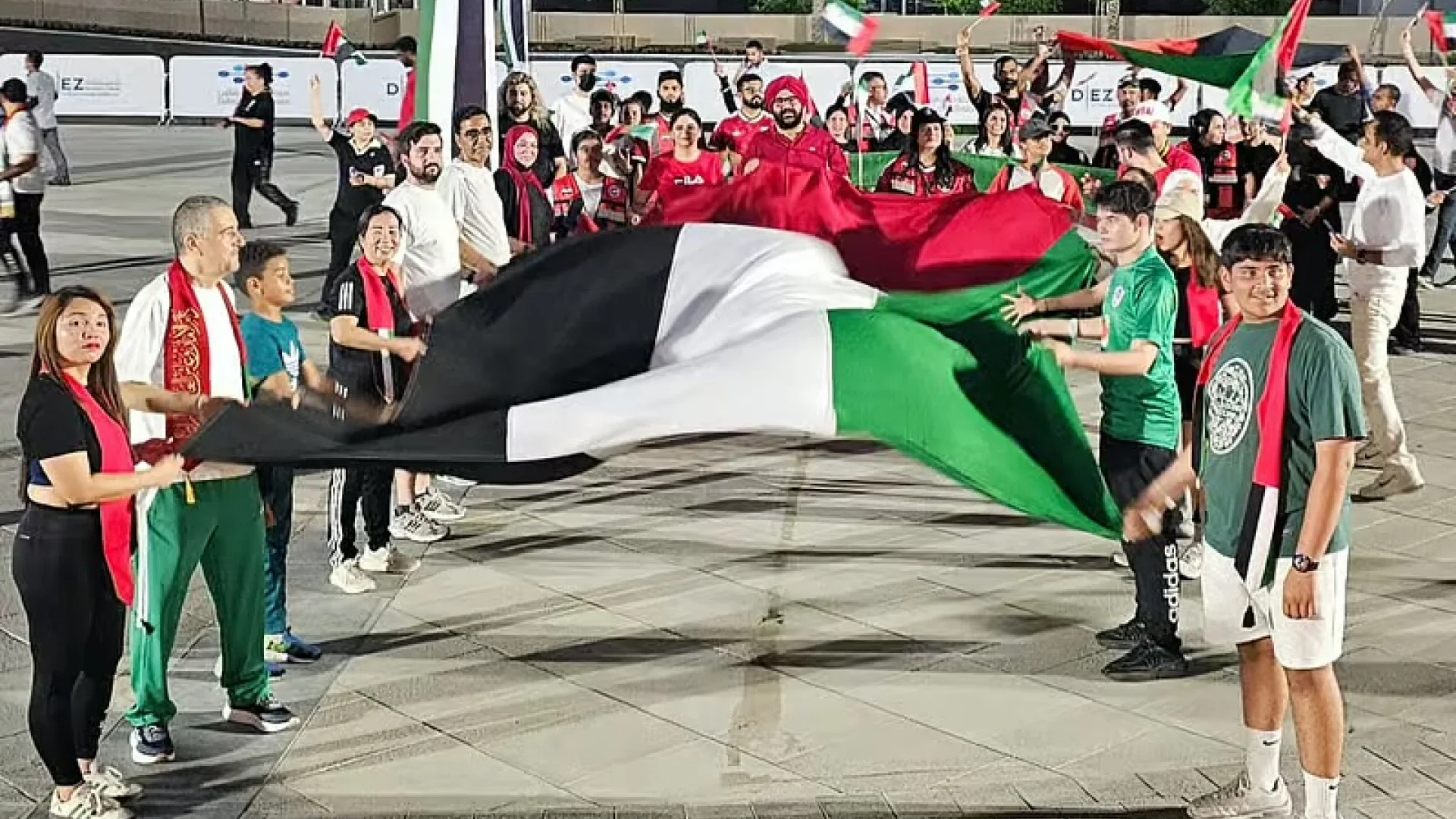
You hear it before you fully see it: a soft thunder of sneakers, the flutter of flags, and the bright, unstoppable laughter of children. The “We Love UAE” walk gathered families from across the Emirates in a public celebration of unity and national spirit—less about competition, more about community. Parents, grandparents and kids moved as one colorful stream, sharing water, photos, and small moments of kindness that made the message tangible. For a few hours, the city felt like a giant neighborhood—and that feeling matters long after the route clears.
The first thing that hits you is the sound. Not music. Not speeches. Just footsteps—hundreds, then thousands—landing in a steady, friendly rhythm on the road. Somewhere behind you a child squeals, delighted by the sheer size of the crowd. A father answers with a laugh: “Slow down. Save your energy.” The little one doesn’t. Not today.
Flags catch the morning light like sparks. Red, green, white, black—worn as capes, printed on shirts, painted on cheeks with the careful precision only a proud parent can manage. A stroller rolls by with a tiny flag taped to its handle. It wobbles as the wheels bounce over a seam in the asphalt, as if it’s waving on its own.
This is the “We Love UAE” walk, as reported by Khaleej Times, and it feels less like an event and more like a moving family album. Nobody is sprinting. Nobody is checking a stopwatch. People are here to be present—together—and you can feel it in the pace: unhurried, conversational, full of pauses for photos, water breaks, and the occasional dramatic announcement from a child who has spotted something important.
On ordinary days, a road is a tool: you cross it, you drive it, you measure your life in minutes and lanes. This morning, the same road feels softened—borrowed by the community. Families walk shoulder to shoulder. Grandparents keep an even, determined rhythm. Teenagers film short clips like tiny documentaries for their friends. And the youngest participants—small hands, big emotions—turn the whole scene into something warm and unmistakably human.
“Hold my hand,” a mother says, not as a warning, but as a promise. The child nods. They step forward together.
Every few meters, a micro-dialogue blooms and disappears into the crowd:
It’s a simple choreography: sharing space, sharing pride, sharing a morning.
The headline idea—families, children, the spirit of the UAE—isn’t an abstract slogan here. It’s visible in the smallest details. Kids perched on shoulders like little captains. A parent tying a shoelace mid-route. A toddler refusing the stroller because walking feels like a superpower. The event is built to welcome them, and that changes the atmosphere completely.
You notice how adults move differently when children are leading the mood. People are gentler. More patient. They smile more easily. They make room. They slow down when a small runner cuts across the path in spontaneous zigzags.
A little girl, maybe six, counts the flag’s colors out loud—carefully, as if she’s reciting something precious. “Green. White. Black. Red.” Her mother leans in: “That’s right.” The girl’s face lifts. Pride isn’t taught here like a lesson; it’s experienced like a day out.
“Spirit” can sound big. Unreachable. Something you only meet in speeches or on national holidays. But on this walk, it’s measured in gestures: a bottle of water offered to a stranger; a quick thumbs-up to a panting teenager; someone stepping aside to let a stroller pass without a bump.
An older man walks with his wife, their pace steady, almost ceremonial. When asked why they came, he answers without hesitation: “Because this country gave us a life. You show up for that.” His wife squeezes his hand, and for a moment they look like they’re walking through memory as much as through the present.
Not far away, a group of friends—different accents, different backgrounds—fall into step together. One of them calls out, half-joking: “We love UAE!” The phrase travels forward like a ripple. People repeat it, not as a chant, but as an echo of shared feeling.
Big cities can be lonely machines. Efficient. Fast. Loud. But every now and then, a city reveals another face: the one that wants to gather. Events like the “We Love UAE” walk do something subtle and powerful—they remind residents that public space belongs to people, not just traffic.
For families, especially, this matters. A child who experiences the city as safe and welcoming—who walks it, not just rides through it—grows up with a different relationship to place. They remember the shade of a building, the sound of applause, the way strangers smiled when they waved a flag.
That relationship becomes culture. And culture becomes the invisible infrastructure that holds communities together.
What’s striking is the absence of hurry. The crowd moves at a pace where conversations can breathe. Parents talk about school schedules and weekend plans. Friends compare photos. Someone stops to adjust a headband in UAE colors. Nobody looks annoyed. There’s an unspoken agreement that today isn’t about optimizing time—it’s about marking it.
A father bends down to his daughter: “If you’re tired, tell me.” She shakes her head hard. “I want to finish.” It’s a child’s sentence, but it lands like a motto: keep going, together.
Along the route, spectators clap. Some hold flags; others hold phones; a few just watch with a calm, pleased expression. The energy feels wholesome, almost domestic—like a neighborhood gathering that simply happens to be enormous.
By midday, the street will go back to normal. Cars will return. People will scatter into offices, malls, homes. But the images will stay: a toddler marching with fierce determination; grandparents finishing the route with quiet dignity; strangers smiling at one another as if they’ve shared something personal.
These events are social investments. They don’t pay out in trophies, but in trust—trust in the community, in the city, in the idea that belonging can be public and joyful. The “We Love UAE” walk turns national pride into something touchable. Not a poster. A morning. A crowd. A memory.
For real estate investors, the “We Love UAE” walk is more than a feel-good headline. Community-scale, family-forward public events are signals of urban livability—an increasingly decisive factor in rental demand, tenant retention, and long-term price resilience across the UAE’s key markets.
1) Family-centric demand supports stable leasing
When public programming visibly prioritizes families and children, it reinforces demand for neighborhoods that perform well on everyday family needs: parks, schools, healthcare access, safe pedestrian routes, and convenient retail. Assets in such areas—especially larger apartments, townhouses, and mid-rise communities—often benefit from:
2) Walkability and public realm quality as pricing power
The walk spotlights the value of pedestrian-friendly infrastructure. In practice, “walkable” districts command premiums because they improve day-to-day life: shaded sidewalks, continuous promenades, activated ground floors, and easy access to community amenities. For investors, this can translate into stronger rentability and better exit liquidity, particularly for well-connected mixed-use developments.
3) Community activation reduces neighborhood risk
Regular public events build social density—people recognize faces, routines form, and a neighborhood becomes a story residents want to stay in. That social stickiness can reduce downside risk by supporting occupancy stability. In expat-heavy markets, where relocation decisions can be rapid, a sense of community can be a differentiator that keeps tenants in place.
4) Retail and F&B upside in proven footfall corridors
Even a single large walk reveals where footfall naturally concentrates and which corridors can be successfully “activated.” Investors evaluating retail podiums, neighborhood centers, or hospitality concepts can use recurring community-event patterns as a proxy for:
5) Development and marketing: community as a product
In the UAE, homes compete not only on finishes and views, but on lifestyle narratives. Events like “We Love UAE” strengthen the broader city brand around safety, inclusion, and shared civic identity—elements developers can translate into positioning for family-focused communities and master-planned districts.
Investor takeaway: Track districts that consistently support walkable public life and family programming. They tend to attract longer-staying residents, support resilient rental demand, and create stronger “place identity”—a quiet, compounding advantage for long-term investors.