
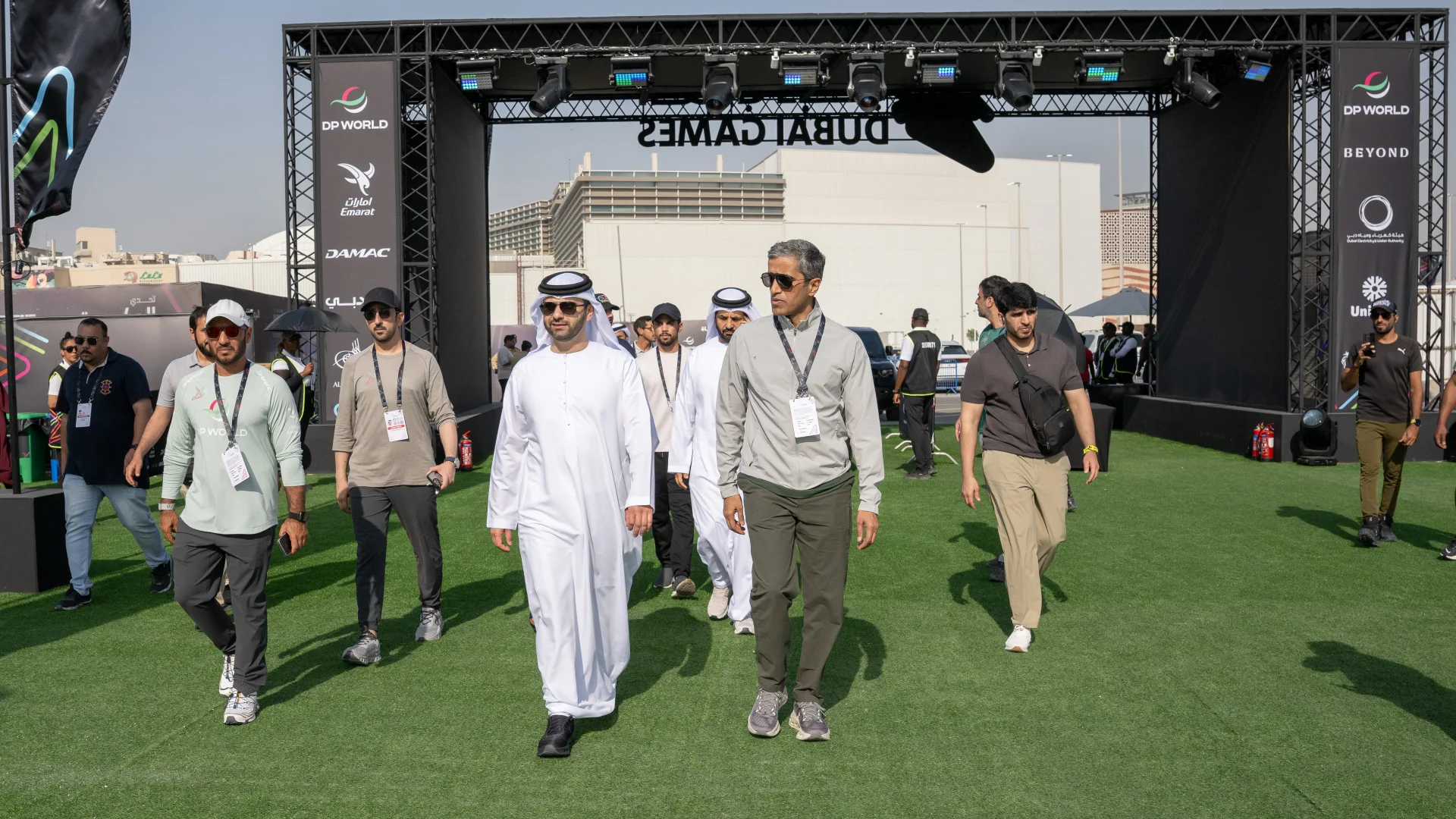

Dubai is turning online retail into physical momentum—warehouses, routes, payment rails, and partnerships that move at city-speed. At the launch of WORLD EF Dubai 2026, Sheikh Mansoor bin Mohammed bin Rashid Al Maktoum attended, underscoring the event’s weight as a regional meeting point for brands, marketplaces, tech, logistics, and investors. The platform looks set to convene the full commerce stack—from fulfillment and last-mile delivery to fintech and international expansion—at a time when MENA’s digital trade is accelerating. The message is clear: the next chapter of cross-border e-commerce wants a hub, and Dubai is writing itself into the title page.
The first thing you notice isn’t a logo or a slogan. It’s the sound of speed.
Soft footsteps on polished floors. A quick shuffle of papers. The sharp click of a camera shutter catching a handshake that will become tomorrow’s headline. Somewhere nearby, a screen wakes up and throws a map across the wall—routes branching like veins, time stamps blinking, deliveries hopping borders as if geography were just a setting you could toggle.
“If we reroute this,” a founder murmurs, half to herself, half to the person leaning in beside her, “we can cut a full day.”
“Do it,” comes the answer. No drama. Just certainty.
This is the atmosphere in which WORLD EF Dubai 2026 was launched: not as a polite calendar entry, but as an announcement with torque. And when Sheikh Mansoor bin Mohammed bin Rashid Al Maktoum attends the launch, the room reads it the way Dubai reads most signals—practically. This matters. This is being backed. This is expected to move.
Dubai doesn’t do “nice-to-have” platforms for long. The city has a habit of turning meeting points into marketplaces, and marketplaces into ecosystems. WORLD EF Dubai 2026 positions itself as a place where the entire e-commerce machine can gather—brands and retailers, marketplaces and SaaS providers, payment innovators and logistics operators, service firms and investors.
In the corner, two executives compare notes like travelers swapping weather reports. “We’re not looking for inspiration,” one says, voice low. “We’re looking for friction removal.” The other nods. “And partners who can keep up.”
That’s the subtext of the launch: the next phase of e-commerce won’t be won by who talks best about digital transformation. It will be won by who can ship, settle, and scale—across borders, across languages, across expectations.
Because e-commerce has stopped being a screen-based phenomenon. It is now a built environment.
Every “Buy Now” button demands real-world muscle: inventory planning, warehousing, pick-and-pack lines, courier fleets, returns processing, customer support, fraud prevention, and payment orchestration that doesn’t collapse under peak demand. In MENA, where consumer growth and digital adoption are reshaping shopping habits, the need for integrated platforms has become urgent.
WORLD EF Dubai 2026 arrives into that urgency. The city around it already functions like a logistics diagram brought to life—air connections, seaport access, free zones, multi-lane highways, and business infrastructure designed for international operators. It’s not that Dubai claims it can connect regions; it has spent years laying down the physical proof.
The promise of WORLD EF Dubai 2026 is breadth with a purpose: to put the whole commerce stack in one place and force the right conversations to happen. Not “Where is the market going?” but “How do we make this work on Monday?”
You can almost see the friction points hovering above the conversations like heat haze: delivery promises, cost per shipment, return rates, customer trust, regulation across jurisdictions. Dubai’s appeal is that it tends to answer friction with infrastructure—physical and procedural—until the problem becomes manageable, then scalable.
If you listen closely, “cross-border” is the word that keeps returning, like a drumbeat behind the music. It’s the ambition most brands share—and the trap many fall into. New markets don’t just mean new customers; they mean new delivery addresses that don’t behave like your domestic ones, new payment preferences, new compliance checks, new customer expectations about speed and returns.
A marketplace operator tells a story with the weary humor of someone who has lived through peak season. “We had an amazing campaign,” he says. “Traffic was insane. Then the last mile buckled and our support lines lit up like a switchboard.” He pauses, then smiles. “Now we design logistics the way you design a product. You test it. You stress it. You build redundancy.”
Dubai, in this narrative, is less a destination than a control tower—one that can coordinate flights, trucks, containers, and payment flows, all while pulling in global expertise. WORLD EF Dubai 2026 is set up to be a convening point for that coordination.
When a senior leader shows up at a launch like this, businesses translate it into a simple sentence: the sector is strategic. Sheikh Mansoor bin Mohammed bin Rashid Al Maktoum’s attendance reinforces that e-commerce, logistics, and digital trade are tied to broader economic priorities—competitiveness, diversification, and global connectivity.
For founders, that can mean momentum: pilots get approved faster, partnerships form more easily, international players take the market more seriously. For larger firms, it signals that the ecosystem will keep maturing—standards, capacity, talent, and capital moving in the same direction.
And still, amid all the dashboards and projections, it’s a small exchange that sticks.
Two people stand in front of a screen showing a graph that rises too sharply for comfort. One points at the peak. “If we don’t smooth this,” she says, “returns will hit us like a wave.”
“Not a wave,” the other replies. “A wall.”
They both laugh—briefly, knowingly. Because everyone here understands the truth e-commerce hides behind its clean interface: the work is messy. Boxes get delayed. Customers change their minds. Payments fail. Inventory lies. And yet the winners are the ones who build systems resilient enough to absorb the mess and still deliver the promise.
WORLD EF Dubai 2026 is being framed as a place where those systems are discussed, traded, refined—where the industry doesn’t just celebrate growth, but engineers it. In a city that moves with the confidence of a hub, the launch feels like an invitation and a challenge at once: bring your ambition, but bring your operating plan.
Because in Dubai, the future rarely arrives quietly. It arrives on a schedule—often with tracking numbers.
For real estate investors, WORLD EF Dubai 2026 is a strong signal about where demand will crystallize in the built environment. E-commerce growth is not purely digital; it converts directly into space requirements—and into location premiums for assets that reduce delivery time, operational cost, and cross-border complexity.
1) Logistics & industrial: the most direct beneficiary
As cross-border volumes expand, Dubai’s role as a distribution and re-export hub typically strengthens. That translates into higher demand for Grade-A warehousing and modern logistics facilities—clear heights, multiple loading bays, yard depth, power capacity for automation, and layouts that support fast picking and returns processing. Investors should watch submarkets with strong corridor connectivity to ports, airports, free zones, and major highways, where tenant stickiness is usually higher and vacancy risk lower.
2) Last-mile hubs reshape neighborhood retail
The “last mile” is increasingly local—and that’s good news for well-located, flexible ground-floor commercial units. Micro-fulfillment, click-and-collect, parcel lockers, and returns drop-off points can boost the leasing appeal of mixed-use communities. Buildings designed with service access, back-of-house capacity, and adaptable floorplates are better positioned to capture this evolving tenant mix.
3) Data centers and digital infrastructure as real assets
More commerce means more data: personalization, fraud detection, real-time routing, and AI-driven forecasting. That can lift the strategic case for data centers and edge infrastructure—assets defined by power availability, cooling, redundancy, and network connectivity. For institutional capital, these can provide an alternative pathway to participate in tech-driven growth through long-duration real estate-like cash flows.
4) Office demand shifts toward operational efficiency
E-commerce companies often prioritize offices that support rapid hiring, hybrid collaboration, and proximity to operational nodes (fulfillment clusters, logistics corridors). This can benefit flexible office operators and well-connected business parks, while pushing landlords to emphasize scalability, transport access, and fit-out speed over purely prestige-driven features.
5) Investment approach: back ecosystems, not single assets
The launch momentum around WORLD EF Dubai 2026 reinforces the idea that Dubai’s advantage is systemic. Investors may find the best risk-adjusted outcomes by building exposure across the commerce ecosystem: logistics assets, mixed-use last-mile nodes, workforce housing near employment clusters, and digital infrastructure. The tighter the integration with trade flows, the stronger the potential for durable occupancy and exit liquidity.
Bottom line: WORLD EF Dubai 2026 is a conference launch on the surface—but underneath, it is a directional marker. Where e-commerce players gather, standards and supply chains evolve. And where supply chains evolve, real estate demand follows—measurably, and often ahead of the headlines.