
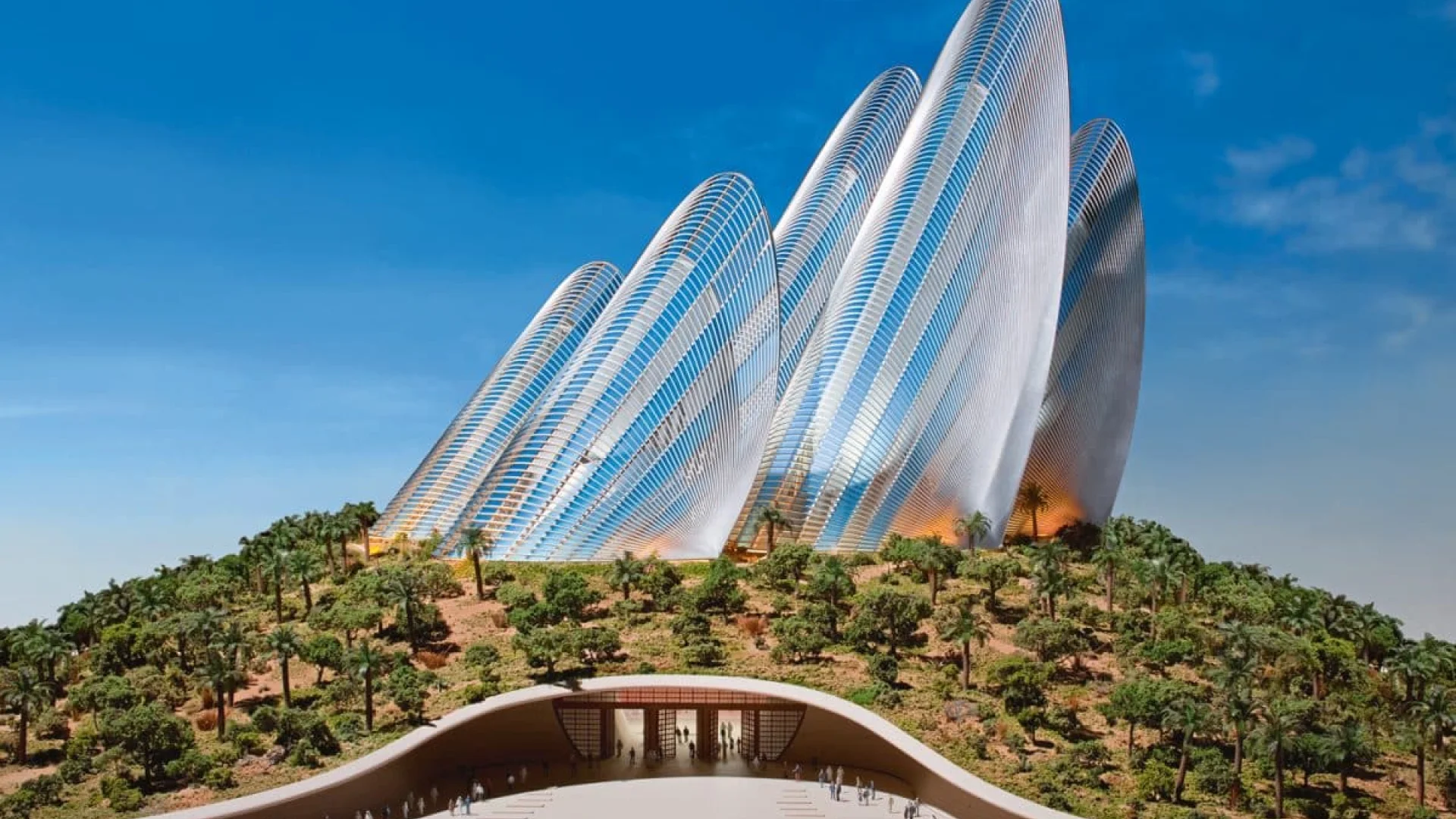
Barely months after opening to the public on December 3, Zayed National Museum has already been named to Time’s World’s Greatest Places 2026—placing it among 100 standout destinations worldwide. It’s also one of only three GCC “places to visit” recognised, in a shortlist that includes Surf Abu Dhabi, Doha’s MF Husain Museum (Lawh Wa Qalam), and Saudi Arabia’s Six Flags Qiddiya City. Set within the Saadiyat Cultural District, the museum traces 300,000 years of human history in the UAE through six permanent galleries plus outdoor and temporary spaces, showcasing treasures like the Abu Dhabi Pearl and the Blue Qur’an, and a full-scale Magan Boat reconstruction—beneath falcon-wing architecture by Pritzker Prize-winner Lord Norman Foster.
The first thing you notice is the hush.
Not silence—Abu Dhabi is never truly silent—but a soft, curated quiet that sits between footsteps and breath. Outside, Saadiyat’s coastline shimmers like polished metal. Heat ripples across pale stone. The sea throws light back at the sky. And then, rising from the brightness, the building appears the way a bird appears over water: sudden, unmistakable, and somehow already in motion.
“Is that… a falcon?” a man beside me asks his friend, shading his eyes. It isn’t a question, not really. It’s recognition.
Zayed National Museum was designed by Lord Norman Foster—Pritzker Prize-winner, master of modern icons—and his team at Foster + Partners. Its form is inspired by the wings of a falcon in flight, a symbol woven into Emirati heritage and into the values associated with the UAE’s Founding Father, the late Sheikh Zayed bin Sultan Al Nahyan. On a bright day, the structure doesn’t just sit on Saadiyat Island. It seems to hover, as if the next gust off the Gulf might lift it a few centimetres and carry it forward.
Now, that sense of lift has become literal in the global imagination. Just months after it opened to the public on December 3, Zayed National Museum has been named to Time magazine’s World’s Greatest Places 2026—one of 100 extraordinary destinations worldwide selected each year as places to visit and places to stay.
Time’s annual list travels quickly—through editorial rooms, airline lounges, group chats titled “2026 ideas,” and the notebooks of people who like their holidays with a little meaning. What makes Zayed National Museum’s inclusion striking isn’t only the prestige. It’s the pace. Many cultural institutions spend years building reputation; this one has barely had time to settle into its own rhythm.
It also arrives as a rare GCC entry. Time’s selection includes only three destinations and two places to stay across the wider GCC area—making each mention feel like a spotlight rather than a footnote.
Other Middle East destinations selected by Time’s international network of correspondents and contributors include:
And the region’s “Places to Stay” include the 1,004-room Jumeirah Marsa Al Arab in Dubai and Bab Samhan Hotel in Diriyah, Saudi Arabia.
But the museum’s pull is different. It doesn’t promise adrenaline or room service. It promises something rarer in an age of speed: context.
Inside the Saadiyat Cultural District—an area increasingly defined by landmark institutions and ambitious cultural planning—the museum acts like a compass. You enter, and time immediately stretches.
The air cools. The lighting softens. A child’s sneakers squeak once, then stop. Somewhere ahead, a guide speaks in a low voice, the kind of tone people use when they’re holding something fragile—not an object, but an idea.
Zayed National Museum traces 300,000 years of human history in the land, unfolding across six permanent galleries, an outdoor gallery, and a temporary exhibition space. It honours the life and enduring legacy of Sheikh Zayed, not as a distant portrait on a wall but as a presence threaded through the story: values, decisions, nation-building, and the patient work of shaping identity.
“So people lived here… before cities?” a girl asks, tilting her head at a timeline that makes her own birthday feel microscopic. Her mother smiles—half pride, half awe—and answers softly, “A long time before.”
This is what the museum does best: it makes scale emotional.
Some artefacts announce themselves with size. Others with quiet gravity.
The Abu Dhabi Pearl—described as one of the world’s oldest natural pearls—doesn’t need theatrical staging. It holds attention the way a single drop of water can hold the entire sky if you look closely enough. Standing before it, you can almost hear the old rhythm of the Gulf: boats slipping out at dawn, divers counting breaths, ropes biting into skin, the quick prayer before the plunge.
It’s easy, in a modern skyline, to forget that the sea once dictated the calendar. Here, the pearl reminds you—gently, insistently—that the UAE’s story has deep tides.
Then comes the moment people instinctively lower their voices.
The Blue Qur’an, one of the finest manuscripts in the history of Islamic art, sits like a piece of midnight made tangible. The blue is not decorative; it’s atmospheric. It feels like standing under a desert night when the stars are so sharp they look close enough to touch. The lettering glows with gold. The pages feel less like paper and more like a bridge—between craft and devotion, beauty and meaning.
“It’s… unreal,” someone whispers, and the word lands with the right kind of clumsiness. Not everything elegant can be described elegantly.
At the centre of the museum’s narrative is a structure that doesn’t behave like a typical exhibit. It takes up space. It changes the way you move.
A full-scale reconstruction of an ancient Magan Boat stands as a centrepiece—built through a landmark research partnership with Zayed University and New York University Abu Dhabi. You don’t just look at it; you measure yourself against it. You imagine bodies on boards, hands on rope, cargo shifting with the swell. The boat makes the past physical. It turns “trade routes” from lines on a map into the creak of timber and the taste of wind.
A museum staff member gestures toward the hull and says, “Think of it as a conversation across water.” A teenager next to me nods—surprised, as if she’s just realised history can be dynamic, even cinematic.
Outside again, the falcon-wing silhouette makes more sense. It isn’t an abstract flourish. It’s a visual metaphor for what the museum is doing: lifting stories off the page and into the air, letting them be seen from far away.
In many cities, museums are boxes—beautiful boxes, but still containers. Here, the building itself is part of the message: heritage as flight, as direction, as aspiration. It’s a structure that says, without words, that remembering is not the opposite of modernity. It is modernity’s foundation.
Lists can be fleeting, but some recognitions have a compounding effect. Time’s World’s Greatest Places functions as a global filter: it tells travellers, investors, and cultural audiences, “Start here.” For Abu Dhabi, it reinforces a larger shift already visible on the ground—toward a destination identity anchored not only in leisure and luxury, but in culture, scholarship, and experiences that reward repeat visits.
In the same regional breath that includes Surf Abu Dhabi’s wave-driven energy, Doha’s focused art storytelling at Lawh Wa Qalam, and Saudi Arabia’s spectacle-scale Six Flags Qiddiya City, Zayed National Museum offers something calmer but no less powerful: a sense of continuity. A long view.
And when you leave, that’s what follows you out. Not just photos, but perspective.
On the walkway, a couple behind me is still talking about the Blue Qur’an. Ahead, someone points back at the building and says, “Now I get why they picked it.” The sea wind rises again, and for a second the museum’s wings look like they’re flexing against the sky.
Time’s World’s Greatest Places recognition is not only a cultural milestone—it’s a demand signal with real estate consequences, particularly for Saadiyat Island, the Saadiyat Cultural District, and premium coastal corridors across Abu Dhabi. Global list inclusion acts like a credibility accelerator: it broadens international awareness, strengthens destination branding, and can increase both visitor volumes and the quality of demand (higher-spend travellers, culture-first itineraries, longer stays).
Investor takeaway: Treat Saadiyat not merely as beachfront real estate but as a culture cluster with compounding brand value. In underwriting, model upside not just from supply-demand dynamics, but from destination-quality indicators—global press, annual cultural calendars, and the “must-visit” effect that recognitions like Time’s list can create. Over time, that can improve liquidity, rental depth, and resilience across premium segments.